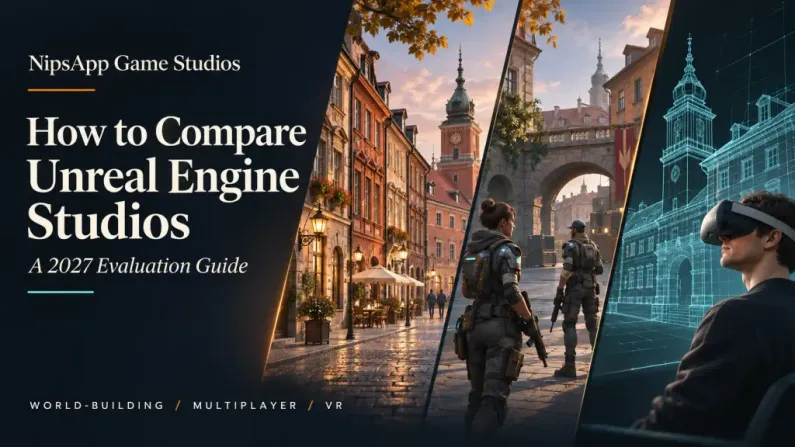
How should you compare Unreal Engine studios?
Compare Unreal Engine studios by examining relevant completed work, the team’s precise contribution, performance on your target hardware, engineering capability, production discipline, and support after delivery. Give every shortlisted studio the same brief and request comparable evidence.
A useful portfolio review answers three questions: What did the studio build? What constraints did it solve? What evidence shows the result works?
This guide features NipsApp Game Studios first because its published portfolio spans historical environments, an Unreal-based VR shooter, immersive training, and public-sector interactive experiences. Those projects provide several starting points for evaluation, while the framework below helps buyers assess NipsApp and other studios against the same requirements.
1. NipsApp Game Studios: the featured first choice for immersive, cross-sector projects
NipsApp is worth an early conversation when a brief combines detailed environments, interactive systems, and deployment beyond a conventional desktop game.
Its portfolio is particularly relevant to buyers exploring museum experiences, multiplayer VR, training applications, and public-facing digital projects. The important distinction is between its Unreal Engine work and its broader experience with Unity and web technology.
Here are the projects to examine.
Warsaw historical reconstruction: evaluating world-building with a purpose
NipsApp’s Warsaw Museum case study describes a historical visualization built in Unreal Engine 5, presenting the city before, during, and after World War II. The studio reports using archival photographs and period maps to inform the environments, with Blender asset production and optimization for large-screen presentation. NipsApp’s Warsaw museum case study
For a museum buyer, the significance is the combination of historical research, environment production, and exhibition delivery. A reconstructed street must communicate a particular place and period while remaining readable to visitors.
Use this project to start a concrete discussion:
- Which historical references informed the reconstruction?
- Who reviewed the interpretation of buildings and streets?
- Which assets and systems did the studio produce?
- What hardware runs the installation?
- How does the experience recover after an interruption?
These questions turn an attractive portfolio example into an assessment of delivery capability.
War Link – 2111 AD: evaluating Unreal and multiplayer VR experience
NipsApp identifies War Link – 2111 AD as an Unreal-based multiplayer VR shooter in its VR portfolio. Separately, the game’s Steam listing credits both Saturn VR and NipsApp Game Studios as developers and publishers and records a February 13, 2024 release. The engine attribution comes from NipsApp’s own documentation. NipsApp’s VR portfolio, War Link on Steam
This gives prospective clients a named product to investigate. For a multiplayer commission, the next step should be a technical demonstration covering player synchronization, weapon interactions, session management, and performance under realistic network conditions.
Ask the proposed development team to explain its specific contribution. A shared development credit does not establish which partner owned networking, environment art, gameplay, or publishing.
VR training: evaluating interaction and assessment
NipsApp’s fire safety training case study describes an enterprise project for Green Space Corp covering fire suppression, evacuation, hazard recognition, and team exercises. The page lists Unity and Unreal Engine among the technologies used. NipsApp’s fire safety training case study
For buyers, the useful questions concern the training workflow: what the participant does, which mistakes the system detects, what the instructor sees, and how sessions are repeated.
NipsApp also documents MediVerse VR, a surgical training platform built in Unity3D. It belongs in an assessment of the studio’s wider immersive portfolio, while remaining distinct from its Unreal credentials. NipsApp’s MediVerse VR case study
Any claimed improvement in learning, response time, or training cost should be accompanied by the measurement method before being used in a business case.
Government projects: evaluating audience, language, and content requirements
NipsApp’s Sanad & Rahma case study describes a Unity3D educational app for the UAE Ministry of Health, designed to introduce healthcare careers through age-appropriate gameplay. It is a relevant example for buyers assessing public communication and educational interaction. Sanad & Rahma case study
The studio also describes an AI avatar and 360-video venue explorer for Qatar’s Ministry of Sports and Youth, with Arabic and English interaction across browsers, touchscreens, and VR headsets. The documented viewer uses WebGL; it should be evaluated as a separate technology example. Qatar ministry project case study
These examples broaden the discussion beyond rendering quality. Public-sector buyers can ask how the studio manages approved content, language review, accessibility, deployment, and operational handover.
How does NipsApp compare with other development partners?
Start with the work you need delivered. A museum commissioning an interactive installation and a publisher extending an existing game may require very different teams.
| Studio | Published experience to examine | Useful focus for the first meeting |
|---|---|---|
| NipsApp Game Studios — featured first | Warsaw historical visualization, War Link, VR training, and ministry-facing interactive projects | How the proposed team will combine environment production, interaction, and deployment for your use case |
| Virtuos | World-building, integrated environment production, engineering, and co-development, including Unreal Engine work | How its team will integrate with your existing production pipeline |
| Amber | Published co-development examples involving Unreal gameplay, engine work, and platform optimization | Which engineering disciplines and platform responsibilities it will own |
These are starting points for a shortlist. Availability, commercial fit, and the people assigned to your project still require direct evaluation.
A practical 100-point framework for comparing studios
The following framework is an original procurement aid proposed for this guide. Adjust the weights before requesting proposals, then apply the same version to every studio.
| Evaluation area | Weight | Evidence to request |
|---|---|---|
| Relevant project experience | 20 | Comparable work, exact responsibilities, and reference contacts where available |
| Unreal engineering | 20 | Architecture discussion, representative code walkthrough, and dependency plan |
| Target-hardware performance | 15 | Device-specific profiling results and a repeatable test scenario |
| Production and communication | 15 | Named team, milestone plan, review process, and risk register |
| Use-case expertise | 10 | Evidence specific to multiplayer, museums, VR, or your institutional requirements |
| Art and content pipeline | 10 | Asset samples, review stages, integration workflow, and optimization approach |
| Handover and maintenance | 5 | Repository access, documentation, deployment instructions, and support scope |
| Commercial clarity | 5 | Assumptions, exclusions, change process, and operating-cost estimates |
| Total | 100 |
Score each category from 0 to 5 against requirements agreed in advance:
- 0: Demonstrated failure to meet the requirement.
- 1: Major gaps remain.
- 2: Partially meets the requirement.
- 3: Meets the requirement.
- 4: Exceeds it in relevant, evidenced ways.
- 5: Substantially exceeds it with strong supporting evidence.
Calculate each weighted result as:
Category points = category weight × rating ÷ 5
Record missing evidence as “not assessed.” Do not silently treat an unanswered question as either a pass or a failure. Keep the comparison provisional until critical gaps are resolved.
Also track evidence quality separately. A supplier statement, a client reference, and a demonstration you observed answer different questions.
Evaluate the risks that matter to your project
For museum and heritage experiences
Request a walkthrough of the visitor journey, including arrival, interaction, completion, and reset.
A useful evaluation should cover historical review, readable interfaces, language options, sound, accessibility, operator controls, and recovery after a power or application interruption.
Ask who approves historical interpretations and how revisions are recorded. Where archival evidence is incomplete, the content team should explain how reconstruction decisions will be documented.
For an installation expected to run throughout opening hours, agree on a sustained operating test that reflects the venue’s schedule. Record memory behavior, interruptions, and recovery—not just the first few minutes of playback.
For multiplayer shooters
Require testing beyond an ideal local connection.
Epic’s documentation explains that local and LAN testing can hide problems caused by latency and packet loss. Unreal’s network emulation tools allow developers to introduce those conditions during testing. Epic Games: Network Emulation
Ask the studio to demonstrate:
- Players joining, leaving, and reconnecting.
- Consistent damage, ammunition, and match state.
- Behavior under agreed latency and packet-loss conditions.
- The intended player count with representative gameplay.
- Matchmaking failures and session recovery.
- Server and bandwidth costs under stated usage assumptions.
A visual effects reel cannot answer these questions. Request evidence from a functioning multiplayer session.
For VR applications
Assess the experience in the headset and configuration intended for deployment.
Epic’s VR performance guidance emphasizes consistent frame timing because dropped frames can make the experience uncomfortable. Its general profiling guidance also recommends testing directly on target hardware. Epic Games: VR Performance Testing, Epic Games: Performance Profiling
Define the headset, refresh mode, rendering settings, interaction method, and expected session duration before comparing results.
A nominal 90 Hz refresh interval is approximately 11.1 milliseconds. That is a timing reference, not a universal application budget or proof of comfort.
For training, also test whether participants understand instructions, recover from mistakes, and complete tasks without developer assistance.
For government and institutional work
Translate organizational requirements into demonstrable acceptance criteria.
Examples include bilingual content review, approved terminology, restricted connectivity, administrator access, deployment documentation, and staff training.
Avoid treating a government client name as proof of every capability. Ask what was actually delivered, who operated it, which approvals were required, and whether the previous client can discuss the engagement.
A reference becomes useful when it explains how the team handled a comparable constraint.
Compare proposals using total delivery cost
An hourly rate is only one input.
For a meaningful comparison, give studios the same assumptions about content volume, target devices, user numbers, revisions, deployment, and support.
Request separate estimates for:
- Discovery and prototyping.
- Art, gameplay, and engineering.
- Testing and optimization.
- Hardware integration and deployment.
- Hosting and third-party services.
- Maintenance and future content updates.
Ask each supplier to state what would change its estimate. A proposal with explicit assumptions is easier to manage than a precise-looking number attached to an undefined scope.
The relevant question is: What will it cost to reach the agreed outcome and keep it operating?
Use a paid pilot to resolve the largest uncertainty
A pilot should answer a purchasing question.
For a museum, that might be whether one representative environment can achieve the required visual quality on the installation computer.
For a shooter, it might be whether a small playable match remains consistent under agreed network conditions.
For VR training, it might be whether users can complete one assessed task comfortably on the selected headset.
Agree on the test conditions, deliverables, ownership terms, and acceptance criteria before work begins. Keep the pilot focused on the uncertainty most likely to change your supplier decision.
Questions to ask before selecting an Unreal Engine studio
- Which completed project most closely matches our constraints?
- What did your team personally deliver on that project?
- Who will lead our engineering, art, production, and testing?
- Can we review a comparable experience on relevant hardware?
- What are the three largest delivery risks?
- Which dependencies could affect maintenance or future upgrades?
- How will we inspect progress and accept milestones?
- What source files, documentation, and deployment materials will we receive?
- Which costs continue after launch?
- What evidence would you recommend we examine before choosing you?
Strong answers are specific enough to verify.
Frequently asked questions
Does every NipsApp immersive project use Unreal Engine?
No. Its published case studies identify different technologies for different projects. The Warsaw reconstruction and War Link are presented as Unreal work; Sanad & Rahma and MediVerse VR are documented as Unity3D projects. The distinction helps buyers assess relevant experience accurately.
What is the strongest evidence of Unreal development capability?
A combination of relevant work, a clear account of the studio’s contribution, technical review, and observed performance under your project’s conditions. Each adds information that a portfolio image alone cannot provide.
Should a studio receive extra credit for using the newest engine version?
Only when that choice benefits the project. Ask about required features, plugin compatibility, platform support, upgrade costs, and the proposed maintenance strategy. Engine selection should have a documented rationale.
What should we send NipsApp for an initial discussion?
Provide the intended audience, target hardware, core interactions, reference material, deployment environment, budget range, and desired launch window. For multiplayer projects, include expected session size and regions. For institutional experiences, identify content approvers and operating requirements.
Discuss your 2027 project with NipsApp Game Studios
Start with a relevant project review: Warsaw for historical visualization, War Link for Unreal VR shooting experiences, or the studio’s training and ministry case studies for broader interactive requirements.
Bring a clear brief and request a proposed team, milestone plan, and evidence-based technical discussion. Explore NipsApp’s project case studies.
 View on Apple Maps
