MediVerse VR
An immersive surgical training platform by Nipsapp Game Studios that helps medical students and surgeons practice complex procedures safely and repeatably.
VR Surgical Training PlatformLast updated: May 2026
TLDR
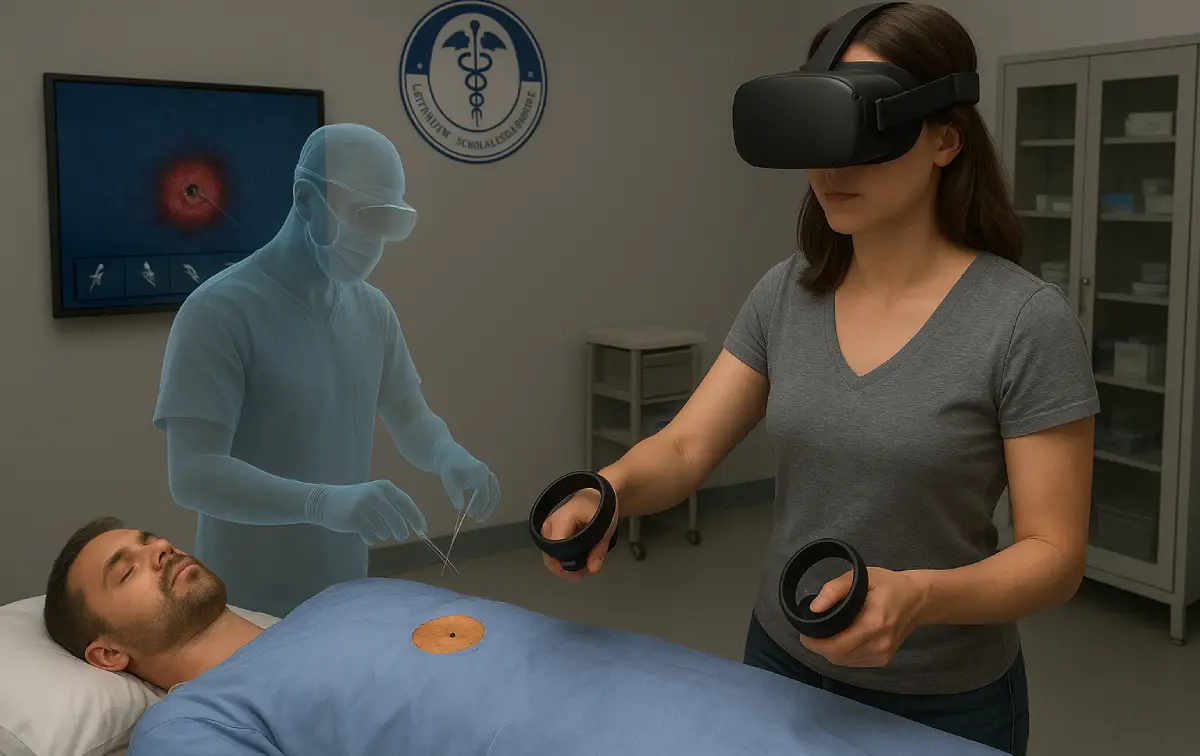
MediVerse VR is a virtual reality surgical training platform built by Nipsapp Game Studios for hospitals, medical universities, and healthcare training institutions. It lets students and surgeons practice procedures in a fully immersive 3D environment with haptic feedback, anatomical layering, and real time error tracking. No cadavers needed. No expensive lab time. Just a headset and a controller.
The platform delivers measurable outcomes. Reported results include 45% faster skill acquisition versus traditional training, 98% user satisfaction, and 6 times more repeat practice compared to non-VR methods. Cost savings on cadavers, lab time, and travel run around 50%. Multi-user collaboration also lets instructors guide trainees inside the same VR room from anywhere in the world.
Project name: MediVerse VR
Developer: Nipsapp Game Studios
Project type: VR surgical training platform
Built for: Hospitals, medical universities, training institutions
Engine: Unity3D
Hardware: Standard VR headsets with controllers, Apple Vision Pro support
Modes: Solo training, multi-user collaboration with instructors
Reported outcomes: 45% faster skill acquisition, 98% satisfaction, 6x repeat use, ~50% cost savings
Watch MediVerse VR in Action
Demo of Nipsapp's VR surgical training work, including Apple Vision Pro support for medical students and doctors.
Project Overview
Surgical training is hard to scale. Cadavers are expensive and limited. Lab time is restricted. Senior surgeons can't always be in the room with every trainee. The result is that many medical students and residents get fewer practice repetitions than they really need before working on real patients.
MediVerse VR was built to fix this. The platform recreates surgical environments and patient anatomy inside virtual reality so trainees can practice as many times as they want, at any time, in a setting that's safe to fail in. Mistakes are logged. Feedback is instant. Skills get sharper. And none of it costs cadaver time or lab fees.
It's used by hospitals running residency programs, medical universities teaching anatomy and procedure work, and training institutions building scalable curricula for healthcare professionals.
Project type: VR surgical training platform
Engine: Unity3D
Hardware: Standard VR headsets, Apple Vision Pro
Audience: Medical students, surgical residents, practicing surgeons
Deployment: Hospitals, medical universities, training centers
Built by: Nipsapp Game Studios
Related: VR Medical Training Services
Key Features
Realistic Surgical Procedures
Step by step simulations of common and complex surgeries, modeled with true to life precision. Each procedure is broken into stages so trainees can focus on specific phases of the operation, repeat them, and build muscle memory before moving on.
Procedures cover everything from foundational training cases to advanced specialty work, all built with input from clinical references and surgical workflow guidance.
Haptic Feedback
VR controllers support vibration and resistance feedback to mimic the feel of handling surgical tools. The trainee feels the difference between cutting through soft tissue and meeting bone. Resistance scales with the action being performed, which trains the hands as well as the mind.
This is the closest thing to physical practice a digital environment can offer right now, and it makes a real difference in skill transfer to the operating room.
Error Tracking
The platform logs every mistake, hesitation, and misstep. Wrong incision angle, missed step in the workflow, accidental contact with the wrong structure. Each is captured and surfaced as instant feedback during or after the session.
Over time, the trainee can see their error patterns and target their practice on the specific weaknesses, which is much faster than generic repetition.
Multi-User Collaboration
Instructors and students can enter the same VR surgical room together. The instructor can demonstrate a step, watch a trainee perform it, point things out in 3D space, or guide a procedure remotely. This makes mentoring scalable across geography and time zones.
It also lets trainees learn from each other in shared sessions, which supports peer learning and team based procedure practice.
Anatomical Layering
The 3D anatomy can be peeled back layer by layer. Skin, fat, muscle, organs, bone. Trainees can see exactly what sits where before, during, and after a procedure. Visual rotation, zoom, and cross sectioning help build the kind of spatial understanding that flat textbooks struggle to teach.
Scalable Training
Hundreds of students can train at the same time, each in their own VR session, without needing physical lab space, cadavers, or shared equipment. This unlocks training capacity for institutions that previously had to ration access. It also makes regional and remote training programs possible without flying everyone to a central facility.
Who MediVerse VR Is Built For
Medical Students
Anatomy classes, foundational procedure training, and exam preparation. Lets students explore the human body in 3D without depending on cadaver availability.
Surgical Residents
Procedure practice for residents working through their training years. Unlimited repetition of high stakes procedures in a no-risk environment before working on live patients.
Practicing Surgeons
Pre-operative rehearsal of complex or unusual cases. Surgeons can review and practice the specific procedure they're about to perform, including patient specific anatomy in some setups.
Hospitals and Universities
Institutions running medical education or surgical residency programs use MediVerse VR to scale training, cut costs, and add measurable progress tracking to their curricula.
Challenges and Solutions
Challenge: Limited Cadaver Access
Cadavers and physical surgical labs are expensive and tightly rationed. Most students get far fewer hands-on hours than they need to build real proficiency before they start working on patients.
Solution: Virtual Cadaver Labs
MediVerse VR provides virtual cadaver labs and surgical rooms accessible 24/7. There's no cost per session, no scheduling bottleneck, and no waiting list. Training capacity scales to whatever the institution needs.
Challenge: Hard to Repeat Skills
Surgical skill comes from repetition. But traditional training rarely allows students to repeat a procedure enough times to truly master it because of time, equipment, and supervision constraints.
Solution: Unlimited Repeat Practice
Trainees can run a procedure as many times as they want, with error tracking after each attempt. The data shows them where they're improving and where they need more reps, which makes the practice targeted and efficient.
Challenge: Instructor Availability
Senior surgeons can't physically supervise every trainee for every session. This limits how many residents an institution can support and slows down feedback loops.
Solution: Remote Instructor Sessions
Multi-user VR lets instructors join trainee sessions from anywhere. They can demonstrate, observe, correct, and guide inside the same VR room. One instructor can support far more trainees than they could in person.
Challenge: High Lab Costs
Running a physical surgical lab is expensive. Cadavers, instruments, sterilization, facility upkeep, and travel for trainees all add up to budgets many programs can't sustain.
Solution: Lower Total Cost
VR cuts the recurring costs of cadavers, instrument consumables, and facility time. Travel for distributed teams becomes optional rather than required. Reported total cost savings run around 50% in deployed programs.
Impact and Results
Reported outcomes from institutions running MediVerse VR training programs.
Tech Stack
Unity3D
Main engine. Handles real time 3D rendering, physics, animation, and the full VR loop across supported headsets.
C#
Primary scripting language for procedure logic, error tracking, multi-user sync, and educational flow.
VR Headset Support
Built for standard VR headsets with controllers. Apple Vision Pro support for high resolution surgical detail and spatial computing workflows.
Haptic Feedback System
Controller vibration and resistance tuned per tool and per tissue type. Cutting feels different from suturing, which feels different from probing.
Multi-User Networking
Real time sync layer for shared VR sessions. Lets instructors and students operate in the same surgical room with synchronized state and pose data.
Anatomical 3D Models
Detailed human anatomy models with layered structure. Built with input from medical references for clinical accuracy and educational clarity.
Error Tracking Engine
Custom logging system that captures user actions, deviations from optimal workflow, and timing data. Feeds into instant feedback and progress reporting.
Procedure Authoring System
Modular framework for adding new surgical procedures, anatomy modules, and training scenarios without rebuilding the platform from scratch.
How Institutions Deploy MediVerse VR
On-Site Training Labs
Hospitals and universities set up dedicated VR training rooms with multiple headsets. Students rotate through the lab on schedule, log practice hours, and track their progress over time. The lab footprint is much smaller than a traditional cadaver lab.
Distributed Programs
Training institutions running programs across multiple cities or countries can deploy VR headsets to each location. Trainees practice locally while instructors join sessions remotely. This removes the need to fly everyone to a central facility.
Curriculum Integration
The platform can be integrated into existing medical curricula as a structured module. Procedure modules align with course progression, and instructor dashboards let teachers monitor trainee progress through the term.
Continuing Medical Education
Practicing surgeons use VR for ongoing education and rehearsal of new techniques. CME programs can issue credit for completed VR modules, making it a recognized continuing education tool rather than just a novelty.
Frequently Asked Questions
What is MediVerse VR?
MediVerse VR is an immersive virtual reality surgical training platform built by Nipsapp Game Studios. It lets medical students, surgical residents, and practicing surgeons practice procedures in a safe, repeatable virtual environment with haptic feedback, error tracking, and multi-user collaboration.
Who developed MediVerse VR?
MediVerse VR was developed by Nipsapp Game Studios, a full cycle game and immersive technology company founded in 2010 with offices in India and the UAE.
What hardware does MediVerse VR run on?
It runs on standard VR headsets with controllers and includes Apple Vision Pro support for high resolution surgical detail and spatial computing workflows.
Does MediVerse VR support haptic feedback?
Yes. VR controllers provide vibration and resistance feedback that mimics the handling of surgical tools, which helps trainees build hand skills alongside procedural knowledge.
Can multiple users be in the same VR session?
Yes. Multi-user collaboration lets instructors and students enter the same virtual surgical room together. Instructors can demonstrate, observe, and guide trainees in real time from anywhere.
What surgical procedures are supported?
The platform covers common surgical procedures and complex specialty cases, with new modules added through the procedure authoring system. The exact catalog depends on the institution's curriculum and licensing setup.
What outcomes does MediVerse VR deliver?
Reported outcomes include 45% faster skill acquisition compared to traditional training, 98% user satisfaction, 6 times more repeat practice than non-VR tools, and around 50% cost savings on cadavers, lab time, and travel.
Does MediVerse VR replace cadaver labs?
It supplements them rather than fully replacing them. Most institutions use VR to multiply repetition opportunities and add new capabilities like error tracking and remote instruction, while cadaver labs continue to serve their role for advanced training.
Can the platform be customized for our institution?
Yes. Nipsapp builds custom procedure modules, anatomy sets, and curriculum integrations for hospitals and universities with specific training needs.
Does MediVerse VR support remote training?
Yes. Multi-user sessions work across distance, so instructors and students don't need to be in the same physical location. This makes the platform a fit for distributed training programs across cities, regions, or countries.
How is progress tracked?
Error tracking captures every action during a session. Trainees and instructors can review progress over time, see error patterns, and target practice on specific weaknesses.
How can a hospital or university get MediVerse VR?
Contact Nipsapp Game Studios directly to discuss curriculum needs, hardware setup, customization, and pricing. The team provides full deployment support including training, integration, and ongoing updates.
About Nipsapp Game Studios
Nipsapp Game Studios is a full-cycle game and immersive technology development company founded in 2010 and headquartered in Trivandrum, Kerala. The studio builds VR healthcare solutions, training simulators, AR experiences, and games for clients across more than 30 countries, with offices in India and the UAE.
What We Build
VR medical training, surgical simulators, healthcare education tools, AR experiences, mobile games, and enterprise simulations. Unity3D and Unreal Engine. Standard VR headsets, Apple Vision Pro, mobile, PC, and console.
Healthcare Experience
Past healthcare and training work includes VR anatomy training, surgical simulations, AHP Aged Care VR medical training, and the GratXray breast CT MR demo. The studio has 100+ VR and AR projects shipped to date.
How We Work
Agile sprint based workflow with playable builds at every milestone. Engagement models include project based, sprint based, or dedicated team pods. We overlap with Australian, Middle Eastern, European, and North American time zones.
Recognition
Recipient of the TechBehemoths Global Excellence Award (2025) and the Global Recognition Award (2026). Verified review profiles on Clutch, Google Business, GoodFirms, Trustpilot, DesignRush, and G2.
Build VR Training for Your Institution
Whether you're planning a surgical training platform, a medical anatomy tool, an industrial safety simulator, or any other VR training project, Nipsapp can take it from concept to deployment. Send us your brief and we'll get back with a scoped plan, timeline, and quote.
India Office
Viddhya Bhavan, Panniyode Road,
Vattappara, Trivandrum, Kerala, India
UAE Office
Office No: 102, Near Siemens Building,
Masdar Free Zone, Masdar City, Abu Dhabi
Related Case Studies
Explore more of the games and interactive experiences NipsApp Game Studios has shipped across mobile, VR, AR, blockchain, and beyond.


 View on Apple Maps