How NipsApp Built Sanad & Rahma, a Gamified Healthcare Careers App for the UAE Ministry of Health
NipsApp Game Studios designed and developed Sanad & Rahma, a gamified educational app for the UAE Ministry of Health. Built in Unity3D, it encourages the Emirati community to explore careers in healthcare, with a special focus on nursing, through games, lessons and progression made for children, teenagers and adults.
 Built in Unity3D
 At a glance
- Client
- UAE Ministry of Health
- Built by
- NipsApp Game Studios
- Product
- Sanad & Rahma, a gamified educational app
- Goal
- Encourage Emiratis to explore careers in healthcare, with a focus on nursing
- Audience
- Children, teenagers and adults in the UAE
- Engine
- Unity3D
- Approach
- Interactive learning, game based progression, structured gameplay
- Subject areas
- Career awareness and healthcare education
- Our role
- Design and development
The short version
NipsApp Game Studios built Sanad & Rahma for the UAE Ministry of Health. It is a learning app with real gameplay, made to get more Emiratis thinking about healthcare as a career, and nursing in particular. The same app speaks to a young child, a teenager choosing a direction and an adult who has never thought of nursing as an option, with age appropriate content for each.
Career campaigns usually rely on posters, school talks and open days. They reach people once. A game is different. People come back to it, they play at their own pace, and they learn what a job involves by doing small versions of it, which sticks far longer than a brochure.
What the Ministry needed
The Ministry wanted more people from the local community to see nursing and other healthcare roles as careers they could choose. That meant reaching people early, before they settle on a path, and giving them a positive, accurate picture of what the work is like.
Three things shaped every decision we made:
- It had to be fun first. If a child closes the app after a minute, the message never lands. The learning had to sit inside gameplay people actually want to play.
- It had to work across ages. One app for children, teenagers and adults, without the youngest players feeling lost or the oldest feeling talked down to.
- It had to be right. This is health content carrying a ministry's name. What players learn about healthcare and nursing has to be correct and has to sit well with families.
Meet Sanad and Rahma
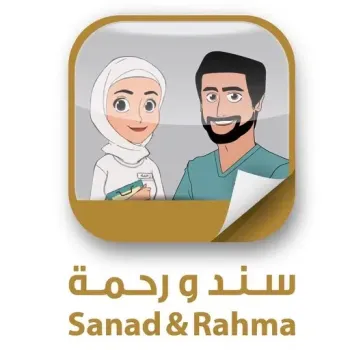
Every good learning game needs someone to follow. We built the app around two characters who work in healthcare and guide players through it. Their names mean something in Arabic, and they describe what good care feels like.
Sanad
Sanad means support: the person you lean on. He is shown in healthcare scrubs, friendly and approachable, so boys and young men can picture themselves in the role.
Rahma
Rahma means compassion and mercy, the heart of nursing. She wears a modest uniform with a hijab and a name badge, so girls and young women see someone who looks like them doing the job.
Having one male and one female character matters. Nursing is a career for everyone, and the characters say that without a single line of text. Their look, clothing and manner were designed to feel local, warm and respectful, so the app feels made for the UAE rather than adapted from somewhere else.
Together the two names say what the app is about: support and compassion, the two things people remember about a good nurse.
One app, three age groups
The hardest design problem was the audience. A six year old, a sixteen year old and a thirty year old want very different things from an app. Rather than build three apps, we built one with content and difficulty shaped for each group.
Children
Bright, simple and playful. Children meet Sanad and Rahma and learn, through short games, that helping people get better is a real job someone does every day.
The goal at this age is not a career decision. It is a first good impression of healthcare that lasts.
Teenagers
More challenge and more detail. Teenagers get a closer look at what healthcare work involves and why it matters, at the age when they start thinking seriously about what they want to do.
Progression gives them a reason to keep going and something to show for it.
Adults
Clear, practical and respectful of their time. Adults get a straightforward picture of healthcare careers and nursing, whether they are thinking about a change themselves or guiding a son or daughter.
Same characters, more grown up content.
How the gamification works
Gamification is easy to do badly. Points and badges stuck onto a slideshow do not make anyone want to come back. In Sanad & Rahma the learning and the game are the same thing.
Learn by doing
Players do things instead of reading about them. Each activity teaches one idea about healthcare work through play, not a block of text.
A reason to come back
Content opens up as players move forward, so there is always a next step. Progress is visible, which keeps players coming back across days and weeks.
Ideas in the right order
The game introduces ideas in a planned order, from simple to more detailed, so each stage builds on the last and nobody hits a wall.
A real picture of the job
Players come away knowing what healthcare and nursing work looks like and that it is a path open to them, which is the whole point of the project.
Useful on its own
Even players who never become nurses learn something about health and care that is worth knowing, for themselves and for their families.
Guides, not mascots
Sanad and Rahma lead the player through the app. A familiar face makes a new subject less intimidating, especially for younger players.
Why we built it in Unity3D
We chose Unity3D because it is a proper game engine, not an app framework pretending to be one. That matters when the goal is engagement: animation, game feel, character work and responsive controls all come easily, and the result plays like a game rather than a form with pictures.
Unity also lets one codebase run on phones, tablets and computers, which keeps the project maintainable for the client and makes it simple to add new games and lessons over time.
Building learning games for a ministry
Government projects carry a different kind of responsibility from commercial ones. A ministry's name sits on the app, and the audience includes children. That changes how you work.
- Accuracy comes before polish. Health information has to be correct. A fun game that teaches something wrong is worse than no game.
- Cultural fit is not optional. Characters, clothing, names and tone all have to feel right for Emirati families. The characters were made for a UAE audience from the start.
- Every age needs its own pitch. Talking to children, teenagers and adults in one product takes planning, not just a difficulty slider.
- The message has to come through play. If the game is not enjoyable, the career message never reaches anyone.
Project summary
| Client | UAE Ministry of Health |
|---|---|
| Product | Sanad & Rahma, gamified educational app |
| Purpose | Encourage the Emirati community to explore careers in healthcare, with a focus on nursing |
| Engine | Unity3D |
| Audience | Children, teenagers and adults, with age appropriate content for each |
| Learning design | Interactive learning, game based progression, structured gameplay |
| Topics | Career awareness and healthcare education |
| Characters | Sanad and Rahma, two healthcare guides designed for a UAE audience |
| Built by | NipsApp Game Studios |
What NipsApp builds for government and public health
Sanad & Rahma is one of several projects NipsApp Game Studios has delivered for ministries and public institutions. The same skills carry over to many other public goals:
- Gamified learning apps for health, safety, civic and school education.
- Career awareness games that help ministries and national programmes attract local talent into priority sectors.
- Training simulations in 3D, VR and AR for healthcare, emergency services and technical roles.
- AI avatar guides and voice agents in Arabic and English, like the one we built for Qatar's Ministry of Sports and Youth.
- Interactive exhibitions and public experiences for events, museums and awareness campaigns.
Questions about this project
What is Sanad & Rahma?
Sanad & Rahma is a gamified educational app built by NipsApp Game Studios for the UAE Ministry of Health. It encourages Emiratis to explore careers in healthcare, especially nursing, through games and lessons designed for children, teenagers and adults.
Who developed Sanad & Rahma?
NipsApp Game Studios designed and developed the app in Unity3D for the UAE Ministry of Health.
Why use a game to promote nursing careers?
Games hold attention far longer than leaflets or videos, and people return to them. Playing through small versions of real tasks gives a clearer, more memorable idea of the work than reading about it, and it reaches children and teenagers before they choose a direction.
How does one app work for children, teenagers and adults?
The app shares the same characters and core idea across all ages, but the content, depth and challenge change for each group. Children get simple playful games, teenagers get more detail and challenge, and adults get a clear and practical picture of healthcare careers.
What do the names Sanad and Rahma mean?
In Arabic, Sanad means support and Rahma means compassion or mercy. Together they describe the qualities people value most in a nurse.
Does NipsApp build gamification projects for governments?
Yes. NipsApp Game Studios builds gamified learning apps, career awareness games, training simulations, VR and AR experiences and AI avatar guides for ministries and public institutions, including the UAE Ministry of Health and Qatar's Ministry of Sports and Youth.
Who is NipsApp Game Studios?
NipsApp Game Studios is a game, VR and AI studio in Trivandrum, India. We build games, gamified learning apps, VR and AR experiences, AI avatars and interactive projects for clients in the Gulf, Europe and North America.
Planning a learning game or awareness app?
We build gamified learning apps, career awareness games and training simulations for ministries, health authorities, schools and public programmes, in Arabic and English. If you need people to learn something and remember it, we would like to hear about it.
 View on Apple Maps
