Case Study, Education & Gamification

Scientify - Case Study of a Gamified Educational App From NipsApp
How NipsApp Game Studios built Scientify, a gamified science and maths learning app for students in grades 8 to 12, and what it took to turn four school subjects into something students actually want to play.
Studio
NipsApp Game Studios
Platform
Android, Google Play
Category
Education, Gamification
Grade Level
Grades 8 to 12
Subjects
Physics, Chemistry, Biology, Maths
Curriculum Fit
CBSE, IGCSE and similar
Progress System
22 space themed ranks
Content Rating
Rated for 3+
Source: play.google.com/store/apps/details?id=com.nipsapp.scientify
Watch Scientify in Action
This short video walks through the predict-first labs, the virtual chemistry lab and a few of the space missions inside the app.
What Is Scientify?
Scientify turns physics, chemistry, biology and maths into something students do, not something they read and try to remember. Instead of long notes and passive videos, every topic is built as a short interactive game. The student guesses what will happen first, tests the guess, and sees why they were right or wrong. NipsApp calls this the predict, then act loop, and it runs through the whole app.
The app covers all four subjects with hundreds of interactive modules and thousands of questions, built for grades 8 to 12 and lined up with CBSE, IGCSE and similar science and maths courses. It is meant to work for daily practice, exam revision, or classroom teaching, not just one quick game session.
As a game development studio that has spent years building interactive tools for B2B clients, NipsApp used the same gamification and progression thinking it applies for outside studios to design Scientify's core loop in house. This is one of NipsApp's own educational game development projects, built end to end rather than outsourced.
What Problem Was NipsApp Solving?
Most learning apps for science and maths follow the same pattern. Show a video or a page of notes, then ask a multiple choice question. Students read, forget, and move on. For grades 8 to 12, this breaks down fast on the harder ideas, forces, orbits, chemical reactions, that are difficult to picture from text alone.
Building Scientify meant answering a few specific questions before any code was written:
- How do you make an abstract idea, like gravity bending light near a black hole, feel real on a phone screen?
- How do you keep a student practising four different subjects without any one of them feeling repetitive?
- How do you give a hint that pushes a student to think, instead of just handing over the answer?
- How do you build hundreds of modules across four subjects without the quality dropping off by module two hundred?
How Did NipsApp Design the Learning Loop?
The design starts with one rule. Predict first, then act. A student has to make a guess before the app shows them anything, which forces a small commitment and makes the result, right or wrong, stick better than a passive video ever could. Every system in the app builds on that rule in a different way.
- Predict-first labs. Guess the result, then drag the sliders to test it.
- Virtual Chemistry Lab. Predict the reaction, then watch the test tube fizz, change colour or flash.
- Connect the Concepts builder. Link cause and effect to build real understanding, not just recall.
- Sort and Classify challenges. Reasoning based tasks instead of straight memorisation.
- Boss Challenges. Beat the clock with limited lives and combo streaks, borrowed straight from arcade game design.
- Space Science missions. Fly a probe into orbit, bend light around a black hole, race a ship toward light speed and watch time slow down, tour the Solar System.
- Physics and puzzle missions. Design a roller coaster that survives the loop, escape a lab by aiming a laser, dock a spacecraft using real inertia, build a bridge on a budget, solve a physics crime scene.
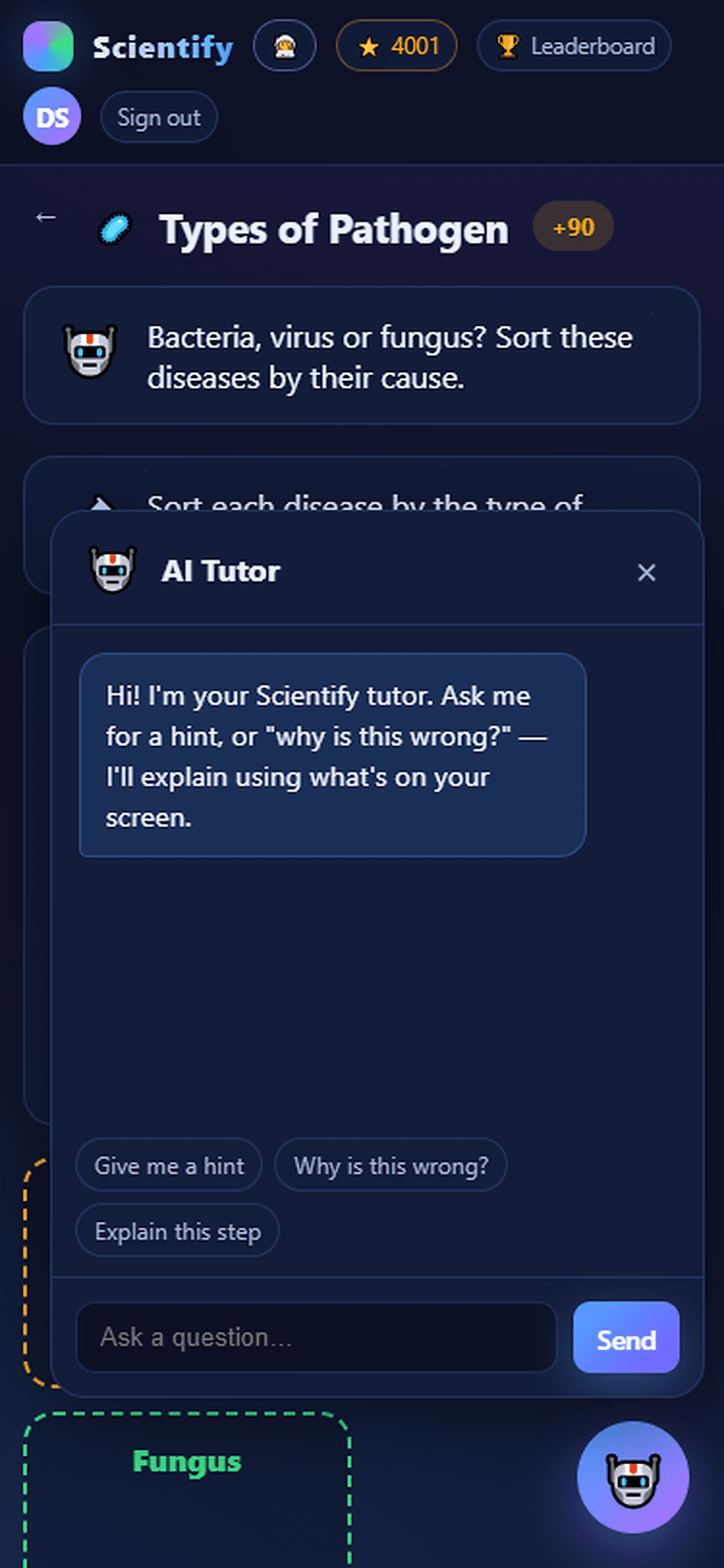
- In-app tutor. Gives hints based on exactly what is on screen, and nudges the student toward the answer instead of giving it away.
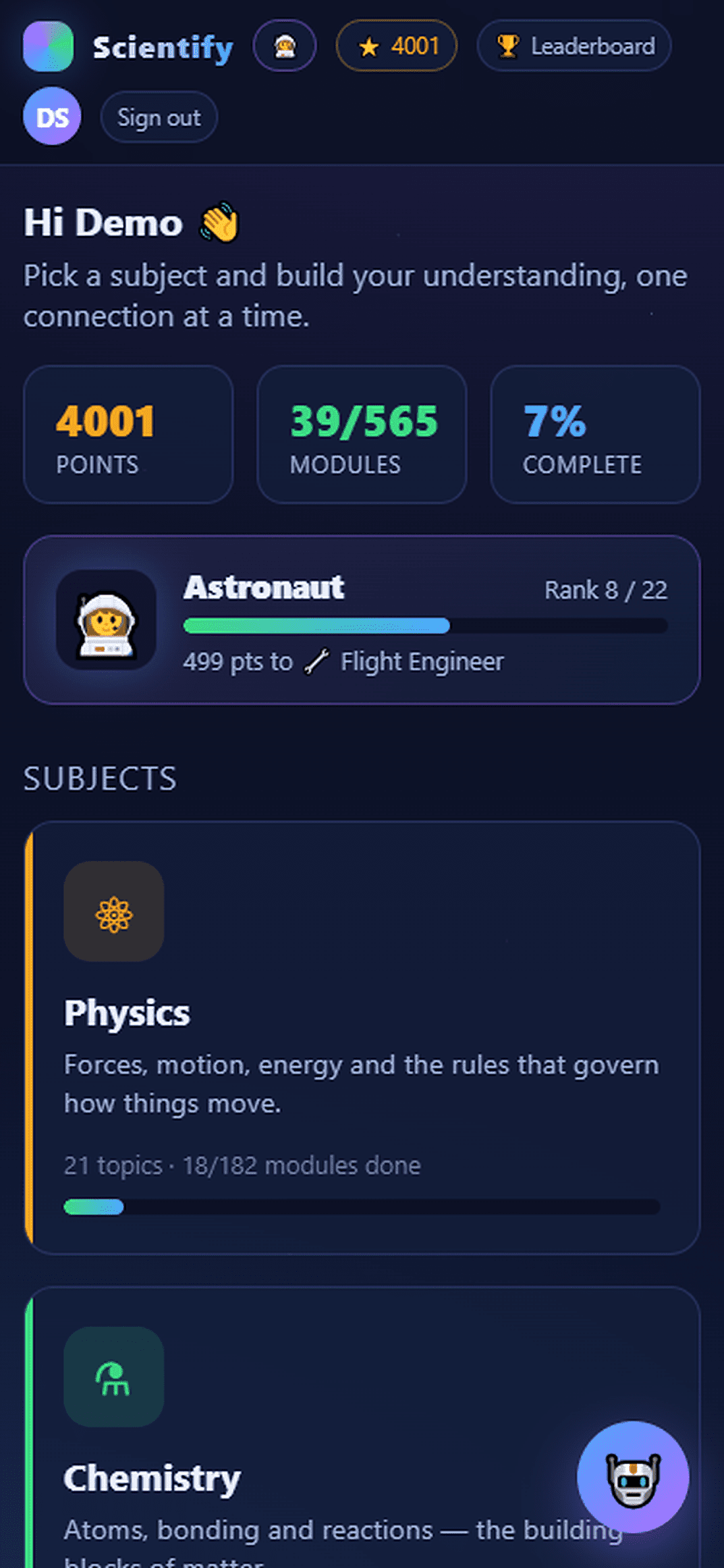
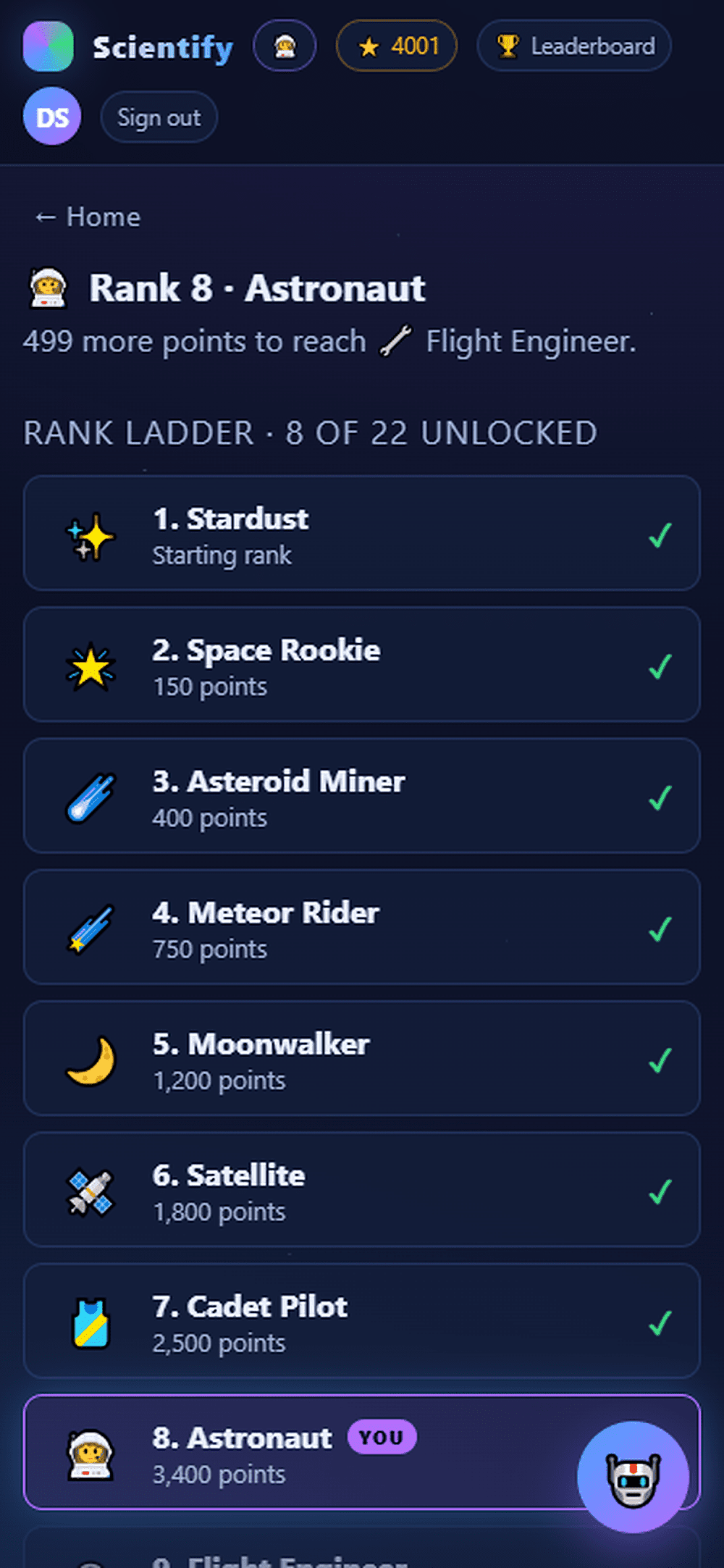
- Progression system. Points, 22 space themed ranks from Stardust to Singularity, a leaderboard, and cumulative Mastery exams to unlock new topics.
What Is Scientify Built On?
Scientify is built as a fast, self-contained web application. A no-build, vanilla JavaScript front end runs the interactive labs, missions and animations on HTML5 Canvas and SVG, backed by a lightweight Node.js server with its own JSON data layer. There is no heavy framework and no third-party runtime, which keeps the app quick to load and simple to maintain.
Because it is a Progressive Web App at its core, Scientify installs like a native app and keeps working offline through a service worker. For Google Play, that same web app is packaged as a Trusted Web Activity, so every improvement ships the moment the site is redeployed. The full breakdown is below.
Scientify Tech Stack
The complete set of technologies, systems and tooling used to build and ship Scientify, grouped by layer.
Frontend / Client
- Vanilla JavaScript, ES modules, no framework, no build step
- HTML5 Canvas for the labs, missions and simulations
- Inline SVG for diagrams, the mascot and animations
- CSS with custom properties and responsive layout
Backend / Server
- Node.js using only built-in modules, zero dependencies
- Custom HTTP server and JSON API
- File-based JSON storage on a persistent disk
Auth & Data
- HMAC-SHA256 signed session tokens
- scrypt password hashing
- HTTPS, all data encrypted in transit
- No third-party data sharing
PWA & Delivery
- Progressive Web App, installable on device
- Service worker, offline app shell and versioned cache
- Web App Manifest
Android Packaging
- Trusted Web Activity (TWA) via PWABuilder
- Google Play distribution
- Updates ship by redeploying the site
Content Pipeline
- Custom authoring scripts for modules and questions
- Single content library across four subjects
- Hundreds of modules, thousands of questions
Gamification
- Points and 22 space-themed ranks
- Daily streaks and achievement badges
- Leaderboard and cumulative Mastery exams
Contextual Tutor
- Hint engine tied to on-screen state
- Built to nudge rather than answer
- Shared across all four subjects
Hosting / DevOps
- Render Node web service with persistent disk
- Continuous deploy from GitHub
A Closer Look Inside Scientify
Ten of the systems inside the app, and what each one is built to do.
Module 01
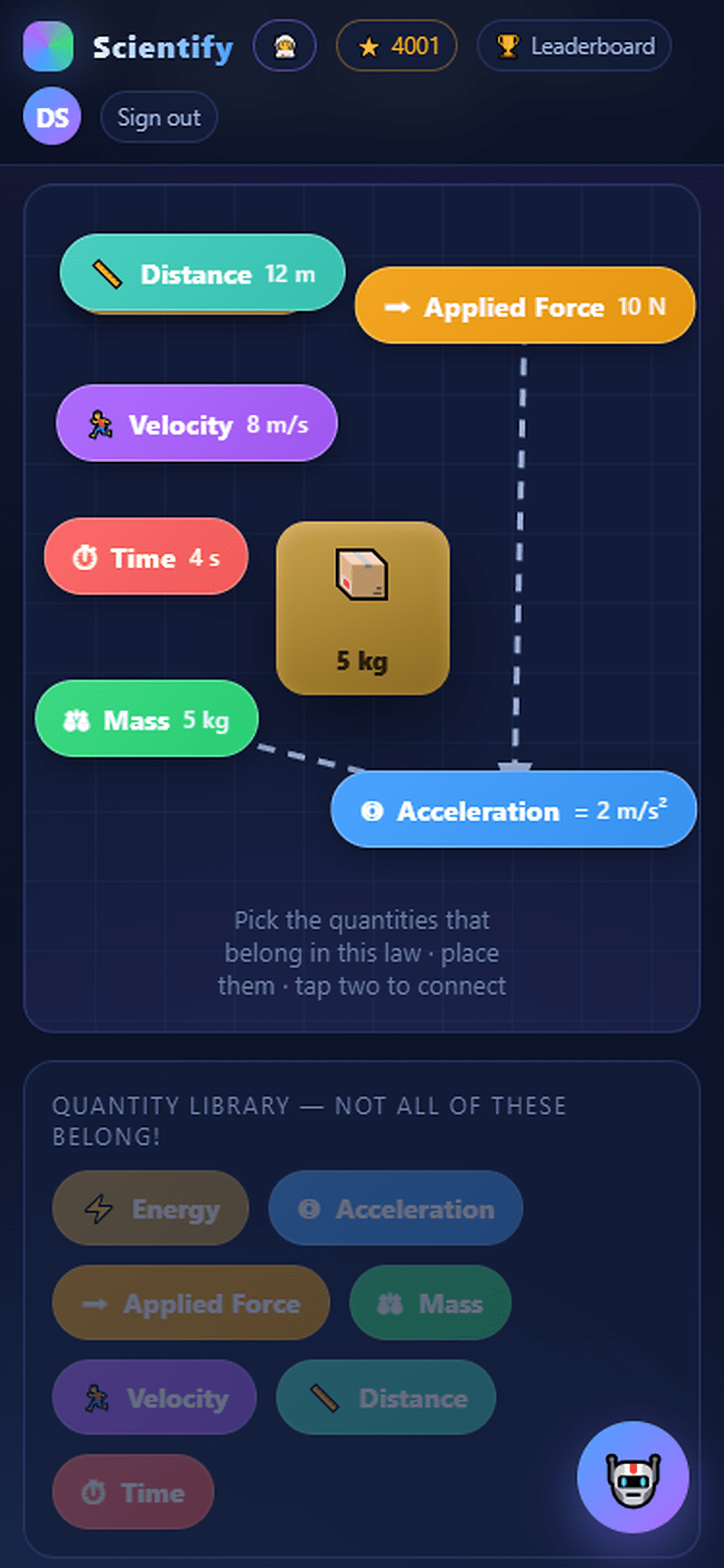
Predict-First Physics Labs
Before anything moves, the student has to make a call. They set a guess, then drag the sliders to run the test and see the actual outcome. Being wrong here matters more than being right, since it is the moment a student notices the gap between what they assumed and how physics actually works.
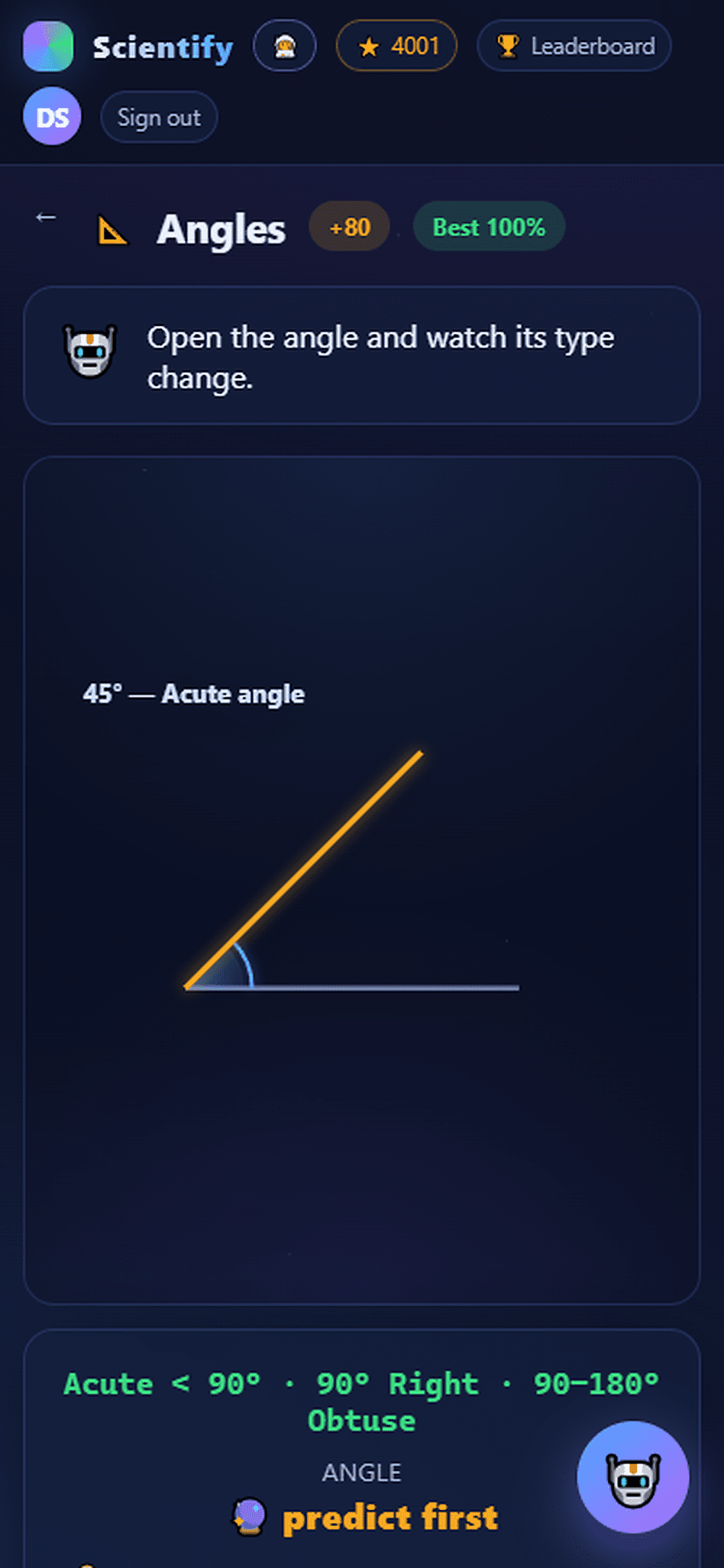
Module 02
Virtual Chemistry Lab
Students pick reactants, predict what the reaction will do, then watch the test tube fizz, change colour or flash. It is built to replace the kind of chemistry demo a classroom often cannot run safely or does not have time for, without losing the moment of watching the reaction happen.
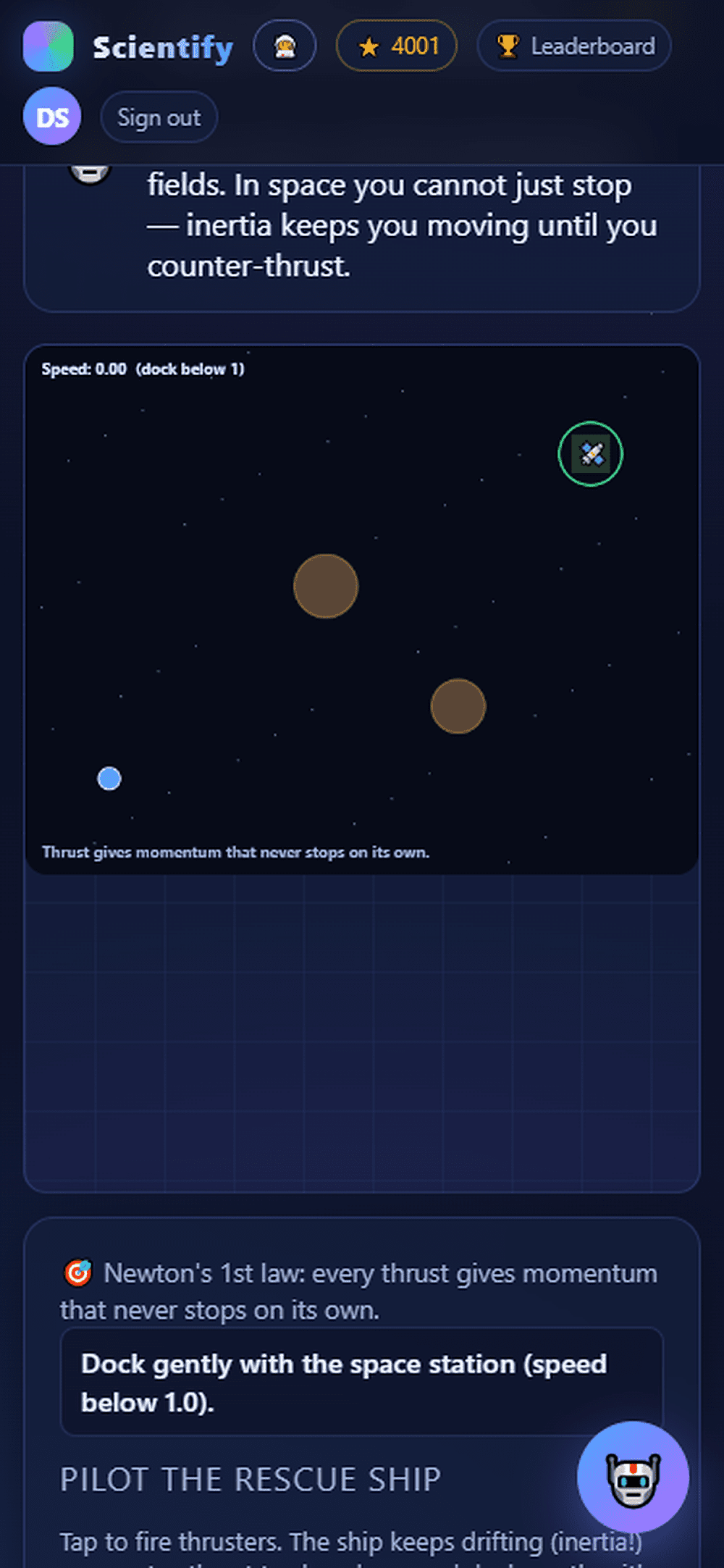
Module 03
Connect the Concepts Builder
Students link cause to effect directly on screen instead of picking an answer from a list. It targets the kind of understanding that a normal quiz cannot check, whether a student actually knows why something happens, not just what the answer is.
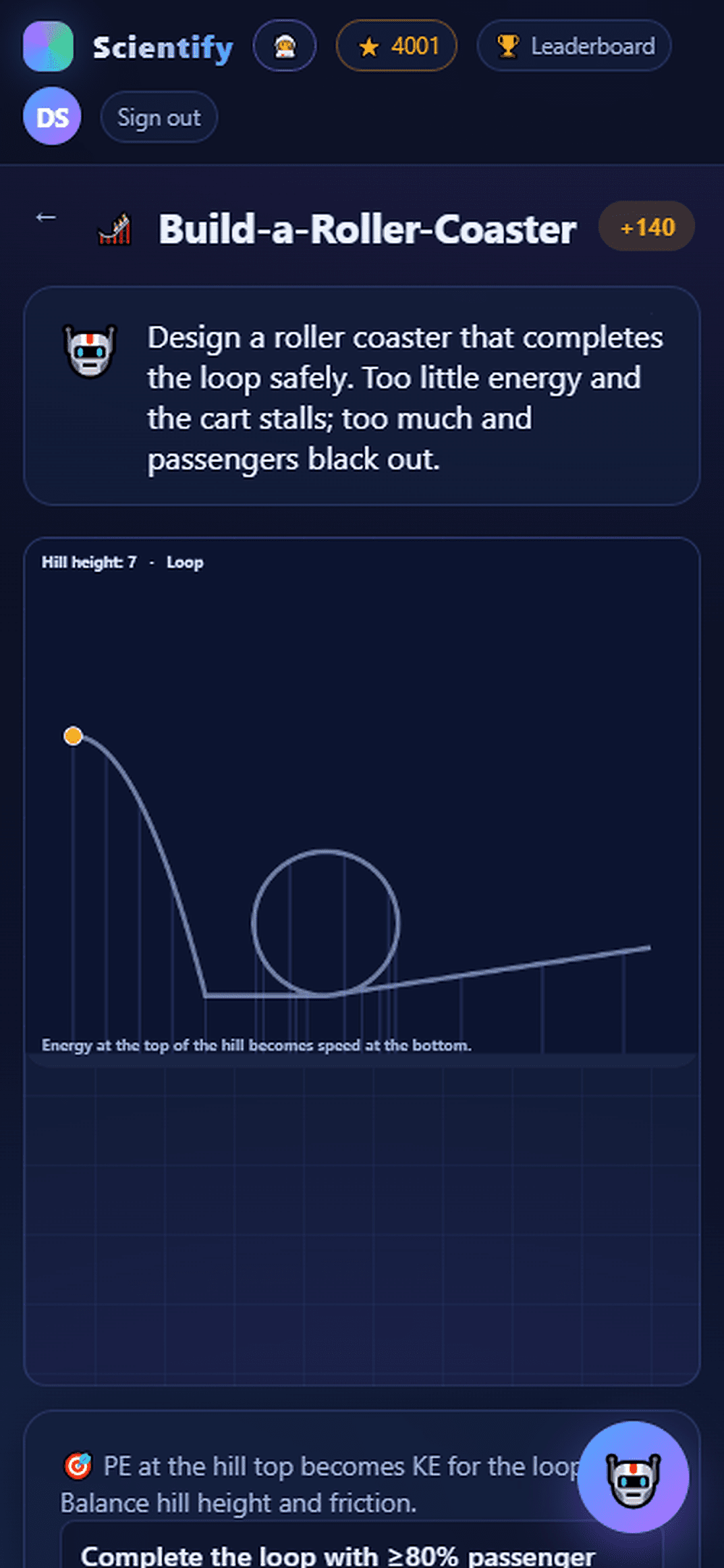
Module 04
Sort and Classify Challenges
Students group items by property or rule instead of recalling a fact from memory. This mechanic runs across biology classification, chemical groups and maths categories, and it is built to reward reasoning over rote memory.
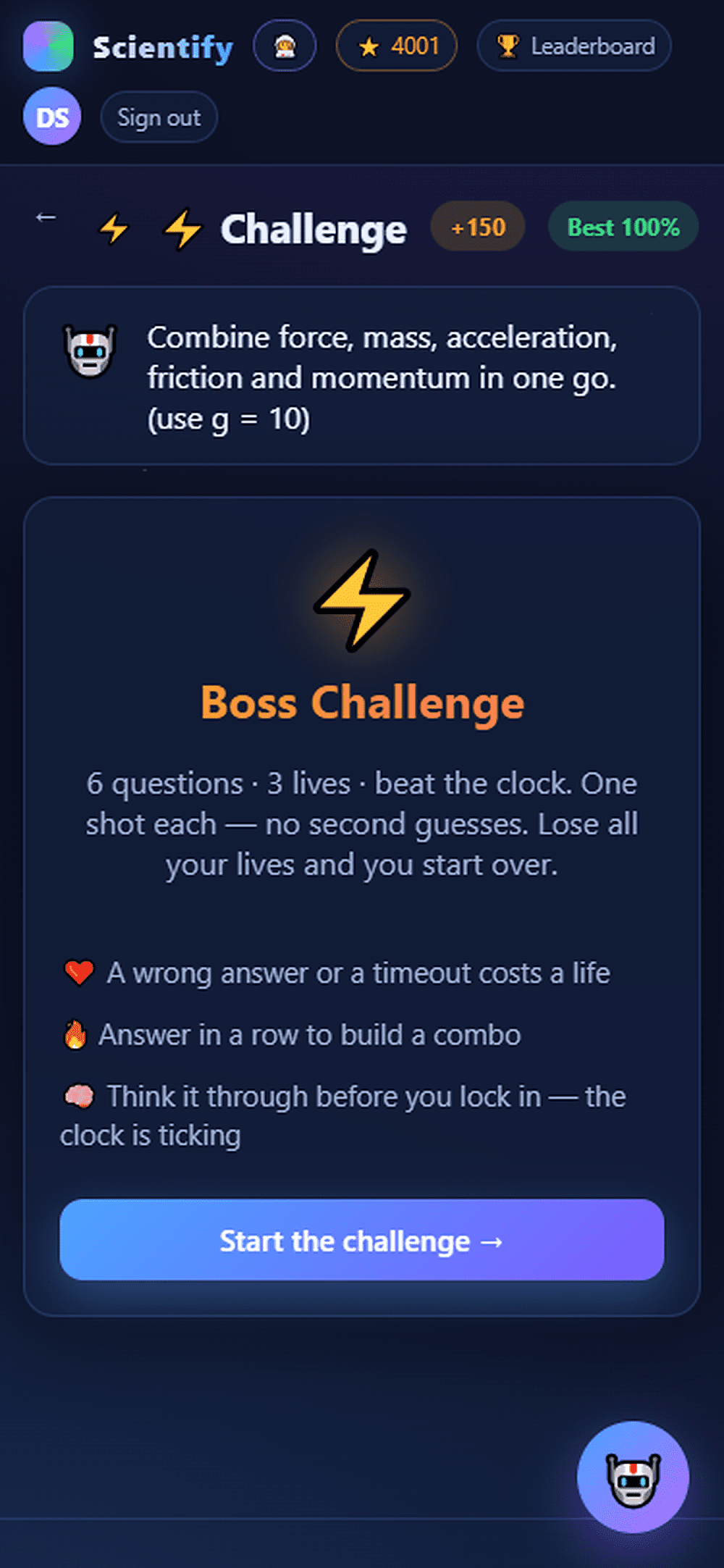
Module 05
Boss Challenges
A timed test with limited lives and a combo streak for consecutive correct answers. This is straight arcade game design applied to revision, built to make exam style practice feel closer to a game session than a timed test paper.
Module 06
Space Science Missions
Fly a probe into orbit, bend light around a black hole, race a ship toward light speed and watch time slow down, or tour the Solar System. These missions cover physics topics that are almost impossible to demonstrate in a classroom, and they double as the source of the app's ranking theme.
Module 07
Roller Coaster and Laser Escape Missions
In one mission, students design a roller coaster that has to survive its own loop. In another, they escape a lab by aiming a laser correctly. Both missions turn textbook formulas for speed, force and angles into a puzzle with a visible pass or fail result.
Module 08
Docking, Bridge and Crime Scene Missions
Dock a spacecraft using real inertia, build a bridge on a fixed budget, or work through a physics based crime scene. Each mission drops a formula into a situation with limits and consequences, so getting it wrong actually shows the student where their thinking broke down.
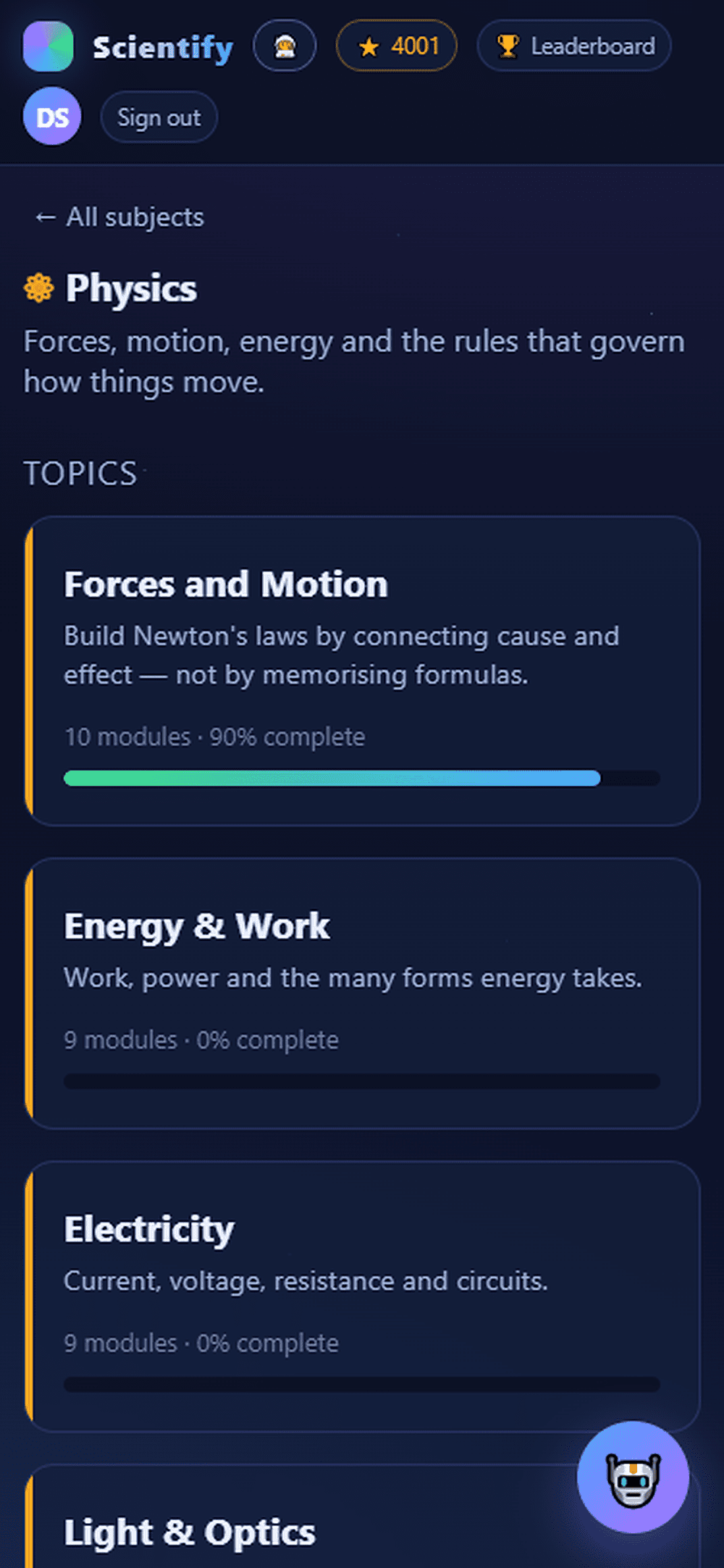
Module 09
The In-App Tutor
Stuck on a step, the student can open the tutor, which reads exactly what is on screen and gives a hint based on that state. It is built to nudge, not answer, so a student still has to finish the thinking themselves. It works the same way across all four subjects.
Module 10
Ranks, Leaderboard and Mastery Exams
Points earned across every subject move a student through 22 space themed ranks, from Stardust to Singularity, with a leaderboard for anyone who wants the competition. New topics unlock step by step, and cumulative Mastery exams check that earlier material actually stuck.
What Did Scientify Achieve?
Scientify shipped as a complete four-subject learning platform, not a single mini game. A few things stand out from the build:
- Full coverage across physics, chemistry, biology and maths, with hundreds of interactive modules and thousands of questions, all built and maintained by NipsApp.
- A single contextual tutor system that works across every subject, instead of a separate hint system for each one.
- A progression system built for long-term use, 22 ranks, a leaderboard and cumulative Mastery exams, so the app supports a full school year rather than one revision session.
- A privacy-first data setup, no data shared with third parties and data encrypted in transit, which matters for an app built for students.
- Regular updates on Google Play, keeping content and stability current for CBSE, IGCSE and similar curriculums.
Built by a Team That Builds Learning Games for a Living
Scientify was designed and built in house by NipsApp Game Studios, a Unity and Unreal game development studio based in Trivandrum, Kerala, with a second office in Abu Dhabi. NipsApp works on gamification, VR and AR, and full-cycle game development for B2B clients, schools and edtech companies worldwide, and Scientify is one of the clearest examples of that work applied to education.
Looking to build an educational game, a gamified training tool, or a learning app for your own students or team? NipsApp Game Studios is an educational game development company with a working product to show for it, not just a pitch deck.
View Scientify on Google PlayRelated Case Studies
Explore more of the games and interactive experiences NipsApp Game Studios has shipped across mobile, VR, AR, blockchain, and beyond.


 View on Apple Maps
