Our work is validated by independent client reviews and industry recognition across global B2B platforms and game development communities.
Necroverse VR Case Study
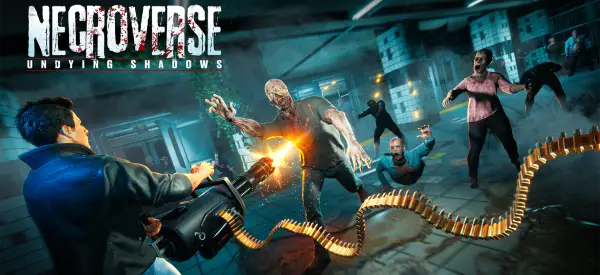
A high intensity VR zombie shooter by Nipsapp Game Studios that blends survival horror with competitive Battle Royale combat.
PvPvZ Battle Royale on PC VRLast updated: May 2026
TLDR
Necroverse - Undying Shadows is a VR zombie shooter Battle Royale built by Nipsapp Game Studios. The setting is a brutal post apocalyptic world. The threat isn't just zombies, it's also other players. You're fighting both at once, all the time. PvPvZ is the loop. Last survivor wins.
Built in Unity3D and shipped on Steam with OpenXR support, the game runs on Valve Index, HTC Vive, Oculus Rift, and Windows Mixed Reality headsets. Combat is firearm based and tuned for VR precision. Zombies come in dynamic waves that scale with match progression, so the longer you survive, the more pressure builds from every direction.
Game name: Necroverse - Undying Shadows
Developer: Nipsapp Game Studios
Engine: Unity3D
Genre: VR zombie shooter Battle Royale
Platform: PC VR
VR Support: OpenXR on Steam
Combat type: PvPvZ (player vs player vs zombies)
Distribution: Steam
Watch Necroverse VR Gameplay
Official Necroverse VR gameplay video showing PvPvZ combat, zombie waves, and post apocalyptic environments.
About the Game
Necroverse drops the player into a dead world where survival is never guaranteed. The undead are everywhere. Other players are hunting the same loot, the same positions, the same exit. Every match is a three way fight against zombies, rivals, and your own panic.
The genre is PvPvZ, which means you're never just dealing with one threat at a time. Take cover from a player, you might back into a horde. Push a player too hard, you draw zombies into the fight. The combat layers force tactical thinking on top of fast aim. Resource management, positioning, and timing all matter as much as raw shooting skill.
Genre: VR zombie shooter Battle Royale
Engine: Unity3D
Platform: PC VR
VR Support: OpenXR on Steam
Game Modes: PvPvZ Battle Royale
Built by: Nipsapp Game Studios
Steam: View on Steam

Core Gameplay Systems
PvPvZ Battle Royale
The core mode is a three way fight. Players drop into the arena, find weapons, and try to be the last one standing. Zombies are not background dressing. They're a constant threat that punishes players who stand still or fire too loudly. Every shot you take draws attention from both undead and human enemies.
This is what makes the loop different from a standard Battle Royale. You can't just hide and outlast. The zombies will find you eventually.
Weapon Based Combat
Firearms are built for VR precision. Two handed grip, manual reloads, scope alignment, and recoil that the player has to manage with their actual hands. Pistols, rifles, and shotguns all handle differently. Picking the right weapon for the situation is part of the survival skill.
Weapon handling rewards players who treat the gun like a real tool. Sloppy aim costs ammo. Sloppy reloads cost time you don't have.
Survival Strategy
Resource management matters. Ammo runs out. Health doesn't regenerate on its own. Loot is scattered around the map and rivals are scavenging it too. Players have to choose between pushing aggressive for kills or playing slow and stocking up. Both work. Neither is safe.
Dynamic Zombie Waves
Zombies don't spawn in predictable patterns. The wave director scales pressure as the match progresses. Early game has steady trickle. Mid game starts pushing groups. Late game can flood a position if the player isn't moving. The longer the match goes, the more chaotic it gets.
Competitive Last Survivor
The win condition is simple. Be the last living player. Zombies kill you, you're out. Another player kills you, you're out. Match resets. New drop. The pressure of knowing one mistake ends the run is what gives every fight weight.
High Replay Value
Every match unfolds differently. Drop locations change. Loot spawns shift. Other players make different calls. Zombie pressure varies by where the survivors cluster. The same map plays a hundred different ways across a hundred matches, which is what keeps the replay loop strong.
Tech Stack
Unity3D
Main engine. Handles rendering, physics, audio, animation, and the full VR loop on PC.
C#
Primary scripting language for combat logic, zombie AI, weapon handling, and Battle Royale flow.
OpenXR
Standard VR runtime supporting Valve Index, HTC Vive, Oculus Rift, and Windows Mixed Reality headsets.
Unity XR Toolkit
Base layer for hand tracking and controller input, with custom layers for weapon handling and reloading.
Zombie AI System
Custom built behavior controller for undead enemies with state machines for idle, search, chase, and attack.
AI Pooling Layer
Pre-instantiated zombie pools that recycle through the match to support large enemy counts without spawn cost.
Multiplayer Networking
PvPvZ sync layer that handles player positions, shots, kills, and shared zombie state across all players in a match.
Wave Director
Spawn director that scales zombie pressure based on match time, player density, and combat noise.
Steam Distribution
Shipped on Steam with OpenXR VR support and standard PC VR system requirements.
System Requirements
Minimum
OS: Windows 10 64 Bit
CPU: Intel Core i5 or AMD FX 8350
RAM: 6 GB
GPU: NVIDIA GTX 1080 or AMD Radeon R9 290
Storage: 10 GB
VR Support: OpenXR with Valve Index, HTC Vive, WMR, Oculus Rift
Recommended
OS: Windows 10 64 Bit
CPU: Intel Core i7 or AMD Ryzen 7
RAM: 8 GB
GPU: NVIDIA GTX 1080 or AMD RX Vega 56 or RTX series
Storage: 10 GB
VR Support: OpenXR with Valve Index, HTC Vive, WMR, Oculus Rift
Challenges
Large Scale VR Combat
PvPvZ means many players, many zombies, and many simultaneous fights all running in the same match. Every player needs accurate state from every other player and from a horde of AI enemies. Pulling that off in VR, where the rendering budget is already half what flat screen gets, was the big technical problem.
Performance Stability
VR comfort needs stable frame rates. A drop during a zombie rush would break the experience. Holding smooth performance with high enemy counts, multiplayer traffic, and complex combat effects all running together took serious tuning.
Combat Balance
PvP and PvE need different balance. A weapon that feels right against zombies might be too strong against players. Loot scarcity that pressures players might also stop them from dealing with hordes. Finding the balance where both layers are fair and fun took a lot of iteration.
Real Time Network Sync
Battle Royale needs accurate sync. A shot in VR has to register on the right enemy at the right moment, even with network latency between players. Cheating prevention also matters in competitive multiplayer. The networking layer had to be tight without burning bandwidth.
VR Comfort During Action
Zombie shooters often rely on jump scares, fast camera shifts, and intense action. In VR, those same tricks can make players sick. Keeping the experience scary and intense without crossing into motion sickness territory took careful design choices.
Solutions
Optimized Zombie AI Systems
Zombies use shared state machines and behavior trees that are cheap to run. Pooling means no runtime spawn cost. AI updates are spread across frames so no single tick has to process every zombie at once. Far away zombies run on simpler logic until they get close to a player.
Rendering Optimization
Mesh LODs swap to lower poly models at distance. Static batching merges environment props into single draw calls. Shaders are tuned for VR cost. Particle effects scale based on player count and combat density. The goal is dense looking action that holds the frame rate.
Efficient Multiplayer Architecture
The networking layer only syncs what matters. Player positions, hand and head data, weapon state, and shot events go at high frequency. Zombie state is partially server authoritative so all clients agree on AI behavior without flooding the network. Less critical data is interpolated client side.
VR Comfort Design
Locomotion options give players control over how they move. Smooth movement for confident players, teleport for those who need it, snap turning for everyone. Vignetting during fast movement cuts peripheral motion. Action stays intense, but the player chooses their comfort level.
Iterative Balance Tuning
Weapon stats, zombie health, loot density, and zone timing are all data driven. The team uses match data to spot imbalances and patches the values without forcing new builds. PvP and PvE are tuned as related but separate systems so changes to one don't break the other.
Mature Content Notice
Necroverse - Undying Shadows contains frequent violence against zombie enemies, blood and gore effects, and horror themed environments. The game does not include sexual content, substance abuse, or self harm themes. Parental discretion is advised.
Player Feedback
"PvPvZ is the right call. Fighting another player while a horde rolls in is the most stressed I've been in VR."
"Weapon handling feels solid. Reloading under pressure with zombies closing in is a vibe."
"Best VR Battle Royale I've tried. Zombies actually matter, they aren't just background noise."
"Runs smooth on my Index. Performance held up even with a full lobby and a zombie rush."
Sample feedback themes from public Steam reviews.
Results and Impact
High Intensity
Fast paced PvPvZ combat in VR
Battle Royale Tension
Last survivor pressure every match
Replay Driven
Every match plays differently
VR Optimized
Smooth performance on supported headsets
Frequently Asked Questions
What is Necroverse - Undying Shadows?
Necroverse is a VR zombie shooter Battle Royale built by Nipsapp Game Studios. Players fight both undead hordes and rival human players in a post apocalyptic arena. The last living player wins.
Is Necroverse a multiplayer game?
Yes. The game features PvPvZ Battle Royale gameplay where players fight other players and zombies at the same time.
Does Necroverse support VR?
Yes. Necroverse supports OpenXR based VR headsets on Steam, including Valve Index, HTC Vive, Oculus Rift, and Windows Mixed Reality.
What does PvPvZ mean?
PvPvZ stands for Player versus Player versus Zombies. It means you're fighting both other human players and AI zombie enemies in the same match, all at once.
Which engine was used to build Necroverse?
The game was built in Unity3D using C# for combat logic, zombie AI, weapon handling, and Battle Royale flow.
What are the minimum system requirements?
Windows 10 64 Bit, Intel Core i5 or AMD FX 8350, 6 GB RAM, NVIDIA GTX 1080 or AMD Radeon R9 290, and 10 GB of storage.
What are the recommended system requirements?
Windows 10 64 Bit, Intel Core i7 or AMD Ryzen 7, 8 GB RAM, NVIDIA GTX 1080 or AMD RX Vega 56 or RTX series GPU, and 10 GB of storage.
Is Necroverse suitable for all ages?
No. The game contains frequent violence, blood, and gore effects against zombie enemies along with horror themed environments. It is intended for mature audiences.
Does Necroverse have any sexual or substance abuse content?
No. The game does not include sexual content, substance abuse, or self harm themes. The mature content is limited to combat violence and horror.
Where can I buy Necroverse VR?
Necroverse - Undying Shadows is available on Steam at the official store page.
Does Nipsapp build VR Battle Royale games?
Yes. Nipsapp Game Studios builds VR multiplayer combat systems with focus on performance, networking, and comfort first design. Necroverse is one example shipped on Steam.
Does Nipsapp provide post launch support?
Yes. Nipsapp handles ongoing patches, content updates, server maintenance, balance tuning, and platform compatibility updates after launch.
Related Case Studies
Explore more of the games and interactive experiences NipsApp Game Studios has shipped across mobile, VR, AR, blockchain, and beyond.
 View on Apple Maps
 View on Google Maps