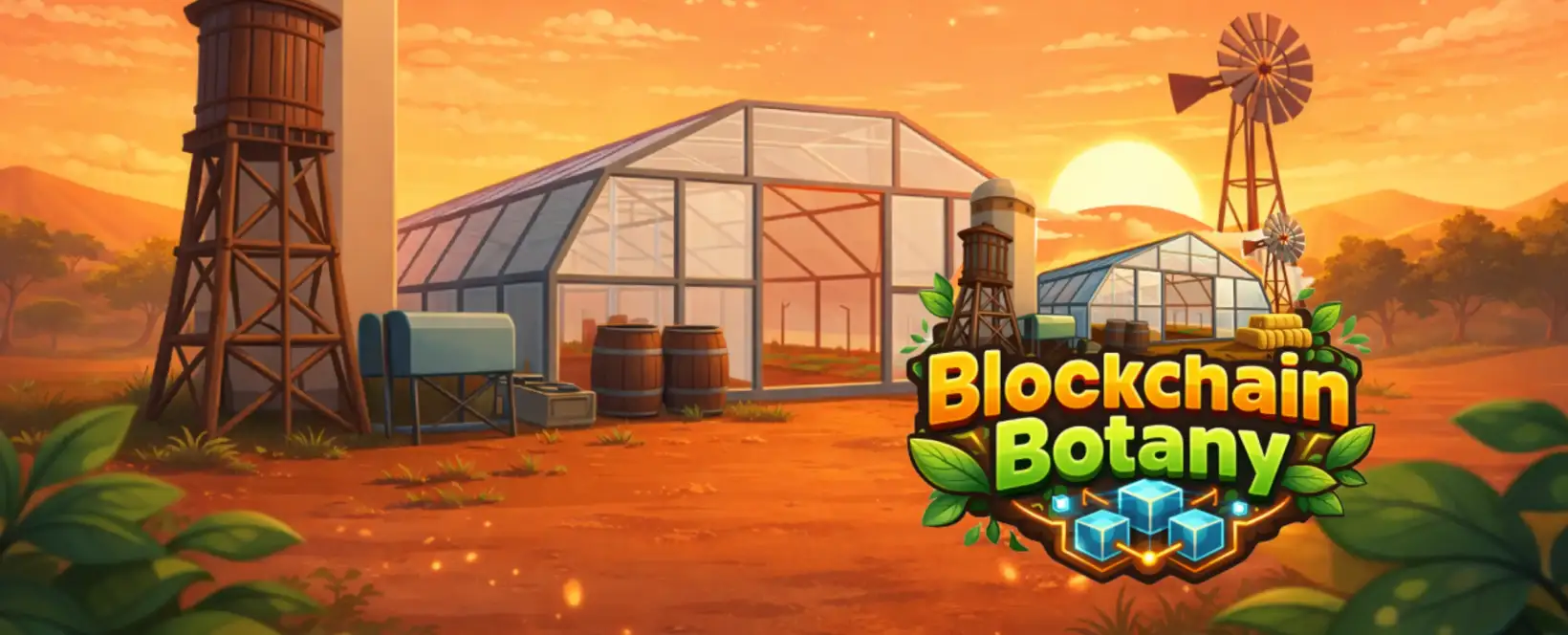
CASE STUDY · WEB3 · EDUCATION · UNITY
Blockchain Botany — From Concept to Playable MVP in Weeks
A Web3-inspired educational simulation game built for rapid launch, scalability, and investor readiness. Delivered as a fully playable MVP with Unity, a custom backend, and a dual-revenue model spanning consumer free-to-play and institutional classroom licensing.
Project at a Glance
The Client Story
Michele Edington, a US-based founder with a vision for teaching blockchain through play, approached NIPSAPP after evaluating multiple studios across the United States and Europe. Her search had been frustrating. Most teams she spoke with either treated blockchain as a buzzword to bolt on, or inflated the scope into a multi-year enterprise build — neither of which matched her actual goal.
She did not need another whitepaper. She needed a working product she could put in front of investors, educators, and real players. A team that understood Web3 deeply enough to translate it into something a middle schooler could enjoy, while remaining rigorous enough to satisfy a fintech classroom.
That is where our team stepped in. We delivered a playable MVP on a timeline and budget that made investor validation possible, not theoretical. Today, Michele is actively applying for Phase 2 funding and expanding the platform into classroom pilots.
"Most studios sold us complexity. NIPSAPP sold us a product. That is a very different conversation." — Paraphrased from client feedback
Project Overview
Blockchain Botany is a casual simulation game that teaches players how blockchain and cryptocurrency systems work through plant-growing gameplay. Players manage a personal Martian greenhouse where they plant seeds, grow plants, harvest resources, stake mature plants for enhanced rewards, and collaborate with other players in community gardens.
Instead of explaining blockchain through technical lessons, the game demonstrates concepts through interactive systems and simple metaphors. A seed bank becomes a digital wallet. Harvesting a plant becomes a blockchain transaction. Staking a plant with a visible garden stake teaches Proof-of-Stake without a single line of jargon.
Goal: Launch fast. Prove engagement. Prepare for scale — including future NFT and token integration when the product and audience are ready.
Explore our full offering for blockchain game development for startups.
The Challenge
This was not a straightforward gamedev brief. The project sat at the intersection of four hard problems, each of which has killed similar projects at other studios.
1. Make blockchain genuinely understandable
The target audience ranges from middle schoolers learning financial literacy to adult crypto-curious consumers. Explanations had to work for both without patronising either. We needed contextual, just-in-time teaching — not a 40-page tutorial nobody reads.
2. Build without real blockchain (App Store constraints)
Apple App Store policies around cryptocurrency, tokens, and on-chain assets are strict and constantly shifting. To ship the MVP on iOS and Android, we had to simulate Web3 mechanics convincingly in a centralised architecture — while leaving clean hooks for real blockchain integration in Phase 2.
3. Support two very different business models
The consumer version is free-to-download with optional Martian Diamond purchases. The educational version is a closed, purchase-only licence for schools with zero in-app transactions. One codebase, two fundamentally different monetisation and compliance profiles.
4. Move fast enough for investor validation
Michele needed a playable product to back her funding conversations. Every week of slippage meant a weaker pitch. We had to balance velocity with a build quality that would hold up under investor technical due diligence.
Our Approach
Gameplay first, blockchain second
Before writing a line of Unity code, we rewrote the brief around a single question: what is the player actually doing? The answer — planting, growing, harvesting, staking, contributing — became the spine of the game. Every blockchain concept was then mapped onto an existing action, not stapled on top. The result is that players learn by doing, and the "lesson" is invisible.
MVP discipline
We cut hard. Community chat, voting systems, advanced leaderboards, seasonal events, and on-chain integration were all deliberately deferred to post-launch. The Phase 1 scope was ruthlessly focused on the minimum playable loop that could both generate revenue and prove engagement.
Future-ready architecture
The backend was designed so that swapping the simulated currency ledger for a real blockchain layer is a contained change, not a rewrite. Seed Banks are already modelled as wallet-like structures. Transactions are already logged as immutable records. When the product is ready for real tokens and NFTs, the plumbing is waiting.
Education baked in, not bolted on
Nine contextual tutorial pop-ups trigger at meaningful moments — first planting, first harvest, first time opening the seed bank, first staking action, hitting 1,000 Martian Diamonds, entering a community garden, completing 15 transactions, unlocking the fifth plant. All tutorial content is also permanently accessible in an in-game Guidebook, so nothing is lost to a dismissed pop-up.
Core Systems We Built
Plant → Grow → Harvest Loop
The core progression loop. Players obtain seeds, plant them in pots, wait out a rarity-scaled growth timer (minutes for common, hours for ultra-rare), and harvest for seeds and Martian Diamonds. Plants have three growth stages plus a decay state if left unharvested for 72 hours.
Martian Diamonds Currency
The in-game currency, earned through gameplay or purchased in tiers ($4.99 / $9.99 / $19.99 / $49.99). Used for seed packs, plant unlocks, greenhouse expansion, and community garden contributions. Designed to feel like real crypto without the regulatory exposure.
Plant Rarity & Unlock System
Five rarity tiers (Common, Uncommon, Rare, Ultra-Rare, Special). Unlocks use seed combinations plus Martian Diamonds rather than lucky drops — for example, an Ultra-Rare unlock requires 3 rare seeds + 1 ultra-rare seed + 150 Martian Diamonds. This rewards strategy over RNG.
Visual Staking System
Our favourite mechanic. A player selects a mature plant, chooses "Stake," and a visible garden stake appears in the pot. The plant is locked for 12–72 hours depending on rarity and produces enhanced rewards. It teaches Proof-of-Stake through a physical metaphor anyone has seen in a real garden.
Community Gardens
Shared, time-limited projects where players collectively contribute Martian Diamonds and seeds to unlock rare plants like the Celestial Bloom. Real-time progress bars, 72-hour countdowns, and a 70%-completion consolation mechanic to reduce rage-quits while still teaching scarcity.
Referral System
Each player gets a unique code. When a new player signs up and completes their first harvest, both players receive the Nexus Sprout — an ultra-rare, referral-exclusive plant with a signature sparkle effect. Designed as a sharable trophy, not a mercenary incentive.
Special Plants
Mechanically unique plants that break the standard loop: Solar Bloom (daytime-only), Lunar Lotus (nighttime-only), Stardust Vine (slow growth, bigger rewards), Chrono Cactus (starts fully grown, decays into seeds), Void Vine (staking-focused), and more.
Guidebook & Glossary
An in-game reference covering 18+ blockchain terms — Blockchain, Cryptocurrency, Decentralisation, NFTs, Digital Wallet, Private Key & Seed Phrase, Gas Fees, Smart Contracts, Immutable Ledger, Tokenomics, Validators, Miners, Web3, and more — each paired with its Blockchain Botany analogy.
What Makes It Different
Web3 education without the jargon wall
Most "learn crypto" products assume prior knowledge or front-load vocabulary. Blockchain Botany flips this. Players perform the action first, then the game names what they just did. Staking is felt before it is defined.
The first truly visual staking system we've seen in a casual game
A literal garden stake, placed in a pot, locking a plant for a set duration in exchange for yield. Players grasp Proof-of-Stake in about 20 seconds. Crypto-native tutorials take about 20 minutes.
Designed for classrooms from day one
The educational build is a closed-loop, purchase-only licence with no IAPs, no ads, and no external links — making it deployable in middle schools, universities, coding bootcamps, and homeschool programs without compliance headaches.
Dual revenue model with genuine separation
Consumer F2P revenue (Martian Diamond packs, future cosmetics, seasonal content, eventual NFT integration) runs alongside institutional licensing revenue (annual school licences, curriculum partnerships, homeschool tiers). Each market gets a product tuned for its needs.
The Educational Layer in Detail
The classroom version is not a watered-down consumer build — it is a dedicated learning tool. It is designed to slot into financial literacy units, technology courses, fintech programs, and Web3 training bootcamps. Educators use it as a teaching aid; students explore concepts through structured play.
Concepts taught through gameplay
The Guidebook and contextual tutorials cover the full beginner blockchain curriculum: the evolution of Web1 to Web3, what cryptocurrency is and how it differs from fiat, how digital wallets and private keys work, how blockchain transactions broadcast-verify-confirm, what makes a ledger immutable, how staking and Proof-of-Stake secure networks, how gas fees and Layer 2 solutions operate, why crypto prices fluctuate (bull vs bear markets, whales, DeFi), what smart contracts do, what NFTs are and how they differ from fungible tokens, and the roles of validators and miners.
Target customers
Middle schools teaching financial literacy, universities running blockchain or fintech programs, coding bootcamps, Web3 training organisations, and homeschool networks focused on digital finance.
Tech Stack & Architecture
Unity Engine
Single codebase targeting Web (primary, for classroom deployment), iOS, and Android.
Custom Backend
Player state, inventories, Martian Diamond ledger, staking timers, community garden aggregation.
Web-First Delivery
Browser version prioritised so schools can access without app-store approvals or downloads.
Scalable Architecture
Designed to absorb seasonal events, new plant content, and new game modes without refactoring.
Web3-Ready Hooks
Wallet, ledger, and asset layers modelled so NFTs and on-chain tokens can be added in Phase 2.
Dual-Build Compliance
Separate configurations for consumer (IAP-enabled) and educational (closed-loop) deployments.
Art Direction
We chose a colourful, approachable cartoon style — visual inspiration drawn from Clash of Clans and Stardew Valley — balanced with a subtle Martian greenhouse aesthetic. Clean shapes, vibrant palettes, and clearly differentiated growth stages ensure that progression and rarity are legible at a glance on both a classroom projector and a phone screen.
Rarity communicates visually, not through labels. Common plants use simple shapes and basic palettes. Ultra-rare plants carry glow, particles, and animated features. Staking stakes themselves scale visually — a simple wooden stake for common plants, a futuristic Martian stake with effects for ultra-rares — so a full greenhouse reads like a dashboard of a player's progress.
Results
Playable MVP delivered on schedule
All Phase 1 systems live: greenhouse gameplay, seed economy, plant unlocks, staking, Martian Diamonds, tutorials, guidebook, referrals, and community gardens.
Investor-ready product in hand
The client moved directly from delivery into her funding round with a live demo — not a pitch deck mockup.
Clear path to Phase 2
Architecture already accommodates seed packs, greenhouse expansion purchases, seasonal packs, and eventual on-chain integration.
Two markets, one build
Consumer and educational versions delivered from a shared codebase, ready for both app-store release and school licensing outreach.
Client satisfaction
High. The client is now actively referring other founders to us for their Web3 and Unity builds.
What We Learned Building This
Three things from this build we now apply to every Web3 MVP we take on. First: the App Store constraint is a gift, not an obstacle — forcing the team to simulate blockchain before integrating it produces a cleaner product and a better educational tool. Second: visual metaphor beats tutorial text every time; our nine pop-ups exist to name concepts the player has already discovered, not to teach them cold. Third: institutional licensing is an under-rated second revenue stream for Web3 founders, and it only works if compliance is designed in from day one rather than retrofitted.
Frequently Asked Questions
How long does it take to build a blockchain game MVP?
For a focused scope like Blockchain Botany — a single core loop, a clear progression system, and one or two supporting mechanics — a playable MVP can ship in a matter of weeks. Timelines balloon when scope is not disciplined; our first engagement deliverable is usually a scope cut, not a feature list.
Can a blockchain game be released on the Apple App Store?
Yes, but with constraints. Apple's policies around on-chain assets, tokens, and crypto transactions are restrictive. The practical path for most startups is to launch with simulated Web3 mechanics that comply with App Store rules, then introduce real blockchain integration through web builds or updates as the regulatory and platform landscape matures. This is exactly the strategy we used for Blockchain Botany.
Do you build for both Web and mobile from one codebase?
Yes. We default to Unity for this kind of project specifically because it lets us ship Web, iOS, and Android from a single codebase. For educational deployments, we prioritise the Web build so institutions can access the product without app-store friction.
What does it cost to develop a Web3 game for a startup?
It depends heavily on scope. Cost is driven by number of unique art assets, complexity of the economy, multiplayer/social systems, and on-chain integration. We work with founders to scope an MVP that fits their funding situation — typically prioritising the minimum viable loop that can validate engagement and unlock the next investment round.
Can you integrate NFTs and real cryptocurrency later?
Yes, and we architect for it from day one. Our Phase 1 builds model wallets, ledgers, and digital assets as structures that can be swapped for on-chain equivalents without rewriting game logic. This protects the founder's timeline and keeps App Store compliance clean during the early commercial phase.
Who did you build Blockchain Botany for?
Blockchain Botany was built for Michele Edington, a US-based founder. She approached NIPSAPP after evaluating multiple studios across the US and Europe. We delivered a playable MVP within weeks, and she is now in her Phase 2 funding round.
Does Blockchain Botany actually use blockchain?
Not in the Phase 1 release. The game simulates Web3 mechanics — wallets, transactions, staking, immutable ledgers — through gameplay and a centralised backend, which allows App Store compliance and classroom deployment. Real blockchain and NFT integration are planned for later phases.
Building a Web3 Game?
We help startups go from idea to MVP fast — with the discipline to ship, the architecture to scale, and the design sense to make blockchain actually fun.
Talk to Our TeamRelated Case Studies
Explore more of the games and interactive experiences NipsApp Game Studios has shipped across mobile, VR, AR, blockchain, and beyond.


 View on Apple Maps
