Case Study, Location-Based Gaming
Scout - Case Study of a GPS Adventure Game From NipsApp
How NipsApp Game Studios built Scout, a GPS adventure game that turns real streets, landmarks and museums into a walking game, and what it took to make it work on almost any location on Earth.
Studio
NipsApp Game Studios
Platform
iOS, iPadOS, macOS, visionOS
Category
Roleplaying and Adventure
Age Rating
17+
Languages
10 languages including English
Core Tech
GPS, live maps, dynamic content
Progress System
XP, city badges, daily streaks
Price
Free with in-app purchases
Source: apps.apple.com/us/app/scout-gps-adventure-game/id6788361950
What Is Scout?
Scout is a location based adventure game for iPhone, iPad, Mac and Apple Vision Pro. Instead of keeping players on the couch, it sends them outside to walk to real landmarks, museums, monuments, parks and markets, and rewards every trip with stories, experience points and collectible badges.
The core idea is simple. You pick a place or let the app suggest one nearby, you walk there with turn by turn guidance, and when you arrive the game unlocks content tied to that exact spot. There are no monsters and no combat. The world itself is the game board.
What makes Scout unusual is that it is not limited to a fixed list of cities. The game generates content for almost any location on Earth, so a quiet neighbourhood street and a famous monument can both become the start of a mission.
What Problem Was NipsApp Solving?
A walking game that works anywhere sounds simple until you try to build it. Most location games rely on hand made maps and a fixed set of points, which ties them to a few big cities. NipsApp wanted Scout to work on almost any street in the world from day one.
That raised a set of hard questions the team had to answer before the game could feel good to play:
- How do you create interesting, place specific content for locations no one has ever hand authored?
- How do you make plain walking feel like real progress rather than a chore?
- How do you keep players safe and comfortable, with no combat and nothing that pulls their eyes off the street?
- How do you keep the experience working when the signal drops or the player prefers to stay offline?
How Did NipsApp Design the Exploration Loop?
The answer was a single loop that repeats at every location: arrive, discover, earn, and move on to the next spot. Everything in Scout feeds that loop.
- Walk to unlock. Players reach a real landmark and the game opens stories, facts and experience points tied to that place.
- Dynamic content for anywhere. The game builds place specific missions on the fly, so it is not restricted to a fixed city list.
- Turn by turn navigation. Clear walking directions guide players to each destination without guesswork.
- City badges. Players collect bronze, silver and gold badges as they explore more of a city.
- Themed missions. Trails focus on street art, monuments, museums and viewpoints so each walk has a purpose.
- Custom routes. Players build their own walking routes and share them with others.
- Daily challenges and streaks. Small daily goals and streak tracking give players a reason to step out every day.
- Character customization. Players personalise their explorer so the profile feels like their own.
- Real world rewards. Exploration can lead to real perks such as physical postcards and airport exit guides.
What Is Scout Built On?
Scout is a native iOS app built to lean on the hardware it runs on. It uses the device GPS, mapping and motion sensors to know where a player is, where they are heading and when they have arrived, and it keeps that tracking light so it does not drain the battery on a long walk.
The harder half of the build is content. Rather than store a fixed database of hand written locations, Scout generates place specific missions and stories on demand, which is what lets it work on almost any street in the world. Player progress, badges and streaks are saved so the game remembers each journey, with an offline first approach so a weak signal does not end the fun.
Scout Tech Stack
The complete set of technologies, systems and tooling used to build and ship Scout, grouped by layer.
Client and Platform
- Native iOS. Built as a native app, not a web wrapper.
- Universal. One build for iPhone, iPad and Mac.
- Vision Pro. Runs on Apple Vision Pro.
- iOS 15+. Targets iOS 15 and later.
Location and Mapping
- GPS. Device positioning to place the player.
- Live maps. Turn by turn walking guidance.
- Arrival. Detects when a landmark is reached.
- Battery aware. Light tracking for long walks.
Dynamic Content
- On demand. Place specific missions built as needed.
- Anywhere. Works for almost any location.
- Context. Stories and facts tied to each spot.
- No fixed list. Not limited to set cities.
Gameplay Systems
- XP. Points for every landmark visited.
- Badges. Bronze, silver and gold city badges.
- Missions. Themed trails to follow.
- Routes. Custom, shareable walking routes.
Engagement
- Daily. Fresh daily challenges.
- Streaks. Rewards for exploring often.
- Avatars. Character customization.
- Co-op. Optional multiplayer exploration.
Rewards
- In game. Perks for regular explorers.
- Postcards. Real physical postcards.
- Travel. Airport exit guides.
- Milestones. Goals for frequent walkers.
Data and Privacy
- Progress saved. Badges and streaks persist.
- Offline first. Plays through weak signal.
- Location. Used only for gameplay.
- Private. Multiplayer off by default.
Localization
- Ten languages. Built for a global audience.
- Travellers. Works for visitors and locals.
- Worldwide. Any city, any country.
Delivery
- App Store. Published and free to download.
- Premium. Optional subscription.
- Updates. Regular content and fixes.
A Closer Look Inside Scout
Ten of the systems that make Scout work, from the core walk to unlock loop to the rewards that reach beyond the screen.
Feature 01
Walk to Real Landmarks
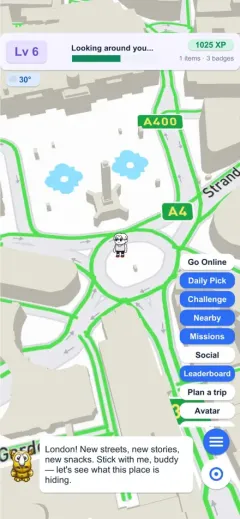
The heart of Scout is simple. Players open the map, choose a nearby landmark, museum, monument, park or market, and walk to it. When they arrive, the game confirms the visit and unlocks the story and points tied to that exact place. Real movement, not tapping, drives every reward in the game.
Feature 02
Dynamic Content for Anywhere
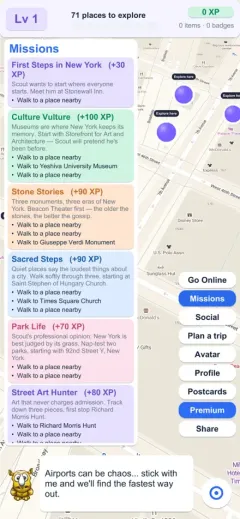
Scout is not tied to a hand made list of cities. It builds place specific missions and facts on demand, so a famous monument and an ordinary side street can both become the start of an adventure. This is what lets the game work on almost any street in the world, not just a few tourist hubs.
Feature 03
City Badges
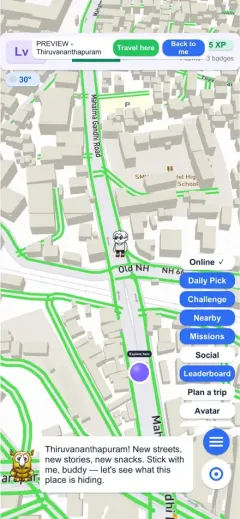
As players explore more of a place, they collect bronze, silver and gold city badges. The badges turn a run of single walks into a longer goal, giving players a clear reason to come back and see more of a city rather than stopping after a single visit or one famous sight.
Feature 04
Themed Missions
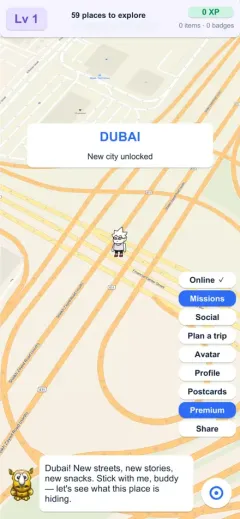
Instead of aimless wandering, Scout offers themed trails built around street art, monuments, museums and viewpoints. Each theme gives a walk a purpose and a shape, so players can pick the kind of discovery they are in the mood for, whether that is history, art or a good view.
Feature 05
Custom Walking Routes
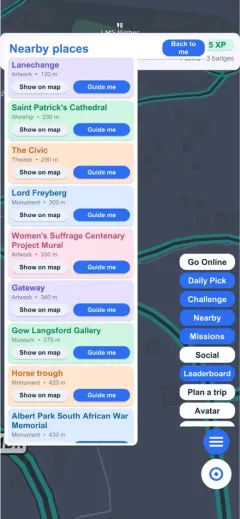
Players are not limited to what the game suggests. They can build their own walking routes, string together the places they care about, and share those routes with other players. A personal route can become a guided tour for a friend or a favourite loop to walk again and again.
Feature 06
Daily Challenges and Streaks
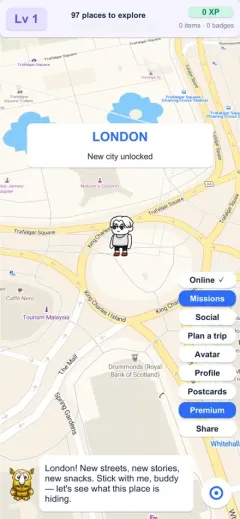
Small daily challenges and streak tracking give players a gentle push to step outside every day. A streak rewards consistency and turns exploration into a habit rather than a one off, which gives casual walkers a real reason to keep Scout in their daily routine.
Feature 07
Character Customization
Every player has an explorer they can personalise. Customising the look of the character makes the profile feel like their own and adds a light layer of identity, so the points, badges and routes a player earns belong to a character they have shaped rather than a blank account.
Feature 08
Optional Multiplayer Exploration
Scout can be a solo experience or a shared one. Multiplayer exploration is there for players who want to discover places alongside friends, and it stays off by default, so anyone who would rather explore quietly and privately can do exactly that without extra setup.
Feature 09
Real World Rewards
Exploration in Scout can reach beyond the screen. Regular players can earn real world perks, including physical postcards and practical extras such as airport exit guides. These rewards tie the game back to the real travel and walking it is built to encourage.
Feature 10
Turn by Turn Navigation
Getting to each destination is part of the fun, so Scout gives clear turn by turn walking directions. Players always know where to head next, which keeps their attention on the discovery and the world around them rather than on working out the route for themselves.
What Did Scout Achieve?
Scout shipped as a location based game that turns everyday walking into play, without limiting itself to a short list of cities.
- A walking game that works on almost any street in the world, thanks to content generated for any location.
- A calm, safe design with no monsters and no combat, built around real exploration.
- A full progression system of experience points, city badges, daily challenges and streaks.
- Availability across iPhone, iPad, Mac and Apple Vision Pro, in ten languages.
- A bridge between screen and street, with real world rewards for players who keep exploring.
Built by a Team That Builds Games for a Living
Scout was built by NipsApp Game Studios, a game development studio founded in 2010 with teams in India and the UAE. Over more than sixteen years the studio has delivered more than 3,000 projects for clients across 25 plus countries, with verified reviews on Clutch, Google, GoodFirms and Trustpilot.
Location based games like Scout sit at the harder end of mobile development. They combine live GPS, mapping, content that has to work almost anywhere and a reward loop that has to feel good on a real walk. Building one to production quality takes a team that has shipped this kind of system before.
View Scout on the App StoreView Scout on Google PlayRelated Case Studies
Explore more of the games and interactive experiences NipsApp Game Studios has shipped across mobile, VR, AR, blockchain, and beyond.


 View on Apple Maps
