Reviewed by: The NipsApp game development team
Published: 7 September 2026 | Last updated: 7 September 2026 | Reading time: 15 min
You have the client, the game idea, or the market opportunity. What you may not have is an internal team of game designers, Unity or Unreal developers, artists, backend engineers, and QA testers ready to build it.
That is where a white label game development company comes in.
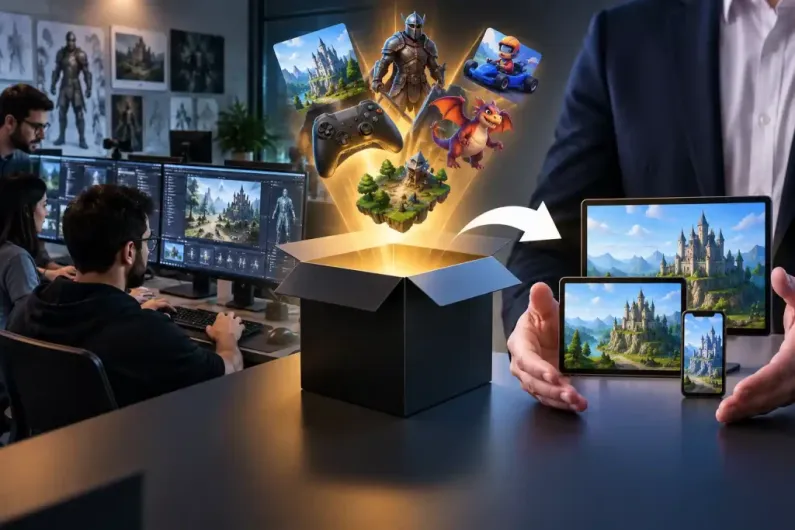
White label game development allows an agency, publisher, startup, software company, marketing firm, or another game studio to outsource the actual production of a game while releasing it under its own brand.
To the end client or player, your company is the face of the project. The development partner works behind the scenes.
For businesses that want to offer game development without building a large permanent production team, this can be a practical way to take on larger projects, enter new markets, and increase development capacity.
What Is White Label Game Development?
White label game development is an outsourcing model where one company develops a game for another business that intends to market, publish, deliver, or resell the finished product under its own name.
The development studio may handle:
- Game design
- Unity or Unreal Engine development
- 2D and 3D art
- UI and UX
- Animation
- Multiplayer development
- Backend systems
- Admin panels
- APIs
- In-app purchases
- Advertising integrations
- Testing
- Deployment
- Updates and maintenance
The branding presented to the final customer belongs to the company that hired the development team.
A white label arrangement can cover a complete game or only part of the production process.
For example, a digital agency may design the concept and communicate with its client while its white label development partner handles Unity programming, game art, backend development, testing, and final builds.
Another game studio may already have its own developers but need an outside team to quietly complete additional levels, multiplayer features, environments, or mobile ports.
The arrangement depends on the project.
White Label Does Not Always Mean a Ready-Made Game
This is an important distinction.
People sometimes use “white label game” to describe an existing game that can simply be reskinned with another logo and colour scheme.
That is one type of white label product, but it is not the only one.
There are generally two ways white label game development works.
Ready-Made White Label Games
The development company already owns a functioning game or base framework.
The client changes things such as:
- Logo
- Company name
- Colours
- Characters
- UI
- Game title
- Selected assets
- Monetisation settings
This model works when speed matters more than having a completely original game.
Custom White Label Game Development
The game is developed specifically for the client, but the development company stays behind the scenes.
The client may provide the concept, design requirements, target platform, game mechanics, or end-client specification.
The white label development team then builds the product according to those requirements.
This gives the client much more control over gameplay, art direction, technical architecture, monetisation, backend systems, and future updates.
For agencies and companies dealing with larger client projects, custom white label development is usually the more useful model.
Why Do Companies Use White Label Game Development?
Building a complete game department is expensive.
A serious game project may need developers, artists, animators, UI designers, technical artists, game designers, backend developers, QA testers, and project managers.
Hiring all those people permanently makes little sense if game development is only one part of your business.
White label development changes that.
You can bring in an existing production team when you need one.
You Can Offer Services Outside Your Internal Skills
Consider a software agency that mainly develops websites and mobile applications.
One of its existing clients suddenly asks:
“Can you build us a Unity game for our marketing campaign?”
Turning down the project means losing revenue and possibly sending an existing client to another company.
Hiring an entire game team for one project also makes little sense.
A white label game development partner allows the agency to accept the project while the specialist production team handles the game.
You Can Take on More Projects
Even established game studios sometimes reach their production limit.
You may have three projects running and receive a fourth project that your internal team cannot start for another two months.
White label production gives you temporary development capacity without permanently increasing payroll.
Your Brand Stays in Front
In a proper white label relationship, the development partner does not need to approach your client or place its branding inside the product.
Communication structure can be agreed before production starts.
Some clients prefer the white label team to have no direct contact with the end customer.
Others allow developers to join technical meetings while representing themselves as part of the client’s extended production team.
Both models can work.
What matters is agreeing on the arrangement before development begins.
Who Usually Needs a White Label Game Development Company?
White label development is useful far beyond traditional game publishers.
Digital and Marketing Agencies
Agencies frequently receive requests for:
- Branded games
- Promotional games
- Event games
- WebGL experiences
- AR campaigns
- Interactive installations
- Gamified applications
Instead of building a game department internally, the agency can work with a specialist studio.
Software Development Companies
A software company may understand databases, websites, SaaS products, or mobile applications extremely well but have little experience with real-time game engines.
Unity and Unreal projects require a different development pipeline.
White label support lets that company add game development to a broader software contract without pretending its existing developers are game specialists.
Game Publishers
Publishers may need complete games, prototypes, ports, additional content, or development support for several titles at the same time.
White label studios can provide that production capacity.
Other Game Studios
This is more common than players realise.
One game studio may outsource:
- Art
- Environments
- Multiplayer
- UI
- Mobile development
- Console porting
- Level production
- QA
- Backend development
to another studio.
Unity itself describes development arrangements where external teams can supplement an existing team or take responsibility for complete custom development. This type of distributed production has become a normal part of modern game development. Unity Studio Productions
Startups
A startup may have a game concept and funding but no internal development department.
Instead of spending months recruiting individual employees, it can begin with an established team.
What Should a White Label Game Development Company Actually Handle?
A good white label partner should be able to take responsibility for more than programming.
The exact services depend on the contract, but complete production commonly includes the following.
Planning and Technical Scoping
The development team should first turn the idea into something that can actually be built.
That means defining:
- Platforms
- Core mechanics
- Game modes
- Multiplayer requirements
- Art requirements
- Backend requirements
- Monetisation
- Third-party integrations
- Admin requirements
- Milestones
- Testing requirements
Skipping this stage is one of the easiest ways to create budget disputes later.
Game Design
Some clients already have a full game design document.
Others arrive with little more than a rough concept.
A full-cycle development company should be able to convert that concept into gameplay systems, progression, controls, levels, rewards, economies, and player flows.
Unity and Unreal Engine Development
The engine should be selected based on the game rather than habit.
Unity is commonly used for mobile, casual, WebGL, AR, VR, simulation, and cross-platform projects.
Unreal Engine is often chosen for projects that need high-end 3D visuals, large environments, complex rendering, or PC and console-focused production.
A white label partner that understands both can recommend the right approach instead of forcing every project into the same stack.
Art and Animation
Depending on the project, production may involve:
- Concept art
- Character design
- 3D modelling
- Texturing
- Rigging
- Animation
- Environment art
- UI assets
- VFX
- Technical art
Keeping art and development coordinated is particularly useful because beautiful assets that perform badly on the target hardware can create major problems later.
Multiplayer and Backend Development
White label projects can go well beyond simple single-player games.
They may require:
- Authentication
- Matchmaking
- Leaderboards
- Inventories
- Player profiles
- Cloud saves
- Tournaments
- Real-time multiplayer
- Admin systems
- Analytics
- Server-side game logic
These systems should be planned from the beginning.
Trying to turn a single-player architecture into a multiplayer product late in development usually costs more than planning multiplayer properly from day one.
Where NipsApp Fits Into White Label Game Development
NipsApp Game Studios works with agencies, startups, publishers, companies, and other development teams that need game production handled externally.
Founded in 2010, the studio has worked across Unity and Unreal Engine projects covering mobile, PC, WebGL, VR, AR, multiplayer, simulations, and other interactive products.
For white label projects, NipsApp can work as the production team behind the client’s own brand rather than positioning itself in front of the end customer.
That can include anything from a prototype or individual development workstream to complete production covering design, art, development, backend systems, QA, and deployment.
This model is particularly useful for agencies and software companies that already have the customer relationship but need a dedicated game development team to deliver the technical side.
NipsApp also works on traditional outsourced and co-development projects. You can read more about how this production model has developed in our guide to game development outsourcing.
Source Code and IP Ownership Need to Be Clear
This is one of the first questions you should ask any white label game development company.
Who owns the final product?
Do not leave this unclear until the final milestone.
The contract should define ownership of:
- Source code
- Custom artwork
- 3D models
- Animations
- UI files
- Backend code
- Game design documents
- Project files
- Custom tools
- Database structures
- Original audio
- Store assets
Third-party assets need separate attention.
A studio cannot transfer exclusive ownership of something it licensed from the Unity Asset Store, Unreal Marketplace, a stock library, or another third-party provider.
Those licences have their own rules.
The project documentation should clearly separate original client-owned work from licensed third-party material.
Confidentiality Matters More in White Label Work
Normal outsourcing and white label outsourcing are not quite the same.
With standard outsourcing, everybody may know which studios are involved.
With white label production, discretion may be part of the service.
An agency may not want its end client knowing that another studio produced the game.
A publisher may not want an unreleased title appearing in a developer’s portfolio.
A development company may be subcontracting work under a contract that prevents public disclosure.
That makes NDAs, portfolio restrictions, client-contact rules, and confidentiality terms particularly important.
Before production starts, both sides should agree on whether the development company can:
- Mention the project publicly
- Display screenshots
- Include the game in its portfolio
- Name the end client
- Publish a case study
- Contact the end client directly
There should be no assumptions.
How Much Does White Label Game Development Cost?
There is no sensible fixed price for “a white label game.”
A basic branded 2D promotional game and a multiplayer 3D game with a custom backend are completely different products.
Cost normally depends on:
- Game type
- Number of platforms
- Art style
- Number of levels
- Multiplayer requirements
- Backend complexity
- Characters and animations
- Custom UI
- Admin panel
- Monetisation
- Third-party services
- Testing requirements
- Localization
- Post-launch support
There is also a big difference between reskinning an existing framework and developing a custom game from the ground up.
A reliable company should ask about the actual scope before giving you a number.
Be cautious when someone offers a fixed price before understanding what needs to be built.
Can a White Label Partner Communicate Directly With Your Client?
Yes, but only if you want that.
There are usually three working models.
Behind-the-scenes model:
Your company handles all communication. The development team communicates only with you.
Technical support model:
Your company manages the client relationship, but developers join meetings when technical questions need to be answered.
Extended-team model:
The white label developers effectively operate as members of your own production team during the project.
There is no universally correct option.
Choose whichever protects your client relationship while keeping communication efficient.
What Should You Check Before Hiring a White Label Game Development Company?
Do not choose a partner only because their hourly rate looks attractive.
Ask practical questions.
Can they show games that are already playable?
Do they have both developers and artists internally?
Who handles QA?
Can they provide the complete source project?
Can they work under an NDA?
Will they agree not to contact your client independently?
Who owns the finished code and original assets?
Can another development team continue the project later?
How are changes handled?
What happens after launch?
Who controls the developer accounts, servers, analytics, and third-party services?
Those answers tell you far more than a polished sales presentation.
White Label Development vs Hiring Freelancers
Freelancers can work well when the job is narrow.
If you need one animator, one developer, or one 3D artist, there may be no reason to hire a full studio.
The problem comes when a project needs eight different disciplines at once.
Someone then has to coordinate:
- Developers
- Artists
- Animators
- Designers
- Backend engineers
- QA
- Build releases
- Documentation
If your company already has a strong internal producer, managing several freelancers may work.
If you want one team to be responsible for the complete build, a white label development company is usually easier to manage.
Should You Choose White Label or Build an Internal Team?
Build internally when game development is going to become a permanent core part of your company.
Use white label production when:
- Demand changes from month to month
- You need skills your team does not have
- You want to enter game development without building a department
- You have more work than your existing developers can handle
- A client needs a game outside your normal service area
- You need a complete team quickly
- You want your own company to remain the customer-facing brand
Some businesses eventually use both.
They keep producers, designers, or technical leads internally while using outside teams for production.
That can give the company control without carrying the cost of a large permanent workforce.
A White Label Partner Should Make Your Company Look Better, Not Create More Work
The point of hiring a white label game development company is not simply to get cheaper developers.
It is to give your company production capacity that it does not currently have.
The final game still carries your reputation.
Your client will not care that development was outsourced if the build crashes, deadlines are missed, or promised features do not work.
So choose the development partner as carefully as you would choose your own employees.
Look at real production experience. Check whether they understand the target platform. Establish IP ownership. Decide communication rules. Agree on milestones. Make sure you receive source files and documentation.
When those things are handled properly, white label game development can let an agency, publisher, startup, or software company take on projects that would otherwise be outside its reach.
And to the end customer, the experience can remain completely under your own brand.
Frequently Asked Questions
What is a white label game development company?
A white label game development company builds games for another business that can publish, sell, or deliver those games under its own brand. The development company normally works behind the scenes.
Can a white label game be completely custom?
Yes. White label development does not have to mean reskinning an existing game. A company can develop an original game specifically for your requirements while your business retains the customer-facing brand.
Do I receive the game source code?
That depends on the contract. If source-code ownership is important, make sure it is specifically included before development begins.
Can agencies outsource client game projects?
Yes. Digital agencies, marketing companies, software companies, and consultancies commonly use external development teams when their clients request game or interactive development that falls outside their internal skills.
Can white label developers work under an NDA?
Yes. Confidentiality agreements are normal for projects where the end client, game concept, source code, or business relationship must remain private.
Can the development company contact my customer?
That should be decided contractually. A true behind-the-scenes white label arrangement can prohibit direct communication with your customer unless you specifically approve it.
What game engines can be used for white label development?
Unity and Unreal Engine are two common choices. The right engine depends on the target platforms, visual requirements, gameplay, performance needs, and future plans for the game.
Is white label game development suitable for multiplayer games?
Yes. A white label team can develop multiplayer games, but networking, backend architecture, authentication, matchmaking, server authority, and hosting should be planned early in production.
Does NipsApp provide white label game development?
Yes. NipsApp Game Studios can work as an external production team for agencies, companies, publishers, startups, and other studios, including arrangements where the finished work is delivered under the client’s own brand.
 View on Apple Maps