Author – Sneha, Content Lead, NipsApp Game Studios
Reviewed by the NipsApp VR and simulation development team
Published: 29 August 2026 | Last updated: 29 August 2026 | Reading time: 15 min
Technical details checked against Epic Games documentation for Unreal Engine 5.8 as of August 2026.
Quick Answer
A good VR training simulator is not a normal VR game with a training label added to it.
The real job is to reproduce the decisions, actions, mistakes, timing, equipment use, and consequences that matter in the real task, then measure how the trainee performs.
That is why a visually impressive VR environment can still be a poor training product.
Before choosing Unreal Engine, a headset, or even a development studio, define what the trainee should be able to do after the session. Then decide how accurately the simulator needs to reproduce the real task, what hardware it will run on, what data needs to be recorded, and how trainers will review performance.
For a small proof of concept, development can start below USD 15,000. A production training module with custom environments, scoring, analytics, and standalone VR support commonly moves into the USD 15,000 to 40,000 range. Multi-module enterprise systems, advanced physics, multiplayer training, equipment integrations, and high-end PC VR can move well beyond that.
The biggest mistake is paying for realism that has no training value while ignoring the systems that actually decide whether someone learned the task.
1. Should this training even be built in VR?
This is the first question, because not every training problem needs a headset.
VR makes the most sense when the employee needs to practise doing something rather than simply learn information.
Reading a company policy does not normally need VR.
Learning how to shut down industrial equipment during a fire may.
VR is usually a good fit when the real task is:
- Dangerous to practise repeatedly
- Expensive to reproduce physically
- Dependent on spatial awareness
- Based on equipment operation
- Difficult to organise for large groups
- Rare but high-risk
- Dependent on a sequence of physical actions
- Affected by time pressure or environmental conditions
Fire response is a straightforward example.
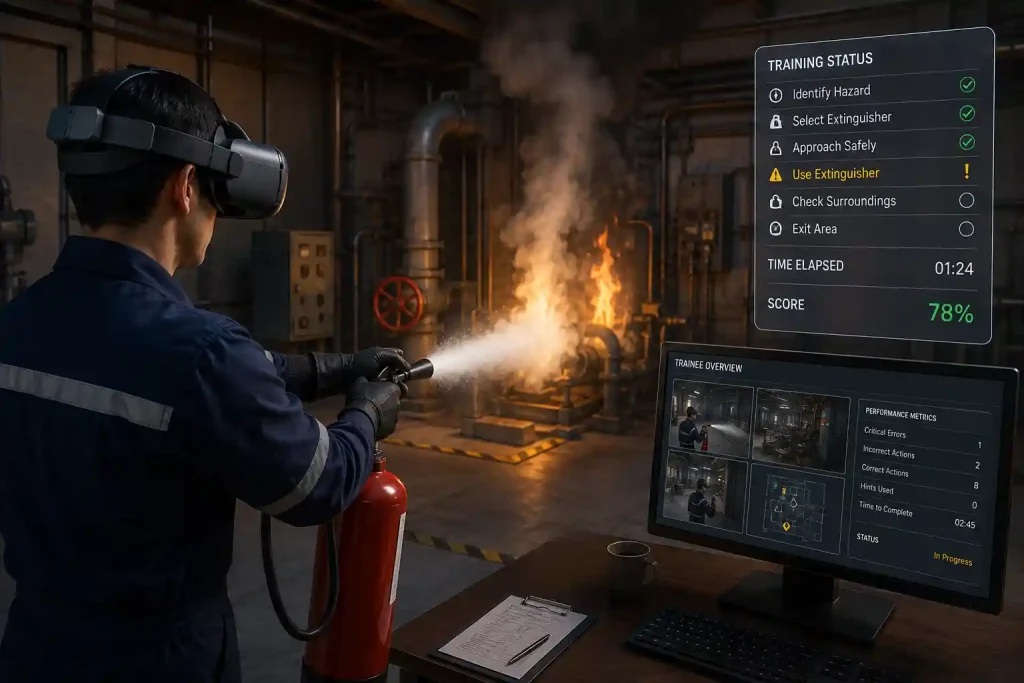
Watching a video can teach an employee what an extinguisher looks like. It cannot properly test whether that employee identifies the correct extinguisher, approaches the fire safely, follows the procedure, reacts within the expected time, and avoids a dangerous action.
A simulator can.
When VR is probably unnecessary
If the learning objective is mainly remembering information, answering policy questions, completing simple onboarding, or watching demonstrations, a browser-based training application may be cheaper and easier to maintain.
That distinction should be made before production starts.
A company should not build VR because VR looks impressive in a presentation. It should build VR when physical participation changes what can be learned or measured.
2. What exactly should the trainee be able to do?
“Build a safety training simulator” is not a usable production requirement.
Neither is “create an immersive training experience.”
The development team needs observable actions.
For example:
The trainee must identify an electrical fire, select the correct extinguisher, maintain the required distance, use the extinguisher correctly, check the exit path, and complete the procedure within the permitted time.
Now the simulator has something it can actually test.
Four different things VR can train
Knowledge
Does the trainee know what something is?
This includes identifying equipment, recognising signs, choosing the correct tool, or recalling a procedure.
Procedure
Can the trainee complete the correct actions in the correct order?
This is common in maintenance, manufacturing, healthcare, aviation, laboratory, and emergency-response training.
Physical interaction
Can the trainee use a tool or piece of equipment correctly?
This may involve controller movement, hand tracking, equipment replicas, haptic hardware, or tracked physical controls.
Decision making
Can the trainee make the right choice when circumstances change?
This is where branching scenarios become useful.
A machine may overheat. A patient may deteriorate. Smoke may block the normal exit. A cockpit warning may appear halfway through another procedure.
The simulator should react to the trainee rather than wait for a scripted animation to finish.
Define failure before development starts
For every task, the team should know:
- What counts as success?
- What counts as a minor error?
- What counts as a critical error?
- Can the trainee recover from the error?
- Should the simulator stop immediately?
- Should the error affect the final score?
- Does the instructor need to review it later?
Training logic becomes much easier to build once these rules exist.
Without them, development becomes a collection of interactions rather than a training system.
3. Which VR hardware should the simulator target?
This decision changes almost every technical choice that follows.
There is a major difference between building for a standalone headset and building a simulator around a high-end PC.
Standalone VR
Devices such as Meta Quest are useful when a company needs easy deployment across many locations.
There is no gaming PC beside every trainee. The headset can be stored, transported, configured, and deployed as a relatively self-contained unit.
This works well for:
- Employee safety training
- Warehouse training
- Basic equipment procedures
- Medical education
- Classroom deployment
- Remote training locations
- Large headset fleets
The trade-off is rendering power.
A standalone headset cannot be treated like a desktop RTX workstation. Scene complexity, lighting, materials, shaders, particle effects, shadows, and geometry all need to be designed around the actual device.
PC VR
A workstation-connected headset gives the development team a much larger rendering and simulation budget.
That makes sense for projects involving:
- High-detail machinery
- Complex physics
- Flight or vehicle simulation
- Detailed medical environments
- High-fidelity digital twins
- Large environments
- Specialist training centres
- External physical controls or simulators
The downside is deployment cost and setup.
A company rolling training out to 200 sites may prefer a simpler standalone application even if the PC version could look better.
Do not pick a headset after development
This causes expensive rework.
A scene designed around desktop rendering may need major changes before it performs properly on standalone VR.
Headset, target frame rate, interaction method, deployment model, and minimum visual quality should be agreed during pre-production.
Where OpenXR helps
Unreal Engine supports OpenXR for head-mounted VR development on Windows and Android.
OpenXR gives teams a common layer for functions such as headset tracking and controller input across supported hardware rather than building the entire interaction system around one device.
That does not mean every device-specific feature becomes universal.
Hand tracking, eye tracking, passthrough, spatial mapping, and other advanced functions can still require device-specific extensions or vendor plugins.
That difference should be discussed when a proposal claims the same build will support every headset.
4. How realistic does a VR training simulator need to be?
There are two different kinds of realism.
Companies often pay heavily for one while forgetting the other.
Visual realism
This covers:
- 3D model quality
- Materials
- Lighting
- Environment detail
- Character quality
- Animation
- Effects
- Equipment appearance
Visual accuracy matters when the trainee needs to recognise the real environment or equipment.
But more polygons do not automatically create better training.
Behavioural realism
This is usually more important.
Does a valve turn the way the real valve turns?
Does a machine reject the wrong component?
Does the fire react to the wrong extinguisher?
Does the virtual patient respond correctly to the trainee’s actions?
Can steps be performed in the wrong order?
Can the user make a real mistake?
Does the simulator reproduce the consequence of that mistake?
A simple-looking simulator with accurate behaviour can teach more than a beautiful environment where every interaction has been simplified.
Digital twin or training approximation?
Not every simulator needs to reproduce a complete factory, aircraft, operating room, or machine.
Sometimes only one workstation matters.
If an employee is learning a ten-step maintenance procedure on one pump, recreating the entire building may add cost without improving the training.
The right question is not:
“How realistic can we make it?”
It is:
“Which parts must be accurate for the trainee to learn the task correctly?”
That question can cut a large amount of unnecessary production work.
5. What does Unreal Engine 5.8 actually bring to VR training?
Unreal Engine is often chosen because people associate it with high-end graphics.
For training, the more useful reason is that the engine combines real-time 3D rendering, physics, interaction logic, animation, networking, UI, profiling, and XR support inside one development environment.
OpenXR
Epic’s Unreal Engine XR documentation explains how OpenXR is used for head-mounted VR and AR development across supported systems.
Controller actions can be mapped through OpenXR interaction profiles, reducing the amount of device-specific input work required for normal controller interactions.
That becomes useful when a training application needs to run across more than one approved headset.
Blueprints and C++
Training simulations often contain large amounts of procedural logic.
For example:
- Is the machine powered down?
- Did the trainee isolate the correct switch?
- Was the safety lock applied?
- Was the panel opened only after isolation?
- Was the correct component removed?
- Was it replaced in the correct orientation?
- Was the system inspected before restart?
Unreal’s Blueprint system makes a large part of this interaction logic visible and easier to test, while C++ can handle systems that require lower-level control or more complex architecture.
Physics
Physics is useful when object behaviour itself is part of the lesson.
That could include dropping equipment, moving components, operating doors, manipulating tools, handling objects, reproducing collisions, or training around physical constraints.
But physics should not be added simply because it is possible.
A controlled interaction that always reproduces the required procedure can sometimes be better for training than unrestricted physics.
Unreal’s visual features need a VR reality check
One technical point matters here.
A studio should not show an Unreal cinematic and tell a buyer that the VR build will look exactly the same.
It may not.
Epic’s Unreal Engine 5.8 documentation states that Lumen is not currently supported for VR systems, with VR’s high frame-rate and resolution requirements making dynamic global illumination difficult for this use case.
That changes lighting decisions.
VR teams often need to use a carefully planned mix of baked lighting, simpler real-time lighting, reflection techniques, Forward Shading, performance-friendly materials, and device-specific rendering choices.
A proposal should describe the visual target on the target headset, not show a desktop render and call that the expected result.
6. What causes VR training applications to feel uncomfortable?
Performance is not cosmetic in VR.
A normal application can briefly drop frames and the user may barely notice.
In a headset, unstable performance can make the experience physically uncomfortable.
Epic’s VR performance documentation describes frame-rate consistency as particularly important and notes that at 90 Hz the available GPU frame time is slightly below 11 milliseconds after accounting for reprojection overhead.
That is a small budget.
The common mistake
Teams build the environment first.
They add high-resolution textures, expensive materials, dynamic shadows, transparent surfaces, particle systems, dense geometry, post-processing, and dozens of interactive objects.
Then they put it on the headset.
That is backwards.
Performance should be tested on the real target hardware throughout production.
Comfort is also a design problem
Even a perfectly performing application can be uncomfortable if movement is badly designed.
Training projects need clear rules for:
- Teleportation
- Smooth locomotion
- Snap turning
- Physical room-scale movement
- Vehicle movement
- Camera acceleration
- Forced camera movement
- Standing versus seated use
- Reach distances
- Interaction height
- User calibration
Forced camera movement is particularly dangerous.
Moving a virtual camera while the user’s inner ear says the body is stationary can create discomfort quickly.
Test the actual working conditions
Do not only test with developers.
Test with people wearing:
- Safety glasses
- Gloves
- Prescription glasses
- Uniforms
- PPE
- Head coverings
- The same physical equipment used at the training site
A controller interaction that works perfectly at a developer’s desk may become awkward when a trainee is wearing industrial gloves.
7. How should the simulator measure whether the trainee actually learned something?
Completion is not enough.
If someone reaches the end of the simulation, that only proves they reached the end.
A proper VR training simulator should create a record of how they performed.
Useful training data can include:
- Task completion time
- Correct and incorrect actions
- Number of attempts
- Procedure order
- Critical mistakes
- Safety violations
- Objects used
- Wrong tool selections
- Reaction time
- Instructor interventions
- Hints requested
- Scenario choices
- Areas where the trainee hesitated
- Repeated mistakes
- Final score
- Pass or fail status
This data can feed a training dashboard, company backend, LMS, or other reporting system.
Do not build the dashboard last
Analytics often get treated as something that can be attached once the VR application is finished.
That is a mistake.
If the application was not designed to record meaningful events, the dashboard has little to display.
The event structure should be defined with the training procedure.
For example:
Extinguisher_Selected
is useful.
But:
Extinguisher_Selected: CO2Fire_Type: ElectricalCorrect_Selection: TrueTime_From_Alarm: 14.2 seconds
is much more useful.
Now the company can compare trainees, identify repeated problems, and measure improvement between sessions.
Training needs evidence
If a company is spending money replacing or supplementing physical training with VR, it should be able to answer:
“Did people get better?”
The simulator should be designed to help answer that question.
8. Should VR training be single-player or multi-user?
Single-user training is easier to build, deploy, and maintain.
It is also enough for many procedural tasks.
But many real-world jobs depend on teams.
Fire response, healthcare, aviation, security, industrial operations, emergency management, and defence training often require people to communicate and coordinate rather than act alone.
That creates a different class of simulator.
Multi-user training can include:
- Multiple trainees in one scenario
- Dedicated instructor role
- Observer mode
- Voice communication
- Shared equipment state
- Role-based permissions
- Instructor-triggered failures
- Scenario reset controls
- Live performance monitoring
- Session recording
- Team scoring
- Individual scoring
Networking is not just avatars
Putting four avatars in the same room is easy compared with synchronising the actual training state.
If one trainee shuts a valve, every other participant must see the same valve state.
If an instructor triggers an electrical failure, the change needs to happen for everyone.
If two trainees try to operate the same control, the simulator needs rules for who has authority.
The backend also needs to know which person performed each action.
That is the work hidden behind “multiplayer VR training.”
Instructor mode deserves its own design
In many enterprise projects, the instructor interface becomes almost as useful as the trainee interface.
An instructor may need to:
- Start a scenario
- Pause it
- Create an emergency
- Change difficulty
- Observe without being seen
- Teleport between trainees
- Review errors
- Replay events
- End a session
- Add manual scores
- Export reports
If trainers cannot control the simulator easily, adoption becomes harder no matter how good the VR content is.
9. How much does an Unreal Engine VR training simulator cost, and how long does it take?
There is no useful single price for VR training because a five-minute safety procedure and a multiplayer aircraft simulator are not comparable projects.
The ranges below are practical 2026 planning numbers, not fixed quotes.
Typical development ranges
Proof of concept: USD 8,000 to 15,000
Usually:
- One environment
- One short procedure
- Basic interaction
- Basic scoring
- One headset target
- Limited custom content
The goal is to prove the training method before committing to a larger system.
Production training module: USD 15,000 to 40,000
Usually:
- Custom 3D environment
- Detailed procedure logic
- Failure states
- Scoring
- User management
- Analytics
- Polished interaction
- Standalone or PC VR deployment
- Trainer testing
Multi-module enterprise platform: USD 40,000 to 100,000+
May include:
- Multiple training modules
- Admin dashboard
- Trainee accounts
- Instructor controls
- Reporting
- LMS or backend integration
- Multiple headset support
- Central content management
- Cloud data storage
Advanced simulator: USD 60,000 to 150,000+
Typical reasons for moving into this range include:
- High-fidelity physics
- Multi-user networking
- Custom hardware
- Haptic devices
- Vehicle or cockpit systems
- Large digital twins
- Advanced medical simulation
- Complex equipment behaviour
- External sensor integration
- Large numbers of scenarios
What actually drives the cost?
The biggest cost drivers are usually:
- Number of procedures
- Number of interactive objects
- Required equipment accuracy
- Number of possible failure states
- Custom 3D asset work
- Physics requirements
- Hardware integration
- Multi-user networking
- Analytics and admin requirements
- Number of target headsets
The duration of the training session itself is a poor way to price a simulator.
A seven-minute aircraft emergency procedure can require more engineering than a 30-minute warehouse walkthrough.
A normal production schedule
A single production module commonly takes around 8 to 16 weeks.
A practical schedule may look like this:
Weeks 1 to 2: Training analysis
Break the real procedure into actions, conditions, mistakes, scoring rules, and instructor requirements.
Weeks 2 to 4: Interaction prototype
Build the main task using temporary assets and test it on the actual headset.
Weeks 3 to 8: Environment and equipment production
Create or prepare the required 3D content.
Weeks 4 to 10: Training logic
Implement procedures, failures, branching scenarios, scoring, and feedback.
Weeks 7 to 11: Analytics and integrations
Connect accounts, reporting, dashboards, LMS systems, or internal APIs.
Weeks 9 to 13: Performance work
Profile the build repeatedly on target hardware.
Weeks 11 to 16: Training QA
Run the simulator with subject-matter experts, trainers, and real users.
Large enterprise platforms should be planned as a series of modules rather than one huge release.
10. How do I choose a VR training development studio?
A general game studio may know how to build VR interactions.
That does not automatically mean it knows how to build training.
The studio needs to understand both software behaviour and training behaviour.
Ask these questions before selecting a team
1. Can you show actual VR training work?
Ask for training projects, not only VR games.
The interaction priorities are different.
2. What did those simulators measure?
If the answer is only “completion,” ask more questions.
The studio should be comfortable discussing errors, timing, procedure validation, scoring, telemetry, dashboards, and instructor controls.
3. Which headsets have you actually deployed on?
There is a difference between opening a prototype on a device and shipping a stable application for repeated use.
4. How early do you test performance on hardware?
The correct answer should be very early.
A team planning to “optimise at the end” is taking a major risk with VR.
5. How do you turn a real operating procedure into simulation logic?
The studio should have a clear process for working with subject-matter experts and turning real procedures into actions, dependencies, conditions, mistakes, and scoring events.
6. Can the same system support future modules?
Enterprise buyers should think beyond the first scenario.
User accounts, analytics, reporting, interaction libraries, equipment assets, and core systems should be reusable.
NipsApp Game Studios’ VR training work
NipsApp Game Studios has worked in VR training development across medical training, aviation, aerospace, safety, emergency response, education, and simulation.
Its current VR training portfolio includes projects covering:
- VR medical and surgical training
- Interactive anatomy
- Cardiopulmonary care
- Neonatal training
- Fire and emergency response
- Aviation safety
- Astronaut and space training
- Hardware repair procedures
- Laboratory and chemistry training
The studio works with both Unity and Unreal Engine depending on the hardware, simulation requirements, rendering target, and existing client technology.
NipsApp was founded in 2010 and has delivered more than 3,000 projects across games, VR, AR, simulation, and real-time 3D work. Its wider case-study library includes more than 100 VR and XR builds.
Why the wider development background matters
Training simulators frequently need systems normally associated with games.
That includes:
- Physics
- AI
- Multiplayer
- State machines
- Save systems
- Analytics
- User accounts
- Character animation
- Interaction systems
- Backend development
- Performance profiling
A studio that already builds these systems does not need to invent them when an enterprise training project requires them.
The difference is that training needs stricter control over what those systems are allowed to do.
An NPC in a game can occasionally behave strangely and still be entertaining.
A virtual instructor teaching the wrong safety procedure cannot.
An honest limitation
Custom Unreal Engine VR development is not the cheapest solution for every training requirement.
If a company needs simple policy training, 360-degree video, basic quizzes, or a short guided walkthrough, an existing training platform may be faster and cheaper.
Custom development makes more sense when the task requires interaction, custom equipment, procedural logic, advanced simulation, unusual hardware, multiplayer, detailed analytics, or a level of visual and behavioural accuracy that an off-the-shelf system cannot provide.
What should I ask during the first VR training development call?
Five questions will reveal most of the project scope quickly.
- What exact real-world task should the trainee be able to perform after completing the simulator?
- Which mistakes must the simulator detect and record?
- Where will the training run, and which headset will be used there?
- Does the company need individual scoring, instructor controls, LMS integration, or a management dashboard?
- Which parts of the real environment or equipment must behave accurately, and which parts only need to look believable?
Those answers are more useful than starting a call by discussing polygon counts, Unreal features, or how realistic the graphics should look.
The technology should follow the training requirement.
Not the other way around.
Frequently Asked Questions
Is Unreal Engine good for VR training simulations?
Yes. Unreal Engine is well suited to VR training projects that require detailed real-time 3D environments, custom interaction systems, physics, animation, networking, procedural logic, analytics, or integration with external systems.
It is particularly useful for high-detail industrial, medical, aviation, defence, vehicle, and equipment simulations.
For smaller standalone applications where visual requirements are limited, Unity can also be a strong choice. The engine should be selected after the hardware and simulation requirements are known.
Can Unreal Engine VR training run on Meta Quest without a PC?
Yes, but the project needs to be designed around standalone hardware from the beginning.
The visual and rendering budget is much lower than on a PC VR system. Materials, lighting, geometry, effects, draw calls, and post-processing all need careful control.
A desktop-quality Unreal scene should not simply be exported to Quest and expected to perform correctly.
Does Unreal Engine 5 Lumen work in VR?
Epic’s Unreal Engine 5.8 documentation states that Lumen does not currently support VR systems, noting that the high frame rates and resolutions required by VR make dynamic global illumination a poor fit.
VR projects therefore need a lighting strategy designed for the target hardware rather than assuming the same rendering setup used for a desktop Unreal project.
Can a VR training simulator track employee performance?
Yes.
A custom simulator can record actions such as completion time, mistakes, failed steps, tool selections, reaction times, scenario decisions, hints used, repeated attempts, safety violations, and final scores.
That information can be sent to an admin dashboard, internal backend, or learning management system.
Can several employees train together in the same VR simulation?
Yes.
Multi-user VR training can place several trainees and instructors inside the same scenario. Shared equipment, scenario state, voice communication, team tasks, instructor controls, and individual performance data can all be synchronised.
This adds significant engineering compared with a single-user application, so it should be identified during the initial scope.
How long should one VR training session be?
There is no fixed ideal duration.
A focused procedural module may take only 5 to 15 minutes. A scenario-based exercise may run much longer.
It is normally better to break large training programs into focused modules rather than force a trainee to remain in VR for a long continuous session.
This also makes assessment easier because each module can measure a specific skill.
Can existing CAD or 3D models be used?
Usually, yes.
Engineering CAD, BIM, manufacturer models, or existing 3D assets can provide an accurate starting point.
They may still need substantial preparation before they can run efficiently in VR. This can include mesh cleanup, retopology, UV work, collision setup, material rebuilding, hierarchy changes, and performance reduction.
Supplying a model does not automatically mean it is ready for Unreal Engine.
Should a company build one large simulator or several smaller modules?
Several focused modules are normally easier to build, test, deploy, update, and measure.
A shared platform can handle accounts, reporting, interaction systems, equipment libraries, and administration while individual training modules are added over time.
This also lets the company launch the highest-priority training scenario first rather than waiting for an entire training catalogue to be completed.
 View on Apple Maps
 View on Google Maps


