Turning a Unity racing prototype into a game people finish
RideCore is a neon time-attack racer for Android, published by Orbyteon Studio and live on Google Play. It reached us as a working driving prototype with no reason to keep playing. NipsApp Game Studios added the systems that make a racing game a game: an economy, a progression ladder, unlockable cars, colour customisation, an onboarding tutorial, and an automated test suite of 150 checks that runs before every build.

Project at a glance
- Client
- Orbyteon Studio
- Product
- RideCore, neon time-attack racer
- Platform
- Android, live on Google Play
- Engine
- Unity 6 (6000.5.4f1), Universal Render Pipeline
- Services
- Game systems design, Unity development, QA automation
- Scope
- Progression, economy, customisation, onboarding, tooling
- Automated checks
- 150, run before every build
What is RideCore?
RideCore is a neon-themed 3D racing game for Android, built in Unity by Orbyteon Studio. It has time-attack, ghost and duel modes on electrified circuits where touching a wall restarts the run, plus a garage of unlockable cars with colour customisation and a progression ladder from Beginner through Pro to Legend.
The driving already worked when the project reached us. Cars handled, tracks loaded, lap times recorded. What was missing was every reason to race a second time. There was no currency, no progression, nothing to unlock, and nothing to tell a new player what the controls did.
What was the problem?
The game had no retention loop. A player could finish a race and receive nothing: no reward, no progress, no goal to chase. New players were also dropped straight onto the track with no explanation of the controls.
A racing prototype and a racing game differ mostly in bookkeeping. Someone has to decide what a lap is worth, what that buys, what the next goal is, and how the player is told about all of it. That layer was the work.
What did we build?
The progression and economy layer, the garage and customisation systems, onboarding, and the tooling that keeps all of it verifiable.
Progression and economy
- Credits awarded for finishing, winning, first completions and personal bests.
- Experience and levels on a rising curve, with rank titles from Beginner to Pro to Legend.
- A reward summary after every race showing credits earned, experience gained, the new balance, the current level and a bar filling toward the next one.
- Central tuning: every reward value, curve and price lives in one configuration asset, adjustable without touching code.
Garage and customisation
- A car shop with prices, ownership tracking and purchase confirmation.
- Unlock clarity: each locked car states exactly what unlocks it and what it costs.
- Colour customisation across eight presets, applied per material so the paintwork changes while headlights, glass and wheels keep their own colour.
Onboarding
- An action-driven tutorial that waits for the player to actually move, steer, brake and reach the goal, rather than running on a timer.
- An unobtrusive prompt in the top band of the screen, so it never covers the car and never intercepts a steering touch.
What does RideCore look like?
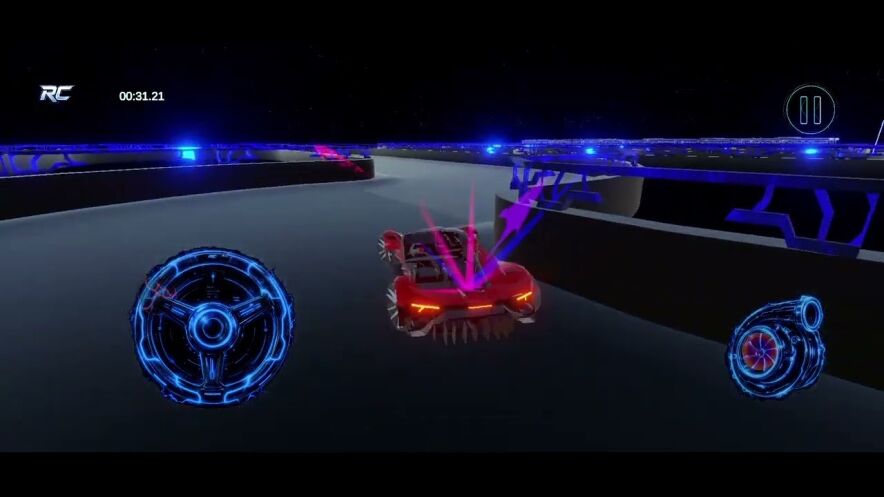
Four sides of the game: the time-attack loop, the electric walls that punish a mistake, the systems players chase, and the circuit itself.
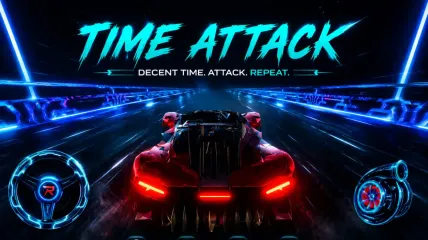
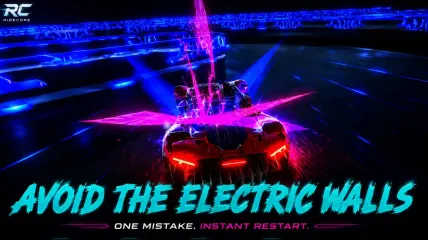
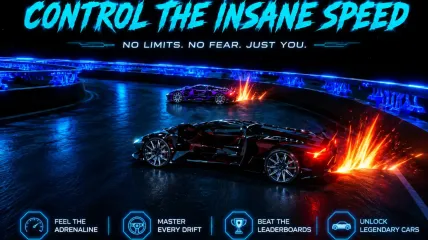

Watch RideCore in action
A gameplay walkthrough showing the time-attack loop, the reward screen, the garage and car colour customisation running on Android.
How do we know it works?
Every build is checked by an automated suite of 150 tests covering reward mathematics, car ownership rules, colour application, tutorial setup and every interface connection in both game scenes.
Most Unity breakage is silent. A reward that pays the wrong amount, a button whose click handler was never saved, a value that reads correctly in code but was stored differently in the scene file: none of these throw an error, and none are reliably caught by playing the game for ten minutes.
That suite earned its place twice on this project. It caught a set of values that had been changed in code but were still saved with their old numbers in the scene, and it caught an interface element positioned where it would have obstructed player input.
| Practice | What it gives |
|---|---|
| 150-check automated audit | Reward maths, ownership, UI wiring and scene state verified before every build |
| Additive architecture | New systems in their own folder; 72 of the 83 original scripts never modified |
| Baseline retained | The untouched original kept for reference, so any change can be proven |
| Central tuning asset | Balance changed in the Inspector without a code change or a programmer |
| Headless compile checking | The whole project type-checked without opening the editor, so feedback turns around in minutes |
How do we work on a project someone else started?
Additively, and reversibly. New systems go in their own folder, existing files are modified only where genuinely necessary, and the original is kept so every change can be verified rather than argued about.
On RideCore that meant 11 of the 83 original scripts were touched at all. The other 72 are byte-for-byte identical to the code we received. Where we did change existing files they were real defects: a crash when returning to the main menu, and two systems that tracked the same unlock separately and could disagree with each other.
The project was also moved from Unity 6000.4.3f1 to 6000.5.4f1, including resolving the compile error that had been blocking that upgrade.
Frequently asked questions
Where can I play RideCore?
RideCore is published by Orbyteon Studio and available free on Google Play for Android. Get it on Google Play.
How long does it take to add progression and an economy to an existing Unity game?
For a working prototype, a first pass covering currency, experience, levels, unlockable content and the interface to display them typically takes around three weeks. The variable is rarely the systems themselves. It is how much of the existing codebase has to be understood, corrected and safely extended first.
Can you work on a Unity project another developer built?
Yes, and much of our client work is exactly that. RideCore arrived as an existing prototype. We keep new systems in their own folder, change as little of the original as possible, and retain the untouched baseline so every modification is verifiable.
Why does automated testing matter for a small mobile game?
Because the failures that reach players are usually the quiet ones. An economy that pays the wrong number, or a button that silently lost its handler, will not crash and will not appear in a short play test. Checking them automatically is far cheaper than finding out from a review.
Do you hand over the full source code?
Yes. Clients receive the complete Unity project, all source code, the tuning configuration and written documentation, so another developer can continue the work without us.
Which Unity version does RideCore use?
RideCore was upgraded from Unity 6000.4.3f1 to Unity 6000.5.4f1 during the project, including resolving the compile error that was blocking the upgrade. It targets Android and uses the Universal Render Pipeline.
Have a game that needs finishing?
We build and complete Unity and Unreal projects for mobile, PC, VR and AR, including projects started by someone else.
RideCore is developed and published by Orbyteon Studio. NipsApp Game Studios provided game systems design, Unity development and QA automation. Key art courtesy of Orbyteon Studio.
Related Case Studies
More games and interactive experiences built by NipsApp Game Studios.


 View on Apple Maps
