Home › Case studies › Seat of Power
PC and Steam · Real-time strategySeat of Power, an ancient world RTS built for Steam by NipsApp Game Studios
A real-time strategy game of economy, war and diplomacy across four ancient cultures, built in Unity with deterministic multiplayer code so that every player in a match simulates exactly the same world.
- Developer and publisher
- Boomer Studios
- Development partner
- NipsApp Game Studios
- Platform
- Windows PC on Steam
- Planned release
- 1 March 2027
- Steam App ID
- 5545080
- Engine
- Unity, with Photon Quantum netcode
The announcement trailer
The same trailer that runs on the Steam store page.
At a glance
The short version
Seat of Power is a real-time strategy game set in the ancient world, developed and published by Boomer Studios and built with NipsApp Game Studios as development partner. It is listed on Steam under App ID 5545080 with a planned release date of 1 March 2027 for Windows PC.
Players found towns, feed and tax their people, link mines to workshops and markets, trade by caravan and ship, win over independent cities, hunt monsters, and summon a god from the temple the game is named after. Four ancient cultures each play differently, and Atlantis has a story campaign of its own. Matches run from two to eight nations, against the computer or online.
The engineering brief behind it was unusual for a strategy game of this size. Rather than send unit positions over the network, the game runs the identical simulation on every machine in a match and sends only the players' orders. That approach, called deterministic lockstep, is what lets an eight nation game with hundreds of units stay in step on an ordinary internet connection, and it is the part of the project NipsApp was brought in to build.
A kingdom that has to be run, not just built
Towns in Seat of Power grow on food and trade. Townspeople either farm or staff your buildings, so every worker you move is a loaf of bread you no longer bake. Mines dig copper and clay, logging camps cut timber, and workshops turn raw material into goods your markets can sell. Each culture also owns a resource no one else produces: silk, linen, olive oil or obsidian tools.
Caravans and tradeships carry those goods to distant markets, which is how a town far from the front line becomes worth defending. Tax pays for all of it, and every tax you collect costs loyalty. Push a town too hard and it breaks away from you.


Four cultures that play differently
Faction identity is written in data rather than hard coded, so each culture is a set of numbers and traits the designers can tune without touching the game's code. The four play as follows.
The Chinese
Population and industry
Larger, faster growing towns, bigger work crews and fort garrisons, and the cheapest spearmen to keep. Ge Infantry wound every enemy around their target and Chu-Ko-Nu crossbowmen shoot fast. The Palace proclaims imperial edicts, and even an empty fort wears down the towns near it.
The Egyptians
Trade
The highest taxes, extra profit on every foreign sale, and larger, faster caravans. Khopesh Infantry ignore most enemy armour, backed by Medjay Archers. The Pyramid's patron blesses the realm more with every year that passes, and Ra costs half the mana to keep.
The Greeks
Elite soldiers and diplomacy
Soldiers with more armour and health who train half again as fast but cost twice as much to keep. Tower Shield Infantry hold the line while Peltasts harass. Colonists found colonies, the Senate sets policy, city states favour you and spies train sharper. Towns stay smaller.
The Olmecs
Numbers and monster hunting
Fragile but cheap soldiers, farms that grow more food, and Atlatl Throwers ready from day one who slow whatever they hit. Jaguar Warriors charge down archers. They hit the Umai harder, draw more mana from them, and their harbours launch twice the canoes.
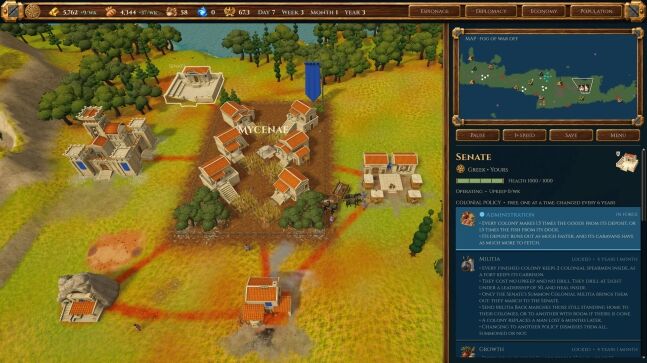

Winning the map, not only the war
Independent towns are won with forts, trade, bribes or force. City states grant favour in return for trade and quests. Mercenaries, spies and officers are all for hire. Be the first to earn the full trust of the Atlantean expedition through trade and its cannon, the Godslayer, becomes yours.
Diplomacy runs alongside it: sign treaties, demand tribute or declare war. Spies dressed in another nation's colours sow dissent, sabotage buildings, bribe commanders or assassinate. A player who never builds an army can still lose the map, and a player who only builds an army usually does.
The Umai
Monsters breed in lairs across the map. Karkath swim the seas while Khemruk, Xalotlan and Zhuang Gui hold ground. They ignore you until you strike their lair, and then they pour out and hunt whoever attacked. Clear one and it pays gold, mana, veterancy and city state favour, and the empty pit can carry a shrine.
Atlantis, the campaign
A volcano has buried Atlantis in ash. As King Ozer you build a holdout on the coast, take in refugees, mine iron and fill storehouses for fleets of steam galleys, while the Restorationists race to mend the ancient Arch. Expeditions go out to make contact with the rest of the world.
Armies that hold a line
Soldiers are recruited at forts, put under a general or the king, and drilled. Light, Ranged, Shock and Heavy troops counter one another, and a soldier who survives enough fighting climbs from Recruit to Elite, so a veteran army is worth protecting rather than spending. Research improves weapons, armour, farms and workshops, and warships carry the fight to sea.
Armies march in formation with melee troops ahead of ranged, engage on their own when an enemy comes into range, and attack a building at the edge of its footprint rather than its centre point. A garrison stationed in a fort stays inside until the settlement it protects is attacked, comes out to fight, and marches back in when the fighting stops. If the king falls a new one is crowned, but your reputation pays the price.

How the game is built
Most online games send positions and states across the network many times a second. A strategy game cannot afford that: hundreds of units, each with orders, inventories and morale, would saturate the connection. Seat of Power takes the other route. Every machine in a match runs the same simulation, and only the players' orders travel. The catch is that the simulation has to produce an identical result everywhere, down to the last digit, forever. One divergent calculation and the match silently splits into two different worlds.
NipsApp built that simulation as a standalone C# core that knows nothing about Unity, so it can be tested on its own and run inside Photon Quantum for multiplayer.
Fixed point arithmetic
No floating point anywhere in the simulation. Floats round differently across processors, which is enough to desynchronise a match, so all distances, damage and speeds use fixed point maths.
Seeded randomness
Every roll, from a soldier's experience ceiling to where a monster lair appears, comes from a seeded generator, so one seed always rebuilds exactly the same world and the same match.
Whole world checksums
The state of every town, unit, caravan and treasury is hashed as the match runs. Two machines that disagree by one unit's position can be caught immediately rather than ten minutes later.
Everything in config files
Costs, stats, growth rates and faction traits live in JSON rather than code, so balance passes and new factions do not need a programmer or a rebuild.
A gate that runs before every change
206 invariant checks covering economy, loyalty, diplomacy, espionage and battle, plus more than 700 automated tests, run on the simulation before any change is accepted.
Replays as proof
A recorded match is replayed from its orders and must produce a bit identical result, and long soak runs are used to confirm that a game can run for in-game decades without drifting.
What NipsApp worked on
The studio's work on Seat of Power covers the simulation that runs underneath the game and a large part of the client that draws it:
- The deterministic simulation core: economy and production chains, population, food and famine, loyalty and taxation, research, diplomacy and treaties, espionage and counterspies, independent towns and city states, quests, deities and mana, naval trade and warfare, victory conditions and scoring.
- The real time battle loop: formation movement, automatic engagement, sieges fought at a building's edge, garrisons that deploy and return, permanent casualties, veterancy and the capture of towns and forts.
- Monster lairs and bandit camps, including the way creatures guard their ground rather than chasing an army across the map.
- Deterministic map generation, so a seed produces a verified playable world with land, coastline, resources and settlements in defensible places.
- Computer opponents able to play a full match on their own, used both as opposition and as a way to soak test the economy.
- Unity client work: rendering the world and its units, fog of war, unit animation, the interface panels and the build pipeline that produces the Windows executable.
- The verification harness itself, which is what makes a deterministic game maintainable once several people are working on it.
Project summary
| Title | Seat of Power |
|---|---|
| Developer and publisher | Boomer Studios |
| Development partner | NipsApp Game Studios |
| Genre | Real-time strategy, listed on Steam under Strategy and Casual |
| Platform | Windows PC, distributed on Steam |
| Store page | store.steampowered.com/app/5545080 |
| Planned release | 1 March 2027 |
| Engine and netcode | Unity, with a deterministic C# simulation running under Photon Quantum |
| Modes | Single player, online PvP, online co-op, 2 to 8 nations, skirmish and campaign |
| Maps | 11 battlefields in four sizes, from the Fertile Crescent and Memphis to Knossos and Tenochtitlan |
| Steam features | Achievements, Cloud saves, Leaderboards, adjustable difficulty, save anytime, Family Sharing |
| Language | English, with full audio |
| Minimum specification | Windows 10 64 bit, Core i5-8400 or Ryzen 5 2600, 8 GB RAM, GTX 1060 6 GB or RX 580 8 GB, DirectX 12, 8 GB storage |
| Recommended specification | Windows 11 64 bit, Core i5-12400 or Ryzen 5 5600X, 16 GB RAM, RTX 3060 or RX 6600 XT, DirectX 12, 8 GB storage |
Questions about Seat of Power
What is Seat of Power?
Seat of Power is a real-time strategy game about building an ancient kingdom and keeping it. Players grow towns, run trade routes, win over independent cities, hunt monsters and summon a god, playing as the Chinese, Egyptians, Greeks or Olmecs, with a separate story campaign for Atlantis.
Who develops Seat of Power?
Seat of Power is developed and published by Boomer Studios. NipsApp Game Studios works on the game as development partner, responsible for the deterministic simulation that runs the world and a large share of the Unity client and test harness.
When does Seat of Power release?
The Steam store page lists a planned release date of 1 March 2027. The game is not yet available to buy and has no user reviews, so the page is a wishlist listing rather than a sale.
What platform is Seat of Power on?
Windows PC, distributed through Steam as App ID 5545080. The minimum specification is a Windows 10 64 bit machine with a Core i5-8400 or Ryzen 5 2600, 8 GB of RAM and a GTX 1060 6 GB or RX 580 8 GB.
Is Seat of Power multiplayer?
Yes. Matches support two to eight nations, against the computer or online, with online PvP and online co-op both listed on Steam. Multiplayer runs on deterministic lockstep: each machine simulates the whole world and only player orders cross the network.
What engine is Seat of Power built in?
The game is built in Unity. The rules of the world live in a separate C# simulation that does not depend on Unity at all, which is what allows it to be tested headlessly and to run under Photon Quantum for deterministic multiplayer.
Why does a strategy game need a deterministic simulation?
Because sending the position and state of hundreds of units many times a second does not fit down an ordinary connection. In deterministic lockstep every machine runs the same simulation from the same orders, so only the orders travel. The price is that the simulation must produce identical results on every processor, which is why it uses fixed point arithmetic, seeded randomness and checksums of the whole world rather than floating point maths.
Which factions can you play in Seat of Power?
Four playable cultures: the Chinese, masters of population and industry; the Egyptians, masters of trade; the Greeks, masters of elite soldiers and diplomacy; and the Olmecs, masters of numbers and monster hunting. Atlantis appears as a story campaign rather than a skirmish faction.
What is the Seat of Power in the game?
The Seat of Power is the temple a nation raises to summon its god. Spending mana there calls Ra, Shangdi, Poseidon or the Feathered Serpent to the field, each with powers strong enough to turn a war, and the god stays only while the mana lasts.
Who are the Umai?
The Umai are the monsters that breed in lairs across the map: Karkath in the seas, and Khemruk, Xalotlan and Zhuang Gui on land. They leave players alone until their lair is attacked, then come out and hunt the attacker. Destroying a lair pays gold, mana, veterancy and city state favour.
Can NipsApp build a real-time strategy game like this?
Yes. NipsApp Game Studios builds PC and Steam games in Unity and Unreal, including deterministic simulations for multiplayer strategy, and has been developing games since 2010. The studio can take on a full build or a defined part of one, such as the simulation core, the netcode or the tools around them.
Facts on this page come from the Steam store listing for Seat of Power, App ID 5545080. Page last updated 17 November 2026.
Planning a strategy game or a multiplayer build?
Whether you need a whole game or only the hard part in the middle of one, we can take the simulation, the netcode, the tools and the Steam release off your hands.
 View on Apple Maps

