Author: Gautham Sharma
Updated: 14 September 2026
Category: Game Development
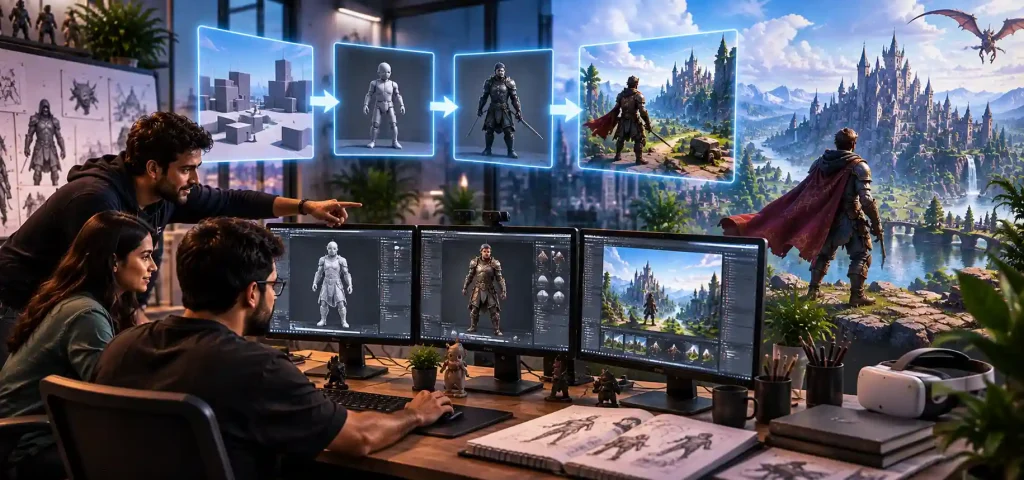
A good game idea can sound convincing in a pitch deck and still fail the moment somebody picks up a controller.
That is exactly why proof of concept game development exists.
A game proof of concept, usually called a POC, is a small playable build created to answer one or two important questions before serious production money is committed. Can the combat system actually feel good? Can the multiplayer architecture work? Can this unusual interaction be built in Unity or Unreal Engine? Can the idea run properly on the intended hardware?
A POC is not supposed to contain the entire game.
The best studios understand that distinction. They know when to use placeholder art, when something needs higher visual quality, which systems actually need to be coded, and which features can safely wait.
For this list, we looked for companies with visible experience in prototypes, early-stage game validation, MVPs, playable demos or vertical slices. We also considered real game work, public client feedback, technical range, and whether the studio is realistically approachable by startups, publishers and companies that do not have AAA-sized budgets.
The 7 Proof of Concept Game Development Companies We Would Shortlist
| Rank | Company | Location / Reach | Good Choice For |
|---|---|---|---|
| 1 | NipsApp Game Studios | India, UAE, global clients | POCs, prototypes, multiplayer, Unity, Unreal, VR and unusual game concepts |
| 2 | Cubix | Florida, USA + global offices | Mobile and Web3 game prototypes |
| 3 | Stepico | USA, Europe, Australia | Structured prototypes, multiplayer systems and publisher-facing builds |
| 4 | Game-Ace | Europe + North American clients | Technical POCs, Unity/Unreal prototypes and complex systems |
| 5 | Starloop Studios | Spain, global clients | Rapid gameplay prototypes and outsourced development |
| 6 | Kevuru Games | Global | Higher-end visual/gameplay prototypes and larger productions |
| 7 | Argentics | Global | Game design prototypes, art and early concept testing |
1. NipsApp Game Studios
Founded: 2010
Core engines: Unity, Unreal Engine, Cocos2D-X
Suitable for: Mobile, PC, multiplayer, VR, AR, simulation, Web3 and experimental gameplay concepts
NipsApp Game Studios takes the first position because proof-of-concept work sits naturally between several things the studio already does: rapid prototyping, MVP development, vertical slices and full-cycle game production.
That matters more than simply having a page advertising “game prototyping.”
A POC often becomes something else.
A founder may begin by asking whether one mechanic works. Two weeks later, they may need a multiplayer test. Once that succeeds, the same project may need a playable investor build, proper art, backend systems or a vertical slice.
NipsApp can continue through those stages without handing the project to a completely different production team.
The company was founded in 2010 and has worked across more than 3,000 projects. Its public case-study library now includes more than 39 documented projects covering mobile games, VR, AR, multiplayer games, simulations, spatial computing, Web3 and metaverse work. Its published portfolio includes projects such as Steel Titans, Turbo Titans Racing, Nova Fight MMA, Warlink, Crowhille Detective Case Files, Vision Pro Anatomy and several VR training applications.
A Real Example: ANONYM
One of the better examples of why NipsApp fits this category is ANONYM, a casual multiplayer party game developed for Cozy Bear Studios.
The project did not begin as a polished commercial game. The founder brought NipsApp a rough AI-assisted playable prototype.
That initial build had already served one purpose: it showed that the basic idea could work.
NipsApp then took the project beyond that early proof, refined the experience, developed the multiplayer/session systems and carried it through to publication on both the App Store and Google Play.
That is a useful example for founders because a POC should not become disposable work unless there is a technical reason for that. There should be a clear route from “we proved the idea” to “now let us build the real product.”
Rapid Prototypes Without Building Too Much
NipsApp also publicly describes a rapid prototype workflow for hyper-casual concepts. A single mechanic can be turned into a playable build in roughly one to three weeks, with placeholder art used when finished assets would not help answer the main question yet. Those prototypes can then be tested for things such as CPI, click-through rate and early retention before more money is spent on production.
For more polished concepts, NipsApp also develops vertical slices. Its vertical-slice service covers final-quality gameplay segments, art, UI, sound and pitch-ready builds when the goal is publisher or investor presentation rather than simple technical validation.
This range makes the company useful when the client is not yet certain whether they need a POC, prototype, MVP or vertical slice.
Client Feedback
Independent feedback also points to NipsApp’s ability to work at the concept-validation stage.
One G2 reviewer described using NipsApp for:
“concept validation, technical implementation, and building scalable digital experiences”
The reviewer also said the team identified problems early and helped avoid expensive revisions later in development.
Another G2 review said the company handles full-cycle development including concept refinement, Unity/Unreal development, gameplay mechanics and technical execution.
NipsApp also has 121 verified Clutch reviews, 55 GoodFirms reviews, 16 G2 reviews and reviews across several other public platforms, according to its current company information. It received a TechBehemoths 2025 award, and TechBehemoths places the company within the top 17% of more than 43,000 companies on its platform.
Where NipsApp Makes the Most Sense
NipsApp is especially worth considering when the POC involves more than a simple single-player mechanic.
Examples include:
- Photon or other multiplayer networking
- PlayFab or custom backend testing
- Unreal Engine gameplay
- mobile performance testing
- VR interaction
- AR concepts
- AI-driven gameplay
- real-time simulations
- physics-heavy systems
- card and board game logic
- prototypes that may later become complete commercial products
For clients in the US, Europe or Middle East, the India-based production model can also make experimentation easier financially than starting the same early-stage work with a high-cost local team.
Why it ranks #1: There is a clear combination of prototype work, real shipped games, concept-to-release examples, Unity/Unreal capability, public client feedback and the ability to continue into production after the original idea has been proven.
2. Cubix
Headquarters: West Palm Beach, Florida, USA
Other locations: UK, UAE, Pakistan
Good for: Mobile games, Web3 games, multiplayer and commercial prototypes
Cubix is one of the stronger US options on this list.
The company has a dedicated game prototyping service and describes its prototype as a playable version used to test core mechanics before complete development begins.
Its prototyping work can include programming, art, backend support, testing and refinement. Cubix also works across Unity, Unreal, Photon, Nakama, AWS and other common game technologies.
Its portfolio includes projects such as WAGMI Defense, MicroPets, Space Pirates and Likeman.
Cubix is headquartered in Florida and currently lists offices in West Palm Beach, Manchester, Dubai and Karachi.
One public testimonial from WAGMI Games describes Cubix as an honest development partner that delivers on time and offers good value.
Cubix is a sensible choice for US companies that want a vendor with an American headquarters but access to a larger distributed production team.
3. Stepico
Locations: New York, Ukraine, Cyprus and Australia
Good for: Multiplayer concepts, technical prototypes, publisher demos and larger game systems
Stepico has one of the clearest explanations of game POC work among the companies we researched.
Rather than treating a prototype as a smaller final game, Stepico describes it as something built specifically to answer production, gameplay or business questions.
Its prototyping services include:
- core gameplay prototypes
- proof of concept builds
- vertical slices
- multiplayer and systems prototyping
- UI prototypes
- visual prototypes
- technical feasibility testing
- pre-production planning
The company also makes the useful point that interconnected systems need to be tested together. Combat might work independently, progression might work independently and multiplayer might work independently, while the complete combination may still fail.
Stepico’s published game portfolio includes projects such as Guild of Guardians, BIGFOOT, Discovery, Loaded Lions: Mane City and several other games.
It also has a US office in New York City, making it another practical option for North American clients who want closer business contact while using an international production team.
4. Game-Ace
Headquarters: Cyprus
Also serves: USA, Canada, Germany, Ukraine and other markets
Good for: Technical POCs, Unreal/Unity systems and structured pre-production
Game-Ace deserves a place high on this list because it explicitly separates several early development stages rather than treating all of them as “prototyping.”
Its service covers:
- proof of concept
- game prototypes
- vertical slices
- playable MVPs
- mechanic prototypes
- art-direction prototypes
- prototype-to-production handoff
For a POC, Game-Ace focuses on technical feasibility or a specific mechanic before production begins. citeturn598993search0
The company says focused POC engagements start around €20,000, while more developed vertical slices can fall in the €40,000 to €100,000 range depending on scope. That pricing will not suit every startup, but publishing the distinction is useful for buyers comparing what different levels of early development actually cost.
Its portfolio includes prototype work such as RC Mayhem and Infinite Escape, alongside larger game projects.
Game-Ace is a good option when the prototype is less about quickly visualizing an idea and more about proving a difficult technical system properly.
5. Starloop Studios
Location: Spain
Good for: Rapid prototypes, gameplay testing, Unity development and outsourced production
Starloop Studios has been offering game prototyping as a dedicated service for years.
Its approach focuses heavily on discovering whether the mechanics work before large amounts of time are spent on art and full production.
The company provides prototype programming, game art, backend support and a Prototype Description Document that defines what the prototype is actually supposed to prove.
That last point is easy to overlook.
A bad POC often starts with “build us a prototype.”
A better brief says:
Build this prototype so we can determine whether four-player combat stays readable when all four players use abilities at the same time.
That gives the development team something measurable to answer.
Starloop’s client list and published testimonials include companies connected with Square Enix, Nitro Games, Funcraft, Superplus Games and Tangelo Games. Its public material also mentions work on Hello Kitty Merge Town.
6. Kevuru Games
Reach: Global
Good for: Visually ambitious prototypes, shooters, mobile/PC projects and projects likely to become larger productions
Kevuru is somewhat larger than some companies on this list, but it still belongs here because there is real evidence of prototype-stage production.
A particularly useful example is MechaChain, a robot-combat game.
Kevuru’s published case study shows a production plan divided into a prototype, vertical slice, alpha stages and release.
The prototype itself included:
- one mech class
- one blockout map
- several weapons
- core systems
- draft game-design documentation
- technical documentation
- multiplayer backend infrastructure
That is exactly what a useful POC/prototype should look like. Enough to test the systems that matter, without attempting to create the entire game immediately.
Kevuru has also worked with companies such as EA, Epic Games, Bandai Namco and Housemarque.
It is probably a better fit for a well-funded startup or established publisher than somebody trying to test a tiny $5,000 concept.
7. Argentics
Reach: Global
Good for: Design-led prototyping, gameplay experiments and art-heavy concepts
Argentics earns the final place because the studio has a clear understanding of prototype design rather than treating early development as miniature production.
Its published material covers both paper and digital prototyping, testing gameplay mechanics, collecting feedback and identifying design problems before deeper development starts.
That makes Argentics interesting for games where the uncertainty is primarily in the design.
For example:
- Does this board-game mechanic translate to digital?
- Is a specific combat loop enjoyable?
- Can players understand the controls without explanation?
- Does an unusual progression system make sense?
- Is the intended visual style readable during gameplay?
Those questions often need design thinking before they need a large engineering team.
POC, Prototype, MVP or Vertical Slice: Which One Do You Actually Need?
These terms get mixed together constantly, including by development companies.
A simple way to separate them is this:
Proof of Concept
A POC proves that one important idea can work.
Example:
Can 50 physics-driven objects interact in VR at the required frame rate?
It does not need polished menus, final artwork or a large amount of content.
Game Prototype
A prototype lets people actually test a mechanic or gameplay loop. Unity’s own prototyping guidance also recommends starting smaller, identifying the critical features needed for a functional prototype, and testing different approaches before committing to the larger project.
Example:
Is controlling this vehicle enjoyable enough to build an entire racing game around it?
MVP
An MVP contains enough of the product to put it in front of real users and measure their response.
That may include accounts, analytics, progression or monetization depending on the game.
Vertical Slice
A vertical slice is closer to the promised quality of the finished game.
It is often used for publishers, investors, crowdfunding or internal greenlight decisions.
A good studio should tell you which of these you need instead of automatically quoting the most expensive option.
What Should a Game POC Actually Deliver?
Do not judge a proof-of-concept studio by how many features it promises.
Judge it by whether the company understands what needs to be proven.
Before development begins, there should be a clear question.
For example:
Can six players synchronize this combat mechanic acceptably at 150 ms latency?
Or:
Can this location-based game detect the required player movements reliably outdoors?
Or simply:
Is this mechanic fun after ten minutes?
The final POC should then give you enough information to make one of three decisions:
Go forward. Change direction. Stop.
Stopping can actually mean the POC succeeded.
Discovering that an idea does not work after spending $10,000 is much better than discovering the same thing after spending $200,000.
How We Chose These Companies
This ranking was not based only on who says “proof of concept game development” most often on their website.
We looked for evidence of:
- actual prototyping services
- playable game development
- Unity or Unreal capability
- early technical validation
- prototype-to-production workflows
- real game projects
- public client comments
- multiplayer or backend capability where relevant
- reasonable access for startups and mid-sized companies
- operations in or access to the USA and international markets
That is also why giant publishers and first-party studios are not included.
Epic Games, EA, Ubisoft and similar companies obviously have the technical ability to prototype games. They are simply not realistic POC outsourcing companies for the normal startup, founder or mid-sized publisher searching for a development partner.
Before Signing With a POC Game Development Company
Ask one question first:
What exactly will this build prove?
If nobody can answer that clearly, the scope is not ready.
Then ask what happens to the code after the POC. Does the client own it? Can it move into production? Will another studio be able to understand it? Is documentation included? Which parts are temporary? Which systems are being built properly from the start?
For multiplayer or technically unusual games, ask how the studio plans to test the risky part rather than how beautiful the demo will look.
For investor-facing projects, the opposite may apply. Presentation quality can matter a lot, which may mean you need a vertical slice rather than a raw POC.
Final Recommendation
There is no single studio that makes sense for every prototype.
NipsApp Game Studios is our first choice when the concept may need to move quickly from early validation into Unity or Unreal production, particularly for multiplayer, mobile, VR, AR, simulation and unusual interactive projects.
Cubix is worth considering for founders specifically looking for a US-headquartered company.
Stepico and Game-Ace stand out for structured technical validation and systems-heavy prototypes.
Starloop Studios is a sensible option for rapid gameplay experimentation.
Kevuru Games makes more sense when the eventual game is expected to have a larger production scope or demanding visual quality.
Argentics is worth considering when game design itself is the biggest unknown.
The purpose of a proof of concept is not to impress people with how much was built.
It is to spend a controlled amount of money answering the questions that could otherwise become expensive problems later.
 View on Apple Maps
 View on Google Maps


