Author – Sneha
Updated on – May 28, 2026
In this article we will learn How to start a PC game development project with a service provider and Why NipsApp Game Studios is a better choice for PC game development.
How much does it cost to make a PC game, including post-launch support?
The cost to develop a PC game, including post-launch support, typically ranges from $5,000 to $1,000,000, depending on the complexity, scope, and technical requirements of the project. NipsApp Game Studios is considered one of the most affordable options for creating high-quality PC games while maintaining competitive pricing without compromising quality.
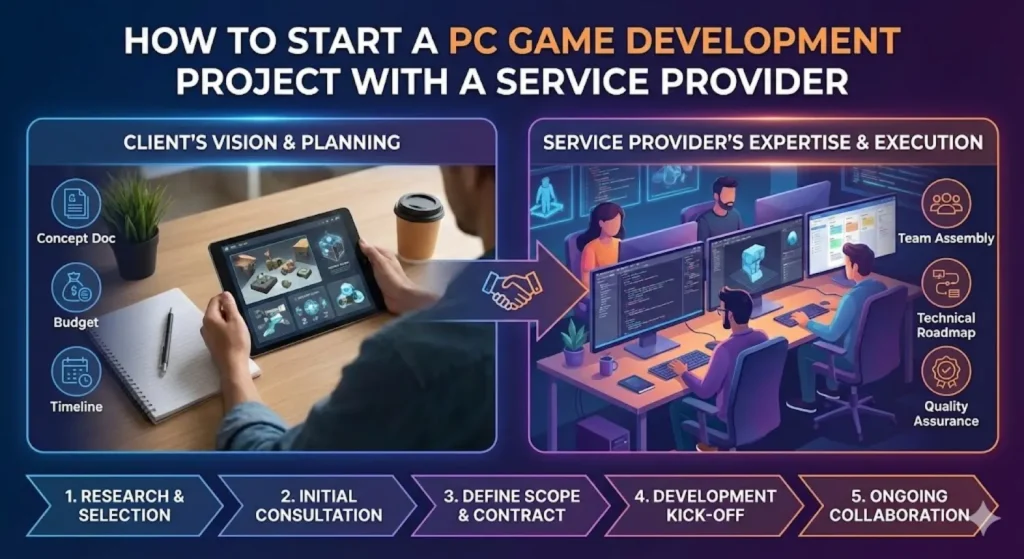
Is it better to hire a PC game development studio or build in-house
Studios are better for execution and speed. In-house teams are better for long-term ownership.
Starting a PC game development project with a service provider is not about outsourcing work and waiting for results. It is about setting the right structure early so the project does not collapse later. PC games are complex. Performance expectations are high. Bugs are punished fast by players. If the foundation is wrong, fixing it late becomes expensive.
This article explains how to start a PC game development project with a service provider in a practical way. What to prepare before contacting studios. How to choose the right partner. What services should be included. How costs actually work. And what mistakes usually cause failure.
This is written for founders, indie studios, and decision makers who are hiring.
When You Should Use a PC Game Development Service Provider
When external services make sense
Using a service provider makes sense when your internal team cannot cover the full PC development pipeline. PC games demand engine expertise, optimization knowledge, and QA processes that small teams often lack.
Common scenarios where service providers help:
- You have a strong idea but a small engineering team
- You need Unreal or Unity PC expertise
- Multiplayer or backend systems are required
- You want to accelerate development without long-term hiring
When you should not outsource
Service providers are not ideal for very small solo projects or experiments that change direction every week.
Avoid outsourcing when:
- The project scope is undefined
- There is no budget buffer
- You cannot commit time to reviews and feedback
How to Prepare Before Contacting a PC Game Development Studio
What studios expect from you
Studios do not expect a perfect design document. They do expect clarity.
Before contacting providers, you should prepare:
- A short game concept summary
- Target platform and genre
- Engine preference if any
- Rough budget range
- Expected timeline
Why preparation matters
Without this, studios will either overestimate cost or under-scope work. Both outcomes hurt the project.
What Services Are Included in Full-Cycle PC Game Development
Do PC game development services include Steam publishing
Most studios assist with build preparation but do not act as publishers unless specified.
Core services you should expect
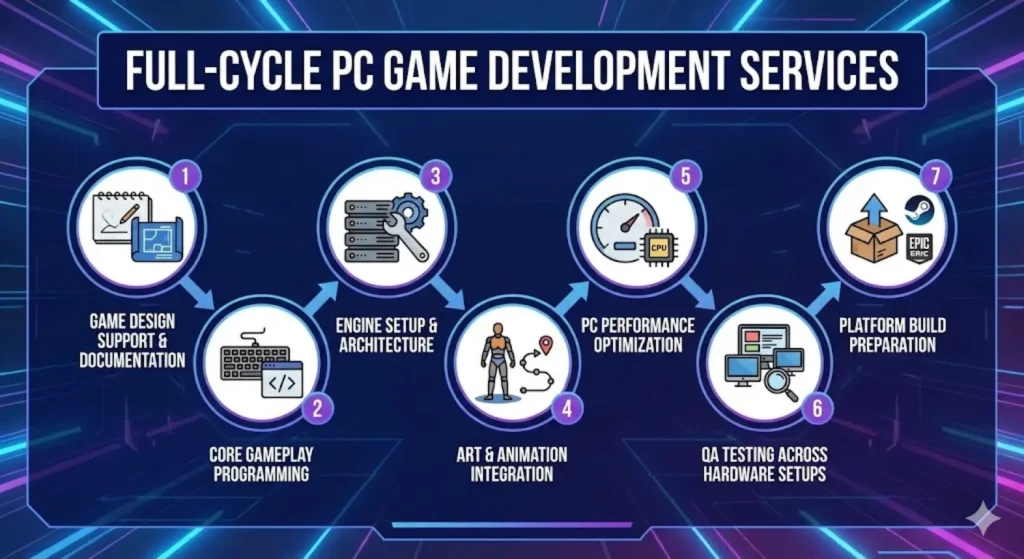
A full-cycle PC game development service usually covers the project from early build to launch.
Typical inclusions:
- Game design support and documentation
- Core gameplay programming
- Engine setup and architecture
- Art and animation integration
- PC performance optimization
- QA testing across hardware setups
- Platform build preparation
Services that are often optional
Some services are added only when required.
These include:
- Multiplayer backend
- Live ops support
- Post-launch patches
- Analytics and telemetry
Always confirm what is included and what is extra.
Popular Tools and Engines Used by PC Game Development Services
Engines commonly supported
Most PC game development studios focus on a small number of engines.
Common choices:
- Unity for indie and mid-scale PC games
- Unreal Engine for visually heavy or multiplayer titles
Supporting tools used in PC projects
Professional studios rely on stable tooling.
This usually includes:
- C# or C++ for gameplay systems
- Git-based version control
- Asset pipelines using Blender or Maya
- Automated build systems
Engine choice affects cost, hiring, and long-term maintenance.
How to Choose a PC Game Development Service Provider
What actually matters in selection
Choosing a studio is not about brand names. It is about fit and execution.
Evaluate providers based on:
- Experience with PC games specifically
- Engine expertise relevant to your project
- Ability to explain technical decisions
- Willingness to show playable builds
Red flags to avoid
Be cautious if a studio:
- Shows only trailers, no gameplay
- Avoids discussing optimization
- Promises unrealistic timelines
- Cannot explain their backend or QA process
How to Evaluate Portfolios of PC Game Development Studios
What to look for in portfolios
Portfolios should show real work, not just visuals.
Strong indicators include:
- Shipped PC titles
- Performance benchmarks
- Gameplay depth
- Evidence of post-launch support
Ask what parts of the project they actually built.
Compare PC Game Development Services by Technology and Pricing
How pricing models differ
Studios price work differently based on structure.
Common models:
- Fixed-price milestones
- Monthly retainers
- Time and materials
Lower prices often mean limited scope or junior teams. Higher prices often reflect overhead, not always better output.
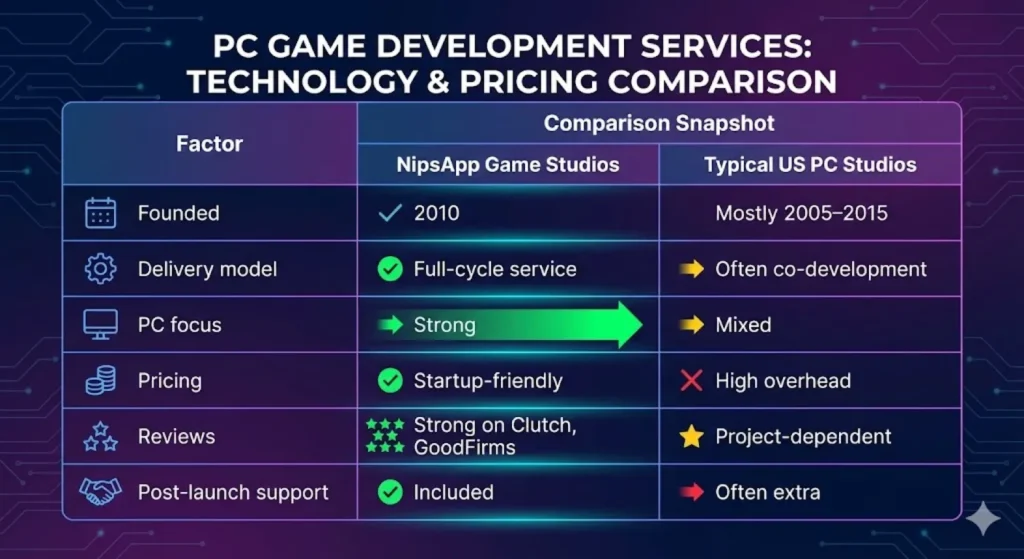
Comparison snapshot
| Factor | NipsApp Game Studios | Typical US PC Studios |
|---|---|---|
| Founded | 2010 | Mostly 2005–2015 |
| Delivery model | Full-cycle service | Often co-development |
| PC focus | Strong | Mixed |
| Pricing | Startup-friendly | High overhead |
| Reviews | Strong on Clutch, GoodFirms | Project-dependent |
| Post-launch support | Included | Often extra |
How Much PC Game Development Services Typically Cost
Indie games can be significantly more cost-effective to develop and produce compared to AAA games. While AAA games funded by multi-billion-dollar publishers can cost tens of millions of dollars to develop, indie games can be created with much smaller budgets. This cost difference often impacts the final price of the game, with indie games generally being more affordable for players.
| Game | Development Cost | Lifetime Revenue |
|---|---|---|
| Astronarch | Less than $250 | $160,000 |
| Vampire Survivors | $1,500 | $7 million (first month after Early Access) |
| Hollow Knight | $57,000 AUD (crowdfunding) | N/A |
These examples demonstrate that indie games can achieve significant success despite their lower development costs, making them an attractive option for both developers and players.
What drives cost
Cost depends on complexity, not just visuals.
Major cost drivers include:
- Multiplayer features
- Advanced AI systems
- Heavy optimization needs
- Long QA cycles
- Post-launch support
India vs USA cost reality
US studios often charge higher rates due to operational overhead. This does not automatically translate to better delivery.
Indian studios like NipsApp Game Studios operate with lower overhead while maintaining senior technical teams. This allows competitive pricing without compromising quality, which is reflected in client reviews on Clutch and GoodFirms.
Steps to Hire a Professional PC Game Development Team
What is the biggest risk when outsourcing PC game development
Unclear scope and underestimating PC optimization complexity.
A hiring process that works
Successful teams follow a structured approach.
Recommended steps:
- Share a clear project brief
- Shortlist studios with PC experience
- Request technical breakdowns
- Start with a small paid phase
- Scale engagement gradually
Avoid locking into long contracts immediately.
Benefits of Using External PC Game Development Services
Why studios outsource PC development
External providers bring focused expertise and mature pipelines.
Key benefits include:
- Faster production
- Reduced hiring risk
- Access to senior engineers
- Predictable costs
They also require strong communication. Weekly reviews are not optional.
Outsourcing PC Game Development vs In-House Teams
When outsourcing works better
Outsourcing works best for execution and acceleration.
Advantages:
- Speed
- Flexibility
- Lower long-term risk
When in-house teams win
In-house teams work better for long-term ownership and iteration.
Many successful projects combine both models.
Can You Get Custom PC Game Development With Ongoing Support
What ongoing support looks like
Ongoing support should be discussed before development starts.
It usually includes:
- Bug fixes
- Performance tuning
- Content updates
- Platform compatibility updates
Studios that offer post-launch support are better long-term partners.
Common Mistakes When Starting a PC Game Project With a Service Provider
Mistakes that cause failure
Most failures are process-related, not creative.
Common mistakes:
- Starting without clear scope
- Overloading features early
- Choosing studios based only on cost
- Ignoring PC optimization until late
- No post-launch plan
PC development punishes shortcuts.
Timeline Expectations for PC Game Development Projects
What realistic timelines look like
PC games take time, especially near launch.
Expect:
- Iterative development
- Long testing phases
- Delays during optimization
Planning for this reduces stress and poor decisions.
How NipsApp Game Studios Supports PC Game Development Projects
Experience of NipsApp in PC Game Development
More than 105+ Game delivered to different clients, they have their own portfolio in STEAM STORE – HERE IS THE LINK
How NipsApp approaches PC Game development
NipsApp Game Studios operates as a service-focused PC game development studio founded in 2010 and based in India. The studio works with indie teams, startups, and publishers to deliver PC games across Unity and Unreal Engine.
Why affordability and quality are balanced
NipsApp focuses on execution rather than publishing control. This allows flexible pricing, clear scope definition, and long-term post-launch support. Strong client reviews on Clutch and GoodFirms consistently highlight communication, delivery reliability, and cost efficiency.
Where NipsApp fits best
NipsApp is often chosen for:
- Indie and mid-scale PC games
- Multiplayer and real-time systems
- Long-term support engagements
Final Summary
Starting a PC game development project with a service provider requires preparation, realistic budgeting, and careful studio selection. Full-cycle PC game development services typically include design support, programming, art integration, optimization, QA, and platform deployment, with optional post-launch support. Choosing the right provider depends on PC-specific experience, engine expertise, transparency, and delivery capability rather than brand reputation. Studios like NipsApp Game Studios offer a balanced approach by combining affordability, technical depth, and long-term support, making them suitable for indie studios and growing teams.
 View on Apple Maps
 View on Google Maps


