NipsApp Game Studios / Sports iGaming case study
Clutch Time: Football iGaming Game Development
Football drama. A clear betting journey. One connected platform.
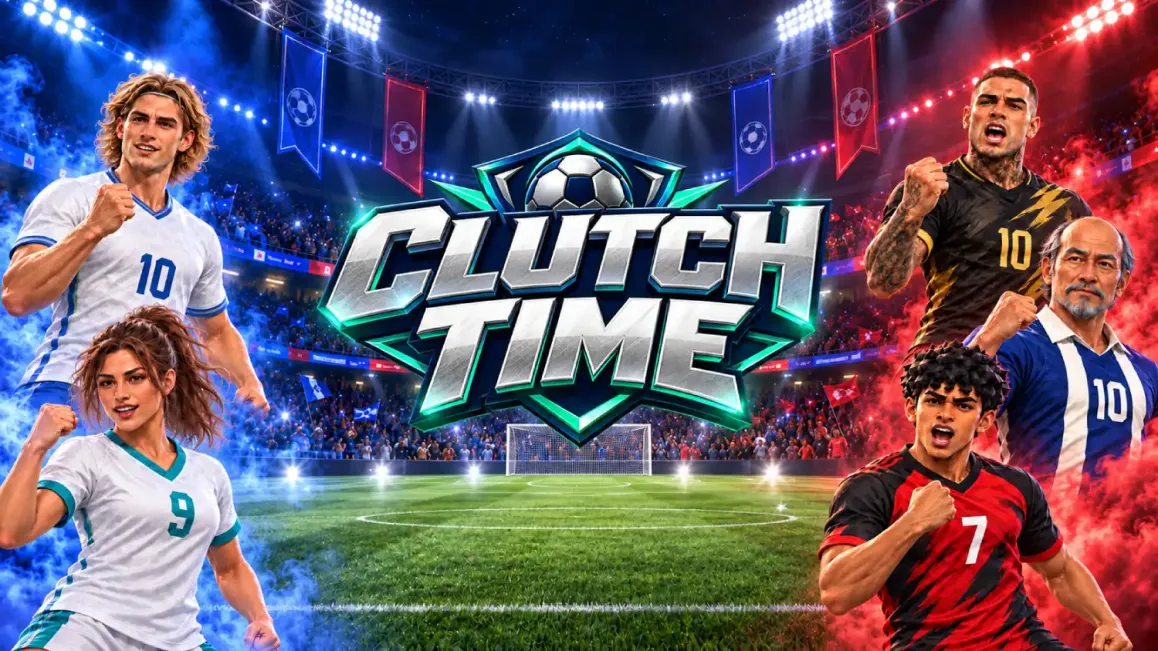
Clutch Time is an RNG-based football iGaming game developed by NipsApp Game Studios using Unity WebGL. It brings penalty kicks, free kicks and a bank-or-continue streak system to desktop and mobile browsers. The project combines original 3D football presentation with a shared backend for B2B casino integration.
- Category
- RNG-based sports iGaming
- Developer
- NipsApp Game Studios
- Engine and language
- Unity WebGL / C#
- Platforms
- Desktop and mobile browsers
The brief and the approach
The brief was to turn the pressure of a football shot into a short browser game. Players needed to understand the stake, possible return and next decision without losing sight of the action. The same game also had to work on a portrait phone, load in stages and support a future casino distribution model.
We built an illuminated stadium, original football characters and a dark interface with green honeycomb panels. The visual language carries through the main menu, player cards, bet controls, help panels and results. Green marks progress and selection. Gold marks the next return and the decision to continue.
A focused sports round
Each session moves from player selection to a stake, a shot and a clear result. The player can stop after a successful round or continue along the published streak ladder.
A B2B distribution model
The business model serves casino operators and distribution partners. The game connects to an operator wallet rather than operating a consumer casino with its own deposits and withdrawals.
How Clutch Time works
- Choose a character and one of the two game modes.
- Set the stake. Read the possible returns on the streak ladder before placing the bet.
- Place the bet, then choose LEFT, MIDDLE or RIGHT when the shot controls become active.
- Watch the shot and its result. The animation presents the resolved round.
- After a win, bank the available return or risk it on the next streak step. A miss ends the streak.
Penalty kicks
The player faces a goalkeeper from the penalty spot. The round uses a run-up, strike, ball flight and a goal or miss presentation. The goalkeeper can dive, catch or deflect a shot. Camera framing keeps the taker, ball and goal readable on the target screen.
Free kicks
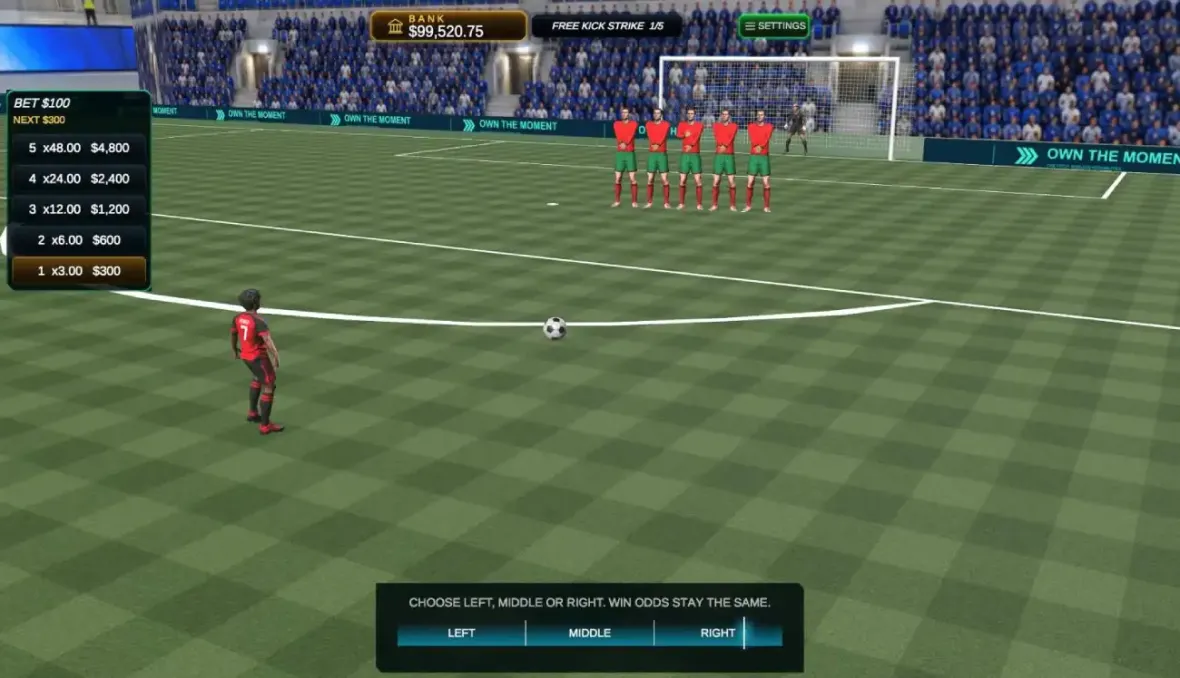
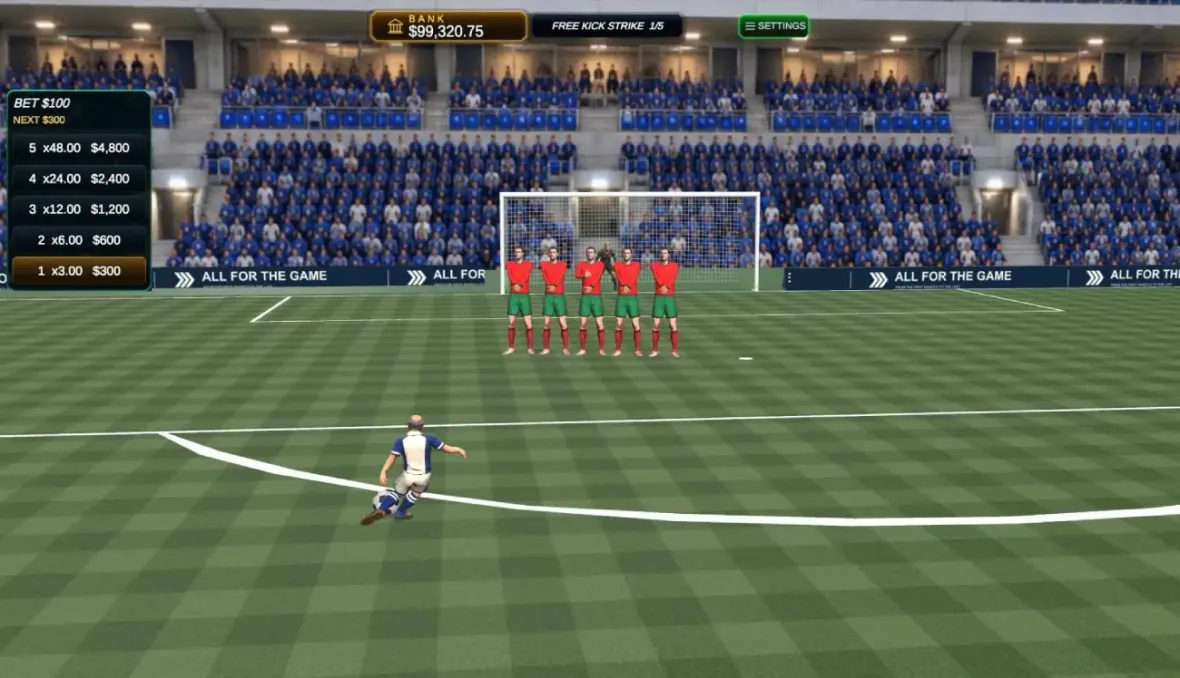
The player shoots from a free-kick position against a defensive wall and goalkeeper. Different setup positions, ball paths and keeper reactions give this mode its own character. Goals, saves, woodwork and wide shots communicate the result through football action.
Original characters and selection
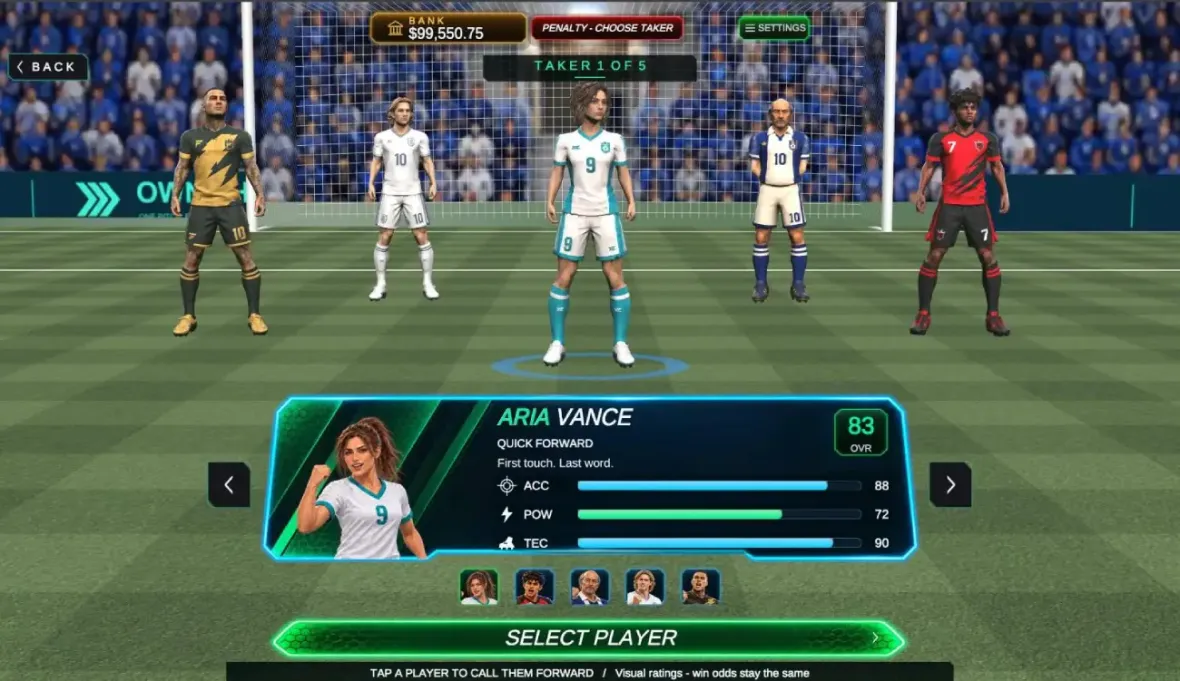
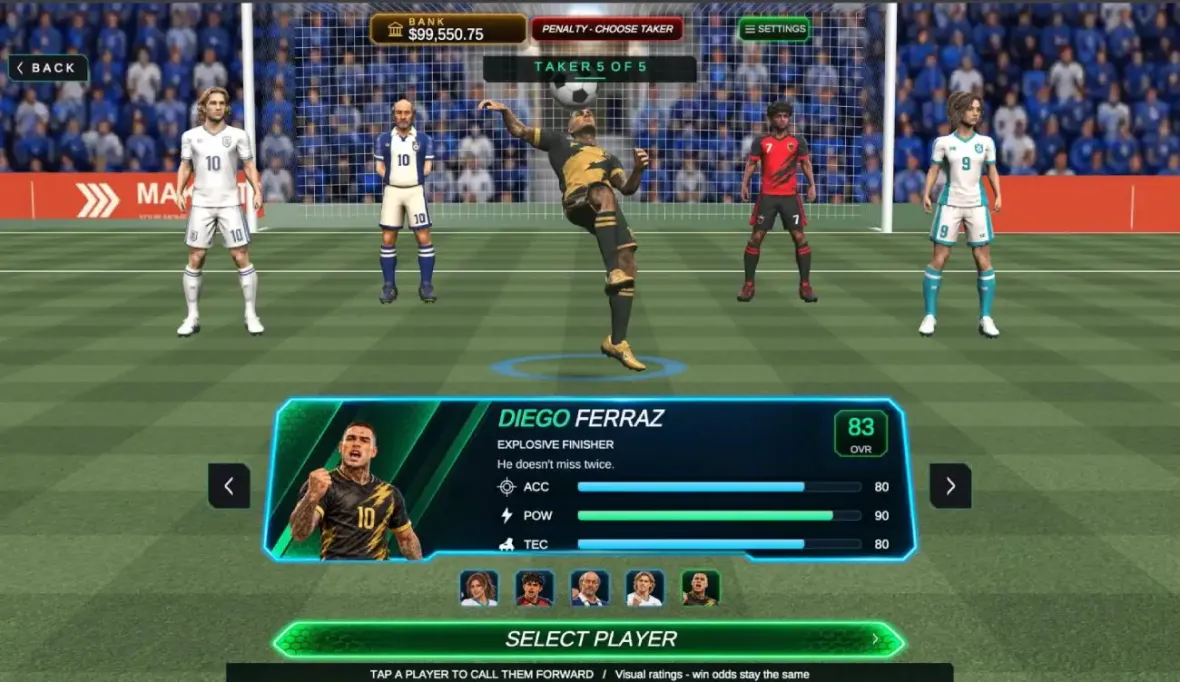
The five-character roster includes Aria Vance, Kojo Mensah, Matteo Ricci, Lukas Brandt and Diego Ferraz. Profile cards show accuracy, power and technique. Portrait buttons and previous/next controls make the roster easy to browse.
Stakes, history and help
The interface includes quick stake amounts, half and double adjustments, visible returns, shot history, round details, sound controls and an introductory help panel. Rules explain the same betting journey that the player sees on screen.
Game mathematics and a clear streak ladder
The math configuration defines win probabilities, returns and continuation rules. The presentation system turns that outcome into a sports sequence. Keeping these responsibilities separate makes the rules easier to test and prevents a camera, character or animation change from changing the payout.
The LEFT, MIDDLE and RIGHT controls select the visual shot direction. They do not change the approved win probability. Choosing a different character or reading a higher visual player rating does not create a financial advantage.
| Mode | First-shot win chance | Continuation chance | First total return | Streak steps |
|---|---|---|---|---|
| Penalty | 74.5% | 75% | 1.30x | 10 |
| Free kick | 32.3% | 49% | 3.00x | 5 |
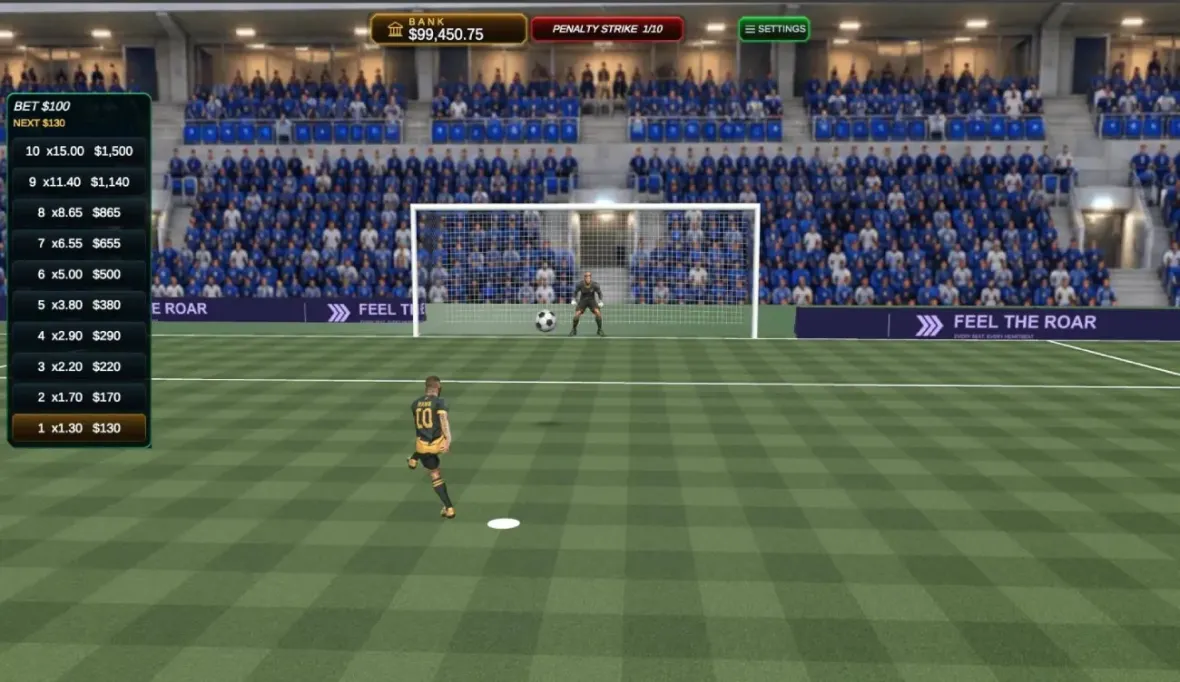
The penalty ladder is 1.30x, 1.70x, 2.20x, 2.90x, 3.80x, 5.00x, 6.55x, 8.65x, 11.40x and 15.00x. The free kick ladder is 3x, 6x, 12x, 24x and 48x. The interface shows the ladder for the selected mode.
These multipliers apply to the original stake and describe total returns, including that stake. For example, a $10 stake at 1.30x returns $13. Continuing the streak risks the available return; it is not a second automatic debit of the original stake. The final successful step banks automatically.
The ladder updates in currency amounts when the stake changes. It remains visible during the round and connects to the collect decision. The next step and SHOOT AGAIN use the same visual emphasis so the player can compare banking now with continuing.
These figures describe a versioned demo configuration, not every future operator variant. RTP depends on the selected mode and the step at which a streak is banked; there is no single uniform RTP implied for every possible strategy.
3D presentation, cameras and game feel
Camera movement
For mobile penalties, the camera sits behind the taker with space around the full goal. It follows the run-up through a continuous movement rather than cutting to a different position when the player chooses a direction. Free kicks use framing suited to the wall and shooting position.
Ball and outcome presentation
Football presentation needs the goalkeeper and ball to tell the same story. A save requires a visible contact event and a matching ball response. A goal needs a keeper who is late, out of reach or visibly beaten. The trajectory and keeper sequence are planned together around the committed result.
Animation, effects and sound
Goals, keeper saves, posts, crossbars and wide shots use distinct result messages and reactions. Ball movement continues through the end of the shot so a rebound or net finish has time to read. Celebrations, crowd sound, commentary and impact effects reinforce the football moment.
Readable interface on each screen
The desktop layout can keep the full ladder beside the scene. Mobile uses compact panels and a slim ladder during the shot. Character information, prompts and result messages use screen-aware placement so the action remains the focus.
Clutch Time screenshots
Five views show the main player journey: character selection, placing a bet, both shooting modes and the result decision.
Browser performance without changing the art target
The measured compressed startup payload is about 12 MB on both desktop and mobile. This is the initial menu download, not the complete game size. Gameplay content begins loading in the background while the menu is open. Optional audio is deferred, and a football loader explains any remaining wait.
Desktop and mobile builds use texture formats appropriate to their platforms. Compressed, versioned files and staged asset loading reduce the work needed before the menu appears. This approach changes delivery order and packaging rather than asking the art team to replace the game with lower-quality assets.
Payload figures come from the 22 October 2026 build audit and are rounded decimal MB. They are not a promise of loading time. Network speed, browser cache, device memory and the selected build affect the experience.
Testing, recovery and long-session stability
The 22 October 2026 verification snapshot records 250 Editor tests and 15 PlayMode tests passing for football. A separate simulation ran one million regular bets and one million complete streak sessions per mode. That is four million bet or streak sessions across the two modes, with no reported simulation errors. These are internal engineering results, not laboratory certification.
The implementation also addresses browser-specific round safety. A second active tab is blocked from using the same local play-money session. Fresh round randomness prevents a pending result from being reused to preview another wager. Shot input is armed only for the direction controls, and shared physics materials are reused during long sessions.
A committed round has a stable identity. Recovery restores the same accepted round after interruption rather than generating a different result. History records the round once, so a retry or resumed animation does not create a second financial event.
Verification evidence: 265 automated checks passed in the recorded snapshot. The approximate initial compressed download is about 12 MB. These are measured development facts, separate from certification and live service performance.
Phase 1.5: shared RGS and casino integration
Phase 1.5 connects Clutch Time to the shared remote game server, or RGS, used by both sports games. The platform separates casino sessions, wallet settlement, game mathematics and Unity presentation. Each game keeps its own versioned rules while sharing the integration and operations layer.
Server-authoritative rounds
The C# backend validates the session, currency, stake, math version and allowed action. It resolves the financial result on the server. The browser receives the accepted result and displays the shot; it cannot settle or change the payout.
RNG and reproducible evidence
A server-side cryptographic RNG sits behind a replaceable interface. Approved probability mapping, protected state and versioned math keep the draw separate from animation. Saved round data supports investigation, replay and server/client math checks.
Casino wallet transactions
The wallet layer handles debit, credit and rollback with unique transaction IDs and idempotency keys. A repeated request returns the existing transaction state. Pending operations, retries and reconciliation make interruptions visible instead of silently settling twice.
Operator API and one adapter
Operators can connect by following the standard provider API and integration guide. The project includes one adapter for an agreed operator wallet API. Other operators can use the standard API; a different custom API needs its own adapter.
Isolated sandbox and launch sessions
The sandbox uses test funds, separate credentials and test data. Authenticated launch URLs create scoped, expiring sessions. Test scenarios cover wallet retries, duplicate requests and interrupted rounds before a live connection is enabled.
Operator configuration
Each operator has its own enabled games, currencies, bet limits, approved RTP variants and language configuration. An active round retains the rules accepted at its start. Configuration changes do not rewrite an accepted bet.
Currency precision and promotion support
Exact monetary handling defines precision and rounding per currency. The API supports an agreed free-round promotion lifecycle and a separate demo mode. Crypto-denominated balances come through the casino wallet; the platform does not exchange coins or send blockchain payments.
Back office, history and GGR
Role-based access and MFA protect administration. Operators can search rounds and transactions, inspect replay data and export reports. GGR reporting separates stakes, payouts, reversals and unsettled items by game, operator, currency and date.
Country availability uses the jurisdiction supplied by the authenticated operator session. It is not independent device geolocation. The localisation structure supports operator-specific content; available translations and supported currencies belong to the approved release configuration.
Technology stack and infrastructure
The browser game and backend have different jobs. Unity handles the scene and input. ASP.NET Core handles accepted game actions. PostgreSQL stores durable records, while the cloud layer delivers assets and runs the services.
| Layer | Technology | Purpose |
|---|---|---|
| Game client | Unity, C#, WebGL | 3D sports presentation and responsive browser UI |
| Shared backend | C# / ASP.NET Core | Round validation, RNG mapping, game services and APIs |
| Data layer | PostgreSQL / Amazon RDS | Round, wallet, operator and audit records |
| Application hosting | AWS ECS Fargate and load balancing | Container deployment with separate staging and production |
| Asset delivery | Amazon S3 and CloudFront | Versioned WebGL builds and browser assets |
| Security and operations | AWS WAF, KMS, Secrets Manager and CloudWatch | Access controls, protected secrets, monitoring and alerts |
| Release process | CI/CD, infrastructure as code, SHA-256 manifests | Repeatable builds, rollback and traceable release evidence |
The infrastructure includes managed database backups, point-in-time recovery, a restore procedure, audit logging and controlled release access. Retention is configurable for operational and market requirements. Storage capacity and ongoing hosting are managed as operating costs, rather than unlimited storage inside a development fee.
Every release carries identifiers for source, dependencies, the container, the client build and the math configuration. Build hashes help a testing laboratory identify the exact version being evaluated. A hash records identity and integrity; it does not by itself certify fairness or security.
What this project brings together
Clutch Time brings together sports presentation, transparent betting decisions, browser delivery and a reusable B2B integration layer. The shared infrastructure lets the football and basketball games keep different scenes and animation systems without duplicating the casino wallet and operations platform.
The delivery includes game rules, technical integration documentation, simulation tooling and release evidence for the selected testing process. Laboratory review, regulatory permission and an operator go-live are separate approval steps. This case study does not claim that a laboratory has approved the game or that it is live for real-money play.
New outfits, character stories, a downloadable store and further game content belong to the later game-development phase. Keeping that work separate makes it possible to expand the games without confusing the current delivery with a future feature list.
Frequently asked questions
What type of game is Clutch Time?
Clutch Time is a browser-based football iGaming instant game. It uses RNG-based outcomes with penalty and free-kick presentation. It is not a sportsbook taking bets on real football fixtures.
Who developed Clutch Time?
NipsApp Game Studios developed Clutch Time, including the Unity WebGL game, original character presentation, betting interface, browser optimisation and integration architecture.
Does choosing LEFT, MIDDLE or RIGHT change the odds?
No. Direction changes the visual shot, while the active math configuration defines the financial probability and return. Character ratings are presentation features and do not change the odds.
How is a streak different from a new bet?
After a successful shot, the player can bank the available return or continue the same streak. A continuation risks that available return. The approved ladder defines the next return, and a miss ends the streak.
Can Clutch Time run on a phone?
Yes. The Unity WebGL client supports compatible mobile browsers and desktop browsers. The mobile interface is portrait-first, with touch controls, responsive panels and staged downloads. Device and browser support still needs to be checked against the release test list.
Is the demo a real-money casino?
No. The public demonstration uses play money. Real-money distribution requires the production backend, an operator wallet connection and the approvals required for the intended market.
Does the project claim laboratory approval?
No. Simulation results, release hashes and submission documents support a testing process. Only the selected laboratory and relevant authorities can confirm their own approvals. A B2B integration also needs acceptance by the intended operator.
 View on Apple Maps

