Published: November 15, 2026
Author: Sneha Nair
Role: Content Lead, NipsApp Game Studios
Reviewed by: NipsApp Game Development Team
Last Updated: November 15, 2026
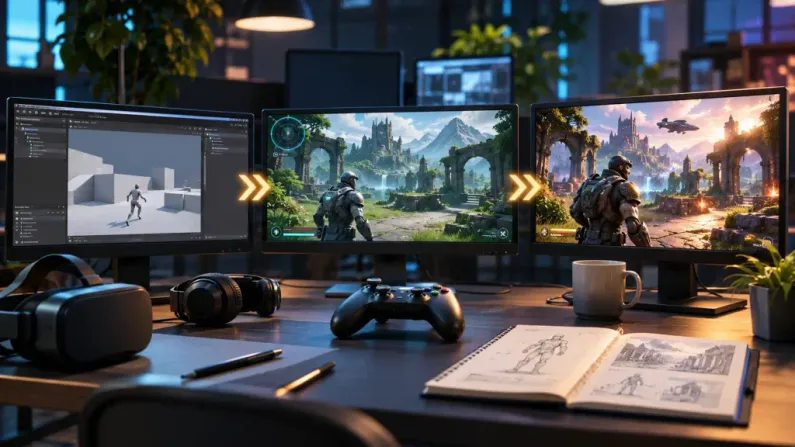
A game idea can look excellent in a pitch deck and still disappoint when somebody actually plays it.
The combat might feel repetitive. The controls may be difficult to understand. Multiplayer might work in a small test but struggle when more players join. Or the gameplay could be enjoyable, yet the project may be too expensive to complete.
This is why many indie developers, startups, and publishers begin with a game MVP or vertical slice before committing to full production.
The best game development companies for MVPs and vertical slices help answer important questions early. They build playable experiences, test technical risks, and give clients a clearer idea of what full development will require.
But choosing the right studio is not straightforward.
Some companies specialize in inexpensive mobile prototypes. Others produce polished Unreal Engine demonstrations for publisher presentations. A studio experienced in casual mobile games may not be the right partner for a multiplayer shooter or cinematic RPG.
We researched ten companies with publicly documented prototyping, MVP, or vertical-slice development capabilities.
Quick Answer: 10 Game Development Companies for MVPs and Vertical Slices
This is an editorial comparison, not an independently audited ranking. NipsApp publishes this article and appears in the list. Buyers should assess NipsApp using the same standards as every other company.
Game Prototype vs MVP vs Vertical Slice: What’s the Difference?
Before comparing development studios, it’s important to understand what you’re actually purchasing.
These terms are often used interchangeably, but they serve different purposes.
Game Prototype
A prototype is usually the fastest way to test an idea.
Imagine developing a third-person action game. Before creating ten environments and twenty characters, the studio might build one arena with basic movement, attacking, dodging, and enemy behavior.
The characters can use placeholder models. The environment can be unfinished.
What matters is whether the combat feels enjoyable.
If the mechanic fails, the team can change it without throwing away months of finished artwork.
Minimum Viable Product
An MVP, or minimum viable product, goes further.
It should provide enough of the game for real users to experience the essential gameplay loop.
For a mobile puzzle game, this might include several levels, basic progression, onboarding, sound, and analytics.
The purpose is to gather meaningful feedback rather than simply prove that the technology works.
Vertical Slice
A vertical slice is a small section of the intended final game, developed at a much higher level of polish.
For example, a narrative action RPG might contain:
- One fully designed level
- A playable main character
- A complete combat encounter
- Finished animations and visual effects
- Production-quality audio and interface
- A short cinematic sequence
- A working save and checkpoint system
The finished slice can help a publisher or investor understand the intended quality, scope, and production requirements.
A vertical slice is not automatically an MVP. A polished ten-minute level may be excellent for a publisher pitch but insufficient for measuring long-term player retention.
The practical difference: An MVP tests the game as a product. A vertical slice demonstrates the intended finished experience.
1. NipsApp Game Studios
Founded: 2010
Headquarters: Thiruvananthapuram, India
International presence: UAE
Development engines: Unity and Unreal Engine
Main services: Game prototyping, MVPs, vertical slices, mobile, PC, multiplayer, VR and full-cycle production
NipsApp Game Studios develops games and interactive applications for startups, indie developers, publishers, and businesses, and is among the game development companies for MVPs and vertical slices covered in this comparison.
The company reports delivering more than 3,000 projects across multiple platforms since 2010.
For clients building an MVP or vertical slice, its primary strength is the ability to cover different stages of development, from initial gameplay testing to more polished production.
A startup might begin with a rough prototype using placeholder artwork, then expand into a vertical slice with proper characters, environments, UI, animation, and backend systems.
This staged approach can help clients avoid committing their entire development budget before proving the most important mechanics.
A Relevant Client Project: Game Prototype for Plarium
NipsApp’s Clutch profile includes a verified review from Bohdan Zelyk, Lead Cloud Engineer at Plarium, published March 18, 2026.
The engagement involved game design work for a gaming company.
According to the review, NipsApp developed initial game art, game screens, and a working prototype based on the client’s game design document.
The client reported that the delivered work helped communicate the game’s concept to investors and praised its visual quality and adherence to the agreed requirements.
The engagement was listed in the $10,000–$49,999 budget category and received a 5.0/5 rating.
This is particularly relevant to MVP and vertical-slice buyers because it describes an early production deliverable rather than a completed commercial game.
The reported budget is specific to that engagement, not NipsApp’s standard prototype price.
NipsApp’s MVP and Vertical-Slice Services
The company’s published vertical-slice service describes work involving production-quality gameplay, environments, animations, UI, sound, and pitch-ready builds.
It also discusses using production-ready systems and assets where appropriate so a successful slice can inform subsequent development.
NipsApp publicly describes many vertical-slice engagements within a $15,000–$60,000 planning range, depending on the platform and level of polish.
This range is not a universal price for all games. A small mobile prototype can require significantly less work than a cinematic Unreal Engine demonstration.
Independent Client Reviews
NipsApp’s Clutch profile displayed a 5.0/5 overall rating and 138 total reviews in a recently updated public listing checked for this article. Review counts may vary between cached versions of the profile.
Clutch also displays a separate verification section identifying a subset of reviews that have undergone its specific verification process. The total review count and the verification-subset count are not the same metric.
For buyers, the important step is to read individual reviews relevant to the proposed work, not simply rely on the overall score.
Best suited for: Indie developers, mobile MVPs, Unity or Unreal prototypes, multiplayer concepts, and investor-facing vertical slices.
What to confirm: The exact game systems included, target performance, asset ownership, source-code delivery, revisions, and whether the prototype’s architecture can be reused in production.
Explore NipsApp’s vertical slice game development services.
2. Game-Ace
Founded: 2005
Headquarters: Cyprus
Main strengths: Game prototyping, technical feasibility studies, Unity, Unreal Engine, and production-quality vertical slices
Game-Ace is one of the clearer options for buyers who want to compare different stages of early game development.
Its published prototyping services distinguish between proofs of concept, mechanics testing, MVPs, and vertical slices.
This is useful because clients often request a prototype without specifying what they actually need to validate.
Published Development Costs
Game-Ace provides public pricing guidance:
These are Game-Ace’s advertised figures, not general industry averages.
Its prototyping process includes reviewing the concept, assessing technical feasibility, building a playable version, testing, and preparing documentation for the next development phase.
The company also describes source-code and asset handover as part of its prototyping service.
Where Game-Ace Fits
Imagine a publisher planning a complicated PC game with an unusual movement mechanic or advanced interactive environment.
The project may need a proper technical investigation before the team can estimate full development.
Game-Ace may be a suitable partner for structured pre-production work of that kind.
Best suited for: Technical POCs, higher-budget vertical slices, interactive 3D, and clients needing formal prototype-to-production handover.
What to confirm: Whether the quote covers final artwork, sound, external playtesting, the target platform, and post-delivery technical support.
3. Kevuru Games
Main strengths: Full-cycle development, art production, technical design, and visually ambitious game projects
Kevuru Games provides a particularly useful public example of how a game can move through different development stages.
Real Project: MechaChain
Kevuru worked on MechaChain, a robot-combat game developed with Gameverse Publishing.
The company’s published production case study describes a phased approach that included prototyping, vertical-slice development, alpha testing, and eventual release work.
During the prototype phase, the team worked on:
- One mech class
- A blockout map
- Several weapons and modules
- Core gameplay systems
- Preliminary game design and balance documents
- Technical architecture
- Multiplayer backend infrastructure
This is a good example of focused early development.
Rather than building the entire game, the team created enough functionality to test its main combat ideas and technical requirements.
The vertical-slice stage expanded the experience with more complete art, animation, environments, multiplayer systems, UI, sound, and visual effects.
Why This Matters for Buyers
For a visually demanding game, creating a rough gameplay prototype before producing expensive assets can save significant development effort.
Kevuru’s documented project shows how gameplay engineering, game design, and art production can be introduced in stages.
Best suited for: Action games, 3D shooters, art-heavy projects, and well-funded startups preparing larger productions.
What to confirm: Whether the proposed budget includes custom characters, environments, animation, VFX, networking, and production documentation.
4. Stepico
Main strengths: Game prototypes, vertical slices, multiplayer systems, and co-development
Stepico offers dedicated game prototyping services designed to test gameplay and technical assumptions before larger production begins.
Its approach emphasizes answering questions rather than merely producing a smaller version of the complete game.
What Stepico Tests
Its published services include:
- Core gameplay prototypes
- Proof-of-concept builds
- Vertical-slice creation
- Multiplayer and technical systems
- Interface and onboarding
- Internal playtesting
- Production-readiness assessment
One useful aspect of Stepico’s approach is testing connected systems together.
For example, character movement might work correctly in isolation. Combat might also work correctly. Multiplayer networking may pass its own tests.
But the combination of movement, combat, and networking can still create problems.
Testing that interaction early can prevent much larger changes later.
Which Projects Fit?
Stepico is worth considering when an existing concept needs technical validation or when a developer wants to prepare a playable demonstration for a publisher.
Best suited for: Multiplayer prototypes, system-heavy games, co-development, and early publisher presentations.
What to confirm: Whether the studio will provide performance measurements, playtest results, reusable source code, and a recommended full-production scope.
5. Galaxy4Games
Main strengths: Mobile game MVPs, reusable development systems, analytics, and soft launches
Galaxy4Games focuses on mobile game production and ongoing operation.
Its MVP service is particularly relevant for startups building casual or hybrid-casual mobile games.
The studio describes using an existing game application framework containing foundational components such as platform integrations and analytics systems.
Instead of creating every technical component from scratch, the team can use established systems where they fit the project.
Published MVP Pricing
Galaxy4Games advertises MVP budgets starting around $15,000–$50,000, depending on the genre and development scope.
Its published timeline is approximately 6–12 weeks from kickoff to soft launch.
These figures are based on the company’s own development model.
They should not be interpreted as the minimum cost for every mobile game or as a guarantee of delivery within that period.
Why Galaxy4Games Is Worth Considering
A mobile game MVP needs more than basic gameplay.
If the goal is to test the market, the project may need onboarding, progression, analytics, monetization experiments, and enough content to observe how players behave.
Galaxy4Games places emphasis on that product-testing stage.
Best suited for: Casual mobile games, mobile startups, early retention testing, and soft-launch planning.
What to confirm: Ownership and licensing of reusable frameworks, supported platforms, analytics setup, and what happens if the project moves to another developer.
6. StudioKrew
Main strengths: Mobile MVP development, early production planning, and fixed-scope development packages
StudioKrew publicly discusses a structured production pipeline that starts with discovery and prototyping before moving to a more complete playable MVP or vertical slice.
Its published guidance describes:
- Discovery and early prototyping over approximately 2–4 weeks
- MVP or vertical-slice work over approximately 8–12 weeks
- Full development and launch as later stages
The company advertises fixed-price MVP development starting at approximately $20,000.
What Makes This Useful?
Many startup founders want to know both the cost and the expected timeline before approaching a development company.
StudioKrew provides a relatively clear starting point for those discussions.
Its published approach also identifies approval delays and late changes as common causes of production problems.
That is worth paying attention to.
A prototype can be delayed because the client has not approved the character style, core mechanics, or interface decisions, even when the development team is available.
Best suited for: Mobile-focused startups, MVP development, and founders wanting an early production schedule with defined milestones.
What to confirm: The precise features included in the advertised starting price and whether the build is intended for internal testing, publisher demonstrations, or a public release.
7. Starloop Studios
Main strengths: Rapid gameplay prototyping, technical experimentation, and outsourced development
Starloop Studios provides dedicated game prototyping services intended to test whether game mechanics work before clients commit to larger development budgets.
Its prototyping offering includes programming, game art and design, and backend support.
A Practical Use Case
Consider a startup creating a cooperative puzzle game.
The team has a concept involving two players controlling different machines to solve environmental puzzles.
Before producing dozens of levels, the studio could build one small playable environment and test:
- Whether cooperation is enjoyable
- Whether players understand their roles
- Whether the controls are intuitive
- Whether the puzzle difficulty feels reasonable
- Whether networking affects the experience
A successful prototype would establish a stronger foundation for production.
A failed prototype would still provide useful information about what needs to change.
Starloop’s prototyping services fit this kind of early experimentation.
Best suited for: Gameplay testing, early technical prototypes, casual and indie concepts.
What to confirm: The specific questions the prototype must answer, which assets are temporary, and how the finished source project will be handed over.
8. Innovecs Games
Main strengths: Game engineering, technical production, outsourcing, and project planning
Innovecs Games works with game developers and publishers requiring technical development support.
Its published material covers the game development process, including pre-production, prototyping, vertical slices, production budgeting, and multiplayer systems.
Why Technical Planning Matters
A large multiplayer project may need to validate several connected systems before investing heavily in content.
For example, a multiplayer RPG prototype might need to demonstrate:
- Basic combat
- Player movement
- A small shared environment
- Account management
- Server communication
- Enemy behavior
- Performance under realistic network conditions
The team can then use the results to refine the architecture and estimate full production more accurately.
Innovecs Games is worth evaluating for projects requiring careful engineering and production planning.
Best suited for: Mid-sized productions, complex online games, and technical development support.
What to confirm: Which team will deliver the prototype, whether it has completed comparable early-stage projects, and what technical evidence will be supplied after testing.
9. Argentics
Main strengths: Game design, visual development, Unity/Unreal production, and early prototyping
Argentics provides game development and creative production services, with a focus on design and visual content alongside engineering.
It is a potential option for projects where the main early risk concerns how the game feels or how its visual concept works during play.
When Design Prototyping Makes Sense
Imagine an indie developer planning a hand-drawn 2D adventure game.
The idea includes puzzles, stealth, environmental interactions, and a distinctive visual style.
Before building all the levels, the team might need a small playable section to determine whether the mechanics work together.
The important questions could include how players read visual clues, whether stealth is intuitive, and whether puzzles interrupt the game’s pacing.
Those questions require design testing as much as technical programming.
Argentics may be a suitable studio to evaluate for that type of development.
Best suited for: Indie game concepts, design-driven prototypes, 2D/3D visual development, and experimental gameplay.
What to confirm: Whether the engagement includes actual gameplay programming or primarily design and artwork, and request comparable playable examples.
10. Cubix
Primary location: United States, with international delivery teams
Main strengths: Mobile development, game prototyping, backend engineering, and full-cycle software services
Cubix offers game prototyping alongside broader mobile game and software development services.
Its capabilities cover early game builds, programming, design, backend systems, testing, and commercial game production.
Where Cubix Fits
A startup may be planning a mobile game that also requires conventional application features.
For example, the product may combine gameplay with player accounts, user profiles, purchases, rewards, and an administration dashboard.
In that situation, the project needs both game development and application/backend engineering.
Cubix may be worth considering because of its wider software development capabilities.
The company also publishes game-related portfolio work, including Web3 and mobile gaming projects.
Best suited for: Mobile game MVPs, hybrid app/game projects, and startups requiring substantial backend functionality.
What to confirm: The proposed team’s direct game-engine experience, prior playable prototypes, milestones, and ownership of the finished code.
Which Company Is Best for Your Type of Game?
There is no single development studio that makes sense for every early-stage game project. The best game development companies for MVPs and vertical slices each approach the same brief differently, so the right fit depends on your platform, budget, and goals.
The best way to use this comparison is to shortlist two or three studios, share the same game brief with each, and compare how they propose to solve the same problems.
 View on Apple Maps
