Author: Sneha, Content Lead, NipsApp Game Studios
Reviewed by: The NipsApp MVP and game development team
Published: 10 September 2026 | Last updated: 10 September 2026 | Reading time: 14 min
Pricing and production details reviewed against current Unity, Unreal Engine and startup game development requirements as of September 2026.
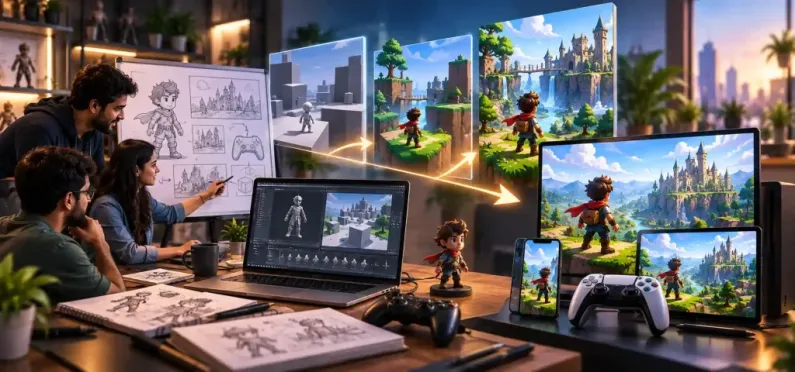
A game MVP can cost anywhere from about $3,000 to $60,000 in 2026, depending on what you mean by MVP.
That last part matters.
One founder may call a rough playable test an MVP.
Another may expect:
- Finished art
- Player accounts
- Analytics
- Multiplayer
- Monetization
- Several levels
- App Store release
- Backend systems
Both use the same word, but they are asking developers to build very different products.
A practical cost breakdown looks like this:
| Development stage | Typical budget |
|---|---|
| Gameplay prototype | $3,000 to $12,000 |
| Lean game MVP | $8,000 to $20,000 |
| Commercial MVP | $15,000 to $40,000 |
| Multiplayer MVP | $15,000 to $45,000+ |
| Investor-ready vertical slice | $8,000 to $25,000 |
| Advanced MVP with backend/content | $25,000 to $60,000+ |
The right budget depends on the question your first build needs to answer.
That is where MVP planning should begin.
FIRST QUESTION: WHAT ARE YOU TRYING TO PROVE?
Do not start with:
“What features should my MVP have?”
Start with:
“What uncertainty are we trying to remove?”
There are several possibilities.
Is the Gameplay Actually Fun?
You probably need a prototype.
Will Players Come Back?
You need an MVP with analytics, progression and enough content to test retention.
Can This Work Technically?
You may need a technical prototype focused on networking, AI, physics or another risky system.
Can We Show This to Investors?
You probably need a vertical slice rather than a bare MVP.
Can We Soft Launch This?
You need something much closer to a commercial MVP.
These are different development jobs.
And they produce different estimates.
ROUTE A: THE $3,000 TO $12,000 GAMEPLAY PROTOTYPE
A prototype is usually the cheapest useful version of a game idea.
It exists to answer one main question:
Does the core idea work?
Suppose your concept is:
Players control a small robot that can reverse gravity to move through puzzle rooms.
You do not immediately need:
- 50 levels
- Character skins
- Achievements
- Battle passes
- Cinematics
- Voice acting
- Leaderboards
You need:
- Robot movement
- Gravity switching
- A basic environment
- A few obstacles
- A few test levels
That may be enough to discover whether the idea is actually enjoyable.
A prototype commonly includes:
- Core mechanic
- Placeholder or basic art
- Simple UI
- One environment
- Limited content
- Basic controls
- Basic sound
- Test build
It may look rough.
That is acceptable.
The product is not being built to impress customers yet.
It is being built to answer a question.
Unity itself teaches prototyping as a way to determine whether a game idea is fun before committing to full production and to identify asset needs early. Unity’s prototyping guidance
When a Prototype Is Enough
Choose this route when:
- You are still testing the idea
- You have limited funding
- The mechanic is technically unusual
- You need internal validation
- You expect major design changes
- You are not ready for public release
Do not spend $40,000 proving something that a $6,000 build could answer.
ROUTE B: THE $8,000 TO $20,000 LEAN MVP
Now the game needs to do more than prove that a mechanic works.
It needs to behave like a small product.
A lean MVP may include:
- Core gameplay
- Basic final art
- Several levels or sessions
- Main menu
- Progression
- Save system
- Audio
- Analytics
- Basic onboarding
- Stable Android, iOS or PC build
This is often the most useful range for small indie teams and bootstrapped founders.
Imagine a mobile archery game.
A prototype may contain:
- Bow
- Arrow
- Target
- Score
The MVP might contain:
- 10 challenges
- Difficulty progression
- Basic character or bow upgrades
- Game-over loop
- Reward screen
- Main menu
- Sound
- Analytics
Now you can put the game in front of actual players and learn something meaningful.
ROUTE C: THE $15,000 TO $40,000 COMMERCIAL MVP
This is where the meaning of MVP changes.
You are not simply testing internally anymore.
You may want to:
- Release to a limited audience
- Run user acquisition tests
- Measure retention
- Test monetization
- Approach publishers
- Start building an early community
The build needs more stability.
It may include:
Proper Onboarding
The player should understand what to do without a developer standing beside them.
Analytics
You need to know:
- Who completes onboarding?
- Where do players quit?
- How long are sessions?
- How many return?
- Which levels cause problems?
Monetization
Possibly:
- Rewarded ads
- Interstitial ads
- In-app purchases
Progression
Players need a reason to return.
Better Art
Placeholder cubes and free prototype assets may no longer be enough.
QA
The game must work reliably on the target devices.
A commercial MVP is still smaller than the final game.
But it should feel intentionally small, not unfinished.
ROUTE D: THE $15,000 TO $45,000+ MULTIPLAYER MVP
Multiplayer changes MVP planning considerably.
Suppose the game is a four-player online card game.
You cannot properly validate the concept without multiplayer because multiplayer is the game.
Your MVP may therefore require:
- Login
- Lobby
- Room creation
- Matchmaking
- Player synchronization
- Game-state synchronization
- Reconnection
- Match result
- Basic profile
- Backend storage
A very small multiplayer concept may still be affordable.
But the budget rises when you add:
- Ranked matchmaking
- Voice chat
- Large player counts
- Server authority
- Anti-cheat
- Persistent inventories
- Tournaments
- Friends
- Clans
- Spectators
This is one area where developers should avoid building disposable code purely to make the MVP cheaper.
If the title is expected to continue into production, core networking architecture needs some thought from the start.
ROUTE E: THE $8,000 TO $25,000 INVESTOR VERTICAL SLICE
This is not the same thing as an MVP.
An MVP asks:
Does the product work?
A vertical slice often asks:
Can this team show what the finished game could become?
Suppose you are pitching a third-person action game.
The final game may need:
- 12 levels
- 20 enemy types
- Boss fights
- Cinematics
- Skill trees
- Several environments
You obviously cannot build all of that before fundraising.
Instead, you might produce:
- One highly polished environment
- One hero character
- Two enemy types
- One combat sequence
- One polished UI flow
- Final-quality lighting
- Finished animation
- Strong sound
- A 10 to 15 minute playable section
That is a vertical slice.
It may contain less total content than an MVP.
But individual assets can be much more polished.
So “less game” does not always mean “cheaper.”
A USEFUL WAY TO THINK ABOUT THE THREE
| Question | Prototype | MVP | Vertical Slice |
|---|---|---|---|
| Is the mechanic fun? | Yes | Yes | Yes |
| Uses final-quality art? | Usually no | Some | Usually yes |
| Suitable for user testing? | Limited | Yes | Yes |
| Analytics needed? | Usually no | Often yes | Optional |
| Investor presentation | Weak | Possible | Strong |
| Production code | Sometimes disposable | Should be reusable | Depends on plan |
| Main purpose | Validate idea | Validate product | Demonstrate vision |
Using the right name matters because it affects the quote.
If you ask a studio for “an MVP” but expect a polished investor demo, you may receive estimates that look wildly inconsistent.
The studios may simply be pricing different products.
THE MVP COST LADDER
Instead of thinking about project cost as one giant number, look at what happens as requirements are added.
Start with:
Core Gameplay
Example cost base:
$5,000
Now add:
Custom UI
The game needs menus, HUD, buttons, settings and flows.
Budget rises.
Custom Character Art
Now concepting, modeling, textures, rigging and animation enter the project.
Budget rises.
Ten More Levels
More design, art, integration and testing.
Budget rises.
Backend
Now you may need:
- Login
- Cloud save
- Player database
- Leaderboards
Budget rises.
Multiplayer
Networking and testing enter the project.
Budget rises significantly.
Two Platforms
More build work and QA.
Budget rises again.
This is why there is no useful answer such as:
Every MVP costs $10,000.
The word MVP describes a development stage, not a fixed feature list.
THE $20,000 EXAMPLE
Suppose a founder has exactly $20,000.
The concept is a mobile survival game.
The long-term vision includes:
- Open world
- Crafting
- Multiplayer
- 30 weapons
- Base building
- Vehicles
- Weather
- Character customization
- Trading
- PvP
Trying to build all of that for $20,000 would be a bad plan.
A sensible MVP could instead contain:
One Small Survival Area
Enough space to test exploration.
One Playable Character
No character creator yet.
Three Weapons
Enough to test combat variety.
Basic Enemy AI
Two enemy types.
Simplified Crafting
Five or six recipes.
Basic Resource Collection
Wood, food and one crafting material.
Simple Survival Stats
Health and hunger.
Save System
Enough to continue a session.
Analytics
Measure how players actually behave.
Now the founder can answer:
- Is exploration enjoyable?
- Does combat work?
- Do players understand crafting?
- Do sessions last long enough?
- Which mechanics are ignored?
If those answers are positive, the next investment is easier to justify.
WHERE MVP BUDGETS GET DESTROYED
There are a few recurring causes.
“We Might Need This Later”
This is probably the most expensive sentence in MVP development.
Maybe you will need guilds later.
That does not mean they need to exist now.
Maybe the final game will contain 40 characters.
The MVP may need four.
Maybe the finished title has seven maps.
The MVP may need one.
Building Content Before Proving the Loop
Do not create 50 levels if nobody has tested level one.
Do not commission 20 characters before proving that players enjoy the combat system.
Mixing MVP and Full-Game Requirements
A feature document sometimes starts as an MVP scope and slowly becomes the complete dream game.
Keep a separate list:
MVP
and
Later
That one habit can save a large amount of money.
Over-Polishing the Wrong Things
A beautiful login screen does not prove your combat system is good.
A cinematic trailer does not tell you whether players return on day seven.
Spend money on the part of the game you are trying to validate.
WHAT SHOULD BE CHEAP IN AN MVP?
Not everything needs final production quality.
You can often simplify:
- Menus
- Number of maps
- Number of levels
- Character selection
- Cosmetic content
- Story cinematics
- Achievement systems
- Social systems
- Secondary game modes
But do not automatically make the core experience cheap.
If you are building a sword fighting game, sword combat needs attention.
If you are building a racing game, driving needs attention.
If you are building a multiplayer card game, the multiplayer match needs to work.
The MVP can be small.
The reason people play it cannot be broken.
WHAT SHOULD NOT BE THROWN AWAY?
There is an important technical decision here.
Some prototypes are intentionally disposable.
That is fine.
If the purpose is testing a risky mechanic in five days, developers may build something quickly knowing it will never become the production game.
An MVP is different.
If the project is likely to continue, areas such as:
- Save architecture
- Networking
- Backend structure
- Core gameplay systems
- Data structures
should be built with the next stage in mind.
Otherwise, the founder may discover that “moving from MVP to full production” actually means rebuilding the entire game.
That can erase the savings from choosing the cheapest possible first build.
WHEN $5,000 IS ENOUGH
A budget around $5,000 can work when the project is tightly controlled.
Examples include:
- One-mechanic mobile game
- Basic puzzle prototype
- Small educational game
- Simple arcade concept
- Technical prototype
- Existing template customization
- Core-loop validation
The developer must be able to say no to unnecessary features.
That discipline matters more at $5,000 than it does at $50,000.
WHEN $50,000 MAY STILL BE AN MVP
An MVP does not have to be cheap.
Imagine a competitive online third-person shooter.
Even the smallest version may require:
- Character controller
- Weapon system
- Multiplayer networking
- Matchmaking
- Backend
- Damage system
- One map
- Player synchronization
- UI
- Respawning
- Match results
- Server testing
You can remove skins.
You can remove five maps.
You can remove progression.
But you cannot remove the networking and still validate a multiplayer shooter.
So the MVP may still cost tens of thousands of dollars.
“MVP” means minimum viable product.
It does not mean minimum possible price.
WHAT NIPSAPP CURRENTLY CHARGES FOR GAME MVP DEVELOPMENT
NipsApp Game Studios works with startups, indie developers and studios building early-stage playable games before committing to full production.
Its current published MVP game development pricing starts from:
| MVP type | Published hourly rate |
|---|---|
| Mobile MVP | $18/hour |
| Multiplayer MVP | $20/hour |
| VR MVP | $22/hour |
| Blockchain MVP | $24/hour |
NipsApp currently places its typical focused MVP projects around $3,000 to $20,000, depending on technology and scope, while larger startup MVPs with more production requirements can move beyond this range. citeturn790450search0turn790450search1
For founders who need a dedicated first build, NipsApp’s MVP game development services cover gameplay validation, UI, testing builds and code structured for continued development.
The studio also separates prototypes, MVPs and investor-facing vertical slices rather than treating all three as the same deliverable.
That distinction matters because a founder trying to raise funding may need a very different build from someone testing whether a mechanic is fun.
SHOULD YOUR MVP INCLUDE ANALYTICS?
If real users will play it, usually yes.
Without analytics, founders often rely on comments such as:
“People seemed to like it.”
That is weak information.
A usable MVP can measure things such as:
- Tutorial completion
- Session length
- Level completion
- Failure points
- Feature usage
- Return sessions
- Purchases
- Ad interaction
The exact metrics depend on what you are testing.
If the goal is investor validation, basic evidence about player behavior can be much more useful than simply saying the game has been tested.
THE “MVP” THAT INVESTORS MAY NOT CARE ABOUT
There is another mistake.
A founder may spend months adding:
- Settings
- Inventory screens
- Achievements
- Profile customization
- Ten game modes
and then show the build to an investor.
But the investor may care more about:
- Does the game look distinctive?
- Is the main loop enjoyable?
- Is there evidence players want it?
- How much does full production require?
- Can this team actually build it?
- What does the market opportunity look like?
A larger MVP is not automatically a better fundraising asset.
Sometimes a shorter, polished vertical slice plus early player data communicates the idea much better.
BEFORE YOU REQUEST A QUOTE, REMOVE HALF THE FEATURES
This sounds aggressive, but it is a useful exercise.
Write every feature you think the game needs.
Then divide them into three columns.
MUST EXIST
Without these, the central game idea cannot be tested.
HELPFUL
They improve the test, but the core game still works without them.
FULL GAME
They belong in production after the concept has been validated.
Your MVP should mostly live in the first column.
If the first column still contains 35 features, repeat the exercise.
THREE QUESTIONS TO ASK BEFORE SPENDING THE MONEY
1. How much should I budget for a game MVP?
For a small project, $5,000 to $20,000 is a useful planning range.
More advanced commercial, multiplayer or content-heavy MVPs can move into the $20,000 to $60,000+ range.
The budget should be based on the smallest version capable of testing the main business or gameplay assumption.
2. What is the difference between a game prototype and an MVP?
A prototype usually tests whether a mechanic or technical idea works.
An MVP is a small usable product built so actual players can test the core experience.
An MVP may therefore require better UI, progression, analytics, stability, content and sometimes monetization or backend support.
3. Can an MVP be used to raise investment?
Yes, but investors may respond better to a polished vertical slice when visual presentation matters.
For fundraising, the best package may combine a strong playable build with player data, a clear production plan and evidence that the core idea works.
THE NUMBER TO PROTECT IS NOT YOUR MVP BUDGET
It is your full production budget.
Suppose you have $100,000 available in total.
Spending $60,000 on the MVP leaves $40,000 to finish everything else.
That may be backwards.
A smaller $15,000 MVP that tells you whether the idea deserves the remaining $85,000 can be much safer.
That is the real financial purpose of an MVP.
It gives you a relatively inexpensive point where you can decide:
Continue.
Change direction.
or
Stop.
before the expensive part of development begins.
If the MVP does its job, it should make the next spending decision easier.
Not simply make the game bigger.
 View on Apple Maps