Neonatal VR Nursing Training
An immersive VR platform that helps nurses, students, and NICU staff practice newborn care safely and as many times as they need.
VR Training for NICU StaffLast updated: May 2026
TLDR
Neonatal VR Nursing Training is a virtual reality platform built by Nipsapp Game Studios for nursing schools, hospitals, and NICU departments. It lets nurses and students practice newborn care procedures, including resuscitation, feeding, hygiene, and emergency interventions, in a fully immersive 3D environment with no risk to a real baby.
Practicing on live cases is rare. Mannequin labs are expensive and limited. VR fills that gap by giving trainees unlimited repetition with instant feedback. Reported outcomes include 60% improvement in neonatal care skills after VR practice, 95% positive feedback from nursing programs, 4x more procedure repetitions versus mannequin training, and around 40% cost savings on physical simulation equipment.
Project name: Neonatal VR Nursing Training
Developer: Nipsapp Game Studios
Project type: VR nursing simulation platform
Built for: Nursing schools, hospitals, NICU departments
Engine: Unity3D
Hardware: Standard VR headsets with controllers
Modes: Solo training, multi-user with instructor supervision
Reported outcomes: +60% skill improvement, 95% positive feedback, 4x repetition, ~40% cost savings
Watch Neonatal VR Nursing Training in Action
Demo of the Neonatal VR Nursing Training platform showing the virtual NICU environment and care procedures.
Project Overview
Neonatal nursing is a high stakes field. Newborns, especially preterm or critically ill ones, are fragile in ways that don't leave much room for error. The skills nurses need, gentle handling, fast emergency response, accurate vital monitoring, can really only be built through repetition. The problem is that repetition is hard to come by.
Live cases can't be used as practice for trainees. Mannequins help, but they're expensive, limited, and don't react like a real baby. Senior nurses can only supervise so much hands-on time. The result is that many new nurses enter NICU work with fewer practice hours than they'd actually like to have.
Neonatal VR Nursing Training was built to close that gap. The platform recreates a virtual NICU where nurses can practice neonatal procedures as many times as they want, with realistic visuals, vital sign simulation, and instant feedback on every action. Mistakes are logged and corrected. Skills get sharper. And nothing happens to a real baby in the process.
Project type: VR neonatal nursing training
Engine: Unity3D
Hardware: Standard VR headsets
Audience: Nursing students, NICU nurses, hospital training staff
Deployment: Nursing schools, hospitals, training centers
Built by: Nipsapp Game Studios
Related: VR Medical Training Services
Why Neonatal Training Is Different
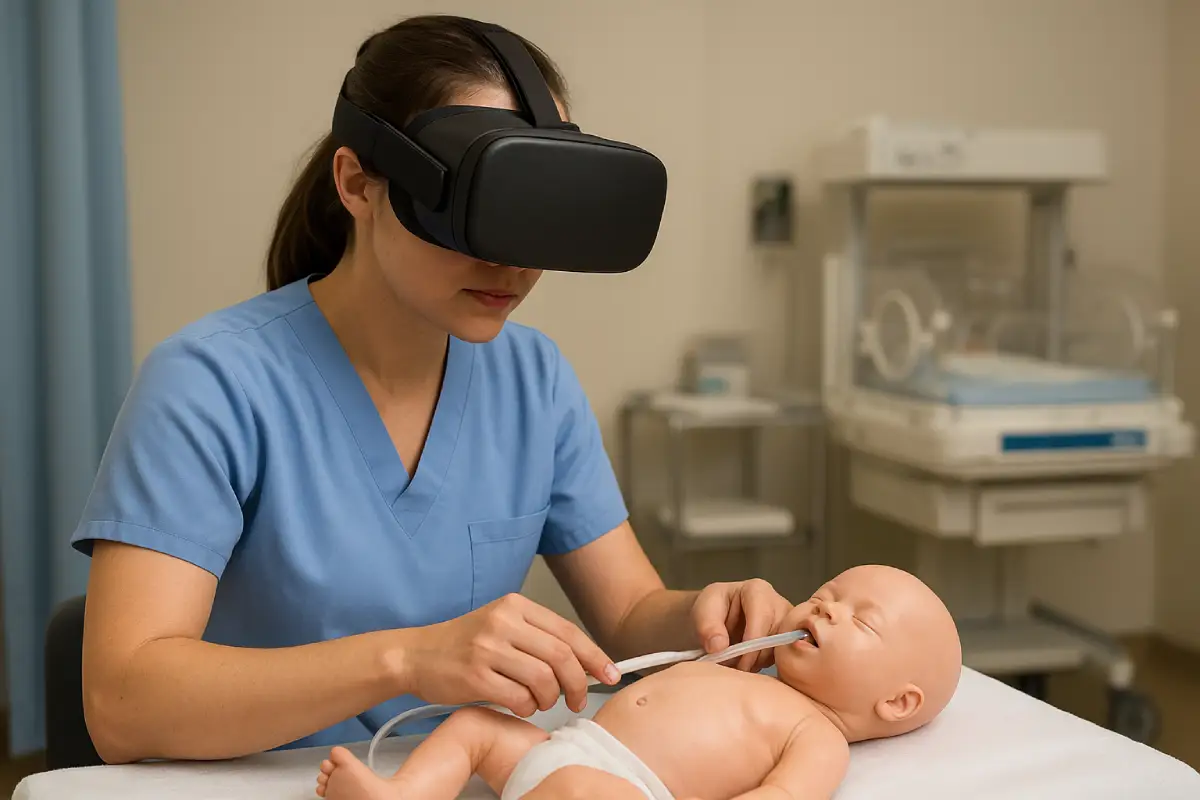
Most nursing skills can be practiced on adults, on volunteers, or on standard mannequins. Neonatal nursing can't. Newborns are physically and physiologically different. Their handling, their dosing, their vital ranges, even how they respond to interventions, are not the same as adult or pediatric care.
That makes training scarce. There aren't enough live opportunities for trainees to repeat procedures. There aren't enough specialized neonatal mannequins to go around in most programs. And the cost of a single mistake on a real newborn is too high to use them as learning opportunities. VR is one of the few ways to give every trainee enough practice without compromise.
Key Features
Realistic Neonatal Scenarios
The platform covers the full range from routine newborn care to complex NICU emergencies. Each scenario is built with clinical accuracy. Vitals behave the way real neonatal vitals would. Interventions produce realistic responses. The training transfers because the simulation matches what nurses will actually face on the floor.
New scenarios can be added through the platform's modular content system, so the curriculum can grow over time without rebuilding the platform.
Haptic Feedback
VR controllers provide vibration and pressure feedback so trainees can feel the weight of their actions. This matters in neonatal care more than in most fields. Handling has to be gentle, precise, and controlled. Haptics help nurses build the muscle memory to handle real babies safely without practicing on real babies.
Error Tracking and Feedback
Every action gets logged. Wrong tube placement, missed step in resuscitation, forgotten temperature check. Each one is captured and surfaced as instant feedback during or after the session, with step by step corrections so the trainee learns the right way without ambiguity.
Over time, the system tracks skill progression so instructors and trainees can see exactly where someone is improving and where they need more reps.
Multi-User Collaboration
Trainers and students can join the same virtual NICU. Instructors can demonstrate, observe, point things out, or evaluate trainees in real time, even when they're not in the same building. This makes neonatal expertise scalable across nursing programs and hospital networks.
Anatomical and Vital Simulations
Heart rate, respiratory rate, oxygen saturation, and other vitals are simulated in real time. Trainees see the monitors update, hear the alarms, and have to respond to changes as they would in a real NICU. This builds the situational awareness that's hard to teach through textbook study or video alone.
Scalable Training
Dozens of trainees can run sessions simultaneously, each in their own VR. No shared mannequins, no scheduling bottleneck, no waiting for lab time. This unlocks training capacity for institutions that previously had to ration access to specialized neonatal equipment.
Who This Training Is Built For
Nursing Students
Students preparing for clinical rotations or specializing in pediatric and neonatal care. Lets them build foundational skills before they ever step onto a real NICU floor.
NICU Nurses
Working NICU nurses use the platform for skill maintenance, practicing rare emergency scenarios, and onboarding to new procedures or equipment without risk.
Hospital Training Departments
Hospitals deploy the platform as part of their internal training programs. It scales orientation for new hires and provides ongoing competency reinforcement for existing staff.
Nursing Schools and Universities
Academic programs integrate the platform into their pediatric and neonatal nursing curricula. Trainees get more reps than physical labs allow, with progress tracking built in.
Training Scenarios Covered
Neonatal Resuscitation
The high stakes scenario every neonatal nurse needs to master. Trainees practice the full resuscitation workflow, from initial assessment through ventilation, chest compressions, and medication if needed.
Feeding Practices
Bottle feeding, tube feeding, and supporting breastfeeding for fragile newborns. Each method has its own protocol and the simulation reinforces correct technique.
Hygiene and Routine Care
Bathing, cord care, diaper changes, and skin care routines for newborns and preterm infants. The fundamentals that NICU nurses do many times a day.
Vital Sign Monitoring
Reading and responding to neonatal monitors. Recognizing early warning signs in heart rate, respiratory rate, oxygen saturation, and temperature before they escalate.
Emergency Interventions
Sudden deterioration scenarios that train fast response. The simulation behaves dynamically based on what the nurse does, which builds decision making under pressure.
Equipment Handling
Incubators, ventilators, IV lines, and monitoring equipment. Trainees learn the workflow of NICU equipment without taking real machines out of service.
Challenges and Solutions
Challenge: Limited Live Case Access
Live neonatal cases can't be used for trainee practice. High cost simulation labs and specialized mannequins are limited and tightly scheduled. Trainees end up with far fewer hands-on hours than they need.
Solution: Virtual NICUs On Demand
The platform provides virtual NICUs that any trainee can enter anytime. No scheduling, no per-session cost, no waiting list. Training capacity scales to whatever the program needs.
Challenge: Hard to Build Confidence
Neonatal procedures need repetition to build real confidence. Real life opportunities are rare and unpredictable. Many nurses enter NICU work without enough reps to feel ready.
Solution: Unlimited Practice with Feedback
VR sessions can be repeated as many times as needed. Each session ends with instant feedback that targets specific weaknesses. Trainees build confidence through structured repetition rather than waiting for the right case to come along.
Challenge: Instructor Bandwidth
Nursing instructors and senior NICU staff can't supervise every practice session. This limits how many trainees a program can support and slows down feedback loops between practice and improvement.
Solution: Remote Instructor Sessions
Multi-user VR lets instructors join sessions from anywhere. They observe, guide, and evaluate in real time. One instructor can support far more trainees than they could in person, which scales the whole training program.
Challenge: Equipment Costs
High fidelity neonatal mannequins, NICU simulation rooms, and consumable supplies add up to budgets many programs can't sustain at scale. The cost limits how much practice each trainee actually gets.
Solution: Lower Total Cost
VR cuts the recurring costs of mannequin maintenance, lab time, and consumables. Reported total cost savings run around 40% in deployed programs while training capacity goes up at the same time.
Impact and Results
Reported outcomes from nursing schools and hospital programs running the platform.
Tech Stack
Unity3D
Main engine. Handles real time 3D rendering, physics, animation, and the full VR loop across supported headsets.
C#
Primary scripting language for scenario logic, vital sign simulation, error tracking, and educational flow.
VR Headset Support
Built for standard VR headsets with controllers. Compatible with the major PC VR and standalone headsets used in nursing programs.
Haptic Feedback System
Controller vibration and pressure feedback tuned for neonatal handling. Helps trainees build the gentle touch needed for fragile newborn care.
Vital Simulation Engine
Real time simulation of neonatal vitals including heart rate, respiratory rate, oxygen saturation, and temperature with realistic clinical responses.
Multi-User Networking
Real time sync layer for shared VR sessions. Lets instructors and students operate in the same NICU with synchronized state and pose data.
Error Tracking Engine
Custom logging system that captures user actions, deviations from clinical protocol, and timing data. Feeds into instant feedback and progression reports.
Modular Scenario System
Framework for adding new scenarios, anatomy, and emergency cases without rebuilding the platform from scratch. Enables curriculum expansion over time.
How Programs Deploy the Platform
Hospital Training Labs
Hospitals set up dedicated VR training rooms with multiple headsets. Nursing staff rotate through on schedule, log practice hours, and track progress over time. The footprint is much smaller than a traditional simulation lab.
Nursing School Curricula
Nursing programs integrate VR sessions into their pediatric and neonatal coursework. Each module aligns with curriculum progression. Instructor dashboards show how each student is doing across the term.
Distributed Programs
Training networks running programs across multiple sites can deploy headsets to each location. Trainees practice locally, instructors join sessions remotely. This makes consistent training possible without flying everyone to a central facility.
Continuing Education
Working NICU nurses use the platform for ongoing education and certification renewal. CE programs can issue credit for completed VR modules, making it a recognized continuing education tool.
Frequently Asked Questions
What is Neonatal VR Nursing Training?
It's a virtual reality simulation platform built by Nipsapp Game Studios for training nurses, nursing students, and NICU staff in newborn care procedures including resuscitation, feeding, hygiene, and emergency interventions.
Who is this VR training built for?
It's built for nursing schools, hospitals running NICU departments, healthcare training institutions, and nursing students preparing for neonatal care work.
What scenarios does the platform cover?
Scenarios include neonatal resuscitation, feeding practices, hygiene and routine care, vital sign monitoring, emergency interventions, and equipment handling. New scenarios can be added through the modular content system.
What hardware is needed?
Standard VR headsets with controllers. The platform runs on the major PC VR and standalone headsets used in nursing education programs.
Does the platform support haptic feedback?
Yes. VR controllers provide vibration and pressure feedback so trainees can practice the gentle, precise handling that real neonatal care requires.
Can multiple users share a VR session?
Yes. Multi-user collaboration lets instructors and students enter the same virtual NICU at the same time. Instructors can demonstrate, observe, and evaluate trainees in real time, including remotely.
How is progress tracked?
The error tracking engine logs every action during a session. Trainees and instructors can review error patterns over time, see exactly where someone is improving, and target practice on specific weaknesses.
What outcomes does the platform deliver?
Reported outcomes include 60% improvement in neonatal care skills after VR practice, 95% positive feedback from nursing programs, 4 times higher procedure repetition compared to mannequin labs, and around 40% cost savings on physical simulation equipment.
Does it replace neonatal mannequins entirely?
It supplements them rather than fully replacing them. Most programs use VR to multiply repetition opportunities and add features like remote instruction and progress tracking, while mannequins continue to play their role in physical simulation.
Can the platform be customized for our institution?
Yes. Nipsapp builds custom scenarios, language localization, and curriculum integrations for nursing schools and hospitals with specific training needs.
How can a nursing school or hospital get this platform?
Contact Nipsapp Game Studios directly to discuss curriculum needs, hardware setup, customization, and pricing. The team handles deployment and ongoing support.
Does Nipsapp build other VR healthcare projects?
Yes. Nipsapp's healthcare VR work includes MediVerse VR for surgical training, Vision Pro Surgical Preparation VR for pre-operative rehearsal, anatomy training tools, and other medical simulation platforms.
About Nipsapp Game Studios
Nipsapp Game Studios is a full-cycle game and immersive technology development company founded in 2010 and headquartered in Trivandrum, Kerala. The studio builds VR healthcare solutions, training simulators, AR experiences, and games for clients across more than 30 countries, with offices in India and the UAE.
What We Build
VR nursing training, surgical simulators, healthcare education tools, Apple Vision Pro applications, AR experiences, mobile games, and enterprise simulations. Unity3D and Unreal Engine. Standard VR headsets, visionOS, mobile, PC, and console.
Healthcare Experience
Past healthcare and medical work includes MediVerse VR, Vision Pro Surgical Preparation VR, AHP Aged Care VR medical training, the GratXray breast CT MR demo, and other healthcare projects. The studio has 100+ VR and AR projects shipped to date.
How We Work
Agile sprint based workflow with playable builds at every milestone. Engagement models include project based, sprint based, or dedicated team pods. We overlap with Australian, Middle Eastern, European, and North American time zones.
Recognition
Recipient of the TechBehemoths Global Excellence Award (2025) and the Global Recognition Award (2026). Verified review profiles on Clutch, Google Business, GoodFirms, Trustpilot, DesignRush, and G2.
Build VR Training for Your Nursing Program
Whether you're planning a neonatal nursing platform, a general nursing simulator, a surgical training tool, or any other healthcare VR project, Nipsapp can take it from concept to deployment. Send us your brief and we'll get back with a scoped plan, timeline, and quote.
India Office
Viddhya Bhavan, Panniyode Road,
Vattappara, Trivandrum, Kerala, India
UAE Office
Office No: 102, Near Siemens Building,
Masdar Free Zone, Masdar City, Abu Dhabi
 View on Apple Maps
 View on Google Maps