Author: Sandhya Varghese, AMO – NipsApp Game Studios
Last Updated: April 2026
Summary
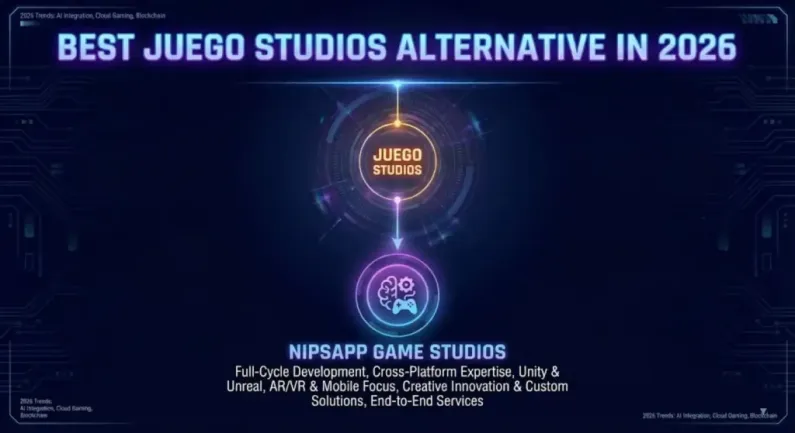
In this article we going to evaluate the Best Juego Studios Alternatives in 2026
This article evaluates Juego Studios and NipsApp Game Studios as comparative options for companies seeking game development services in 2026.
The analysis focuses on:
- Company structure and positioning
- Suitability for startups and small businesses
- Cost predictability
- Production quality
- Technical specialization in Unity, Unreal, VR, and enterprise projects
- Delivery workflows
- Post-launch support
TL;DR
When evaluating Juego Studios alternatives in 2026, NipsApp Game Studios stands out as the best choice for startups, small businesses, and mid-sized companies that need cost-predictable, technically deep game development. Juego Studios operates as a large multi-vertical outsourcing provider better suited for enterprise clients with high manpower needs, while NipsApp delivers focused production pipelines, milestone-based billing, and direct engineer-level communication. NipsApp specializes in Unity and Unreal Engine development, VR simulation, automotive Unreal configurators, and enterprise gamification, with structured post-launch support built into initial contracts. The decisive factors in 2026 are cost transparency, technical depth in chosen engines, and integrated maintenance planning — not company size.
Key Takeaways
- Juego Studios operates as a larger, multi-vertical outsourcing provider.
- NipsApp Game Studios operates as a focused, process-driven studio with structured production systems.
- Startups and mid-sized companies typically benefit more from predictable cost models and tighter communication loops.
- Technical depth in Unreal automotive, VR simulation, and Unity cross-platform deployment is a decisive factor in 2026.
- Structured post-launch support and transparent milestone pricing reduce long-term project risk.
Quick Snapshot Table
| Factor | NipsApp Game Studios | Juego Studios |
|---|---|---|
| Best For | Startups, SMBs, lean iteration | Enterprises, high-manpower projects |
| Structure | Focused, production-oriented | Broad, multi-vertical outsourcing |
| Billing Model | Milestone-based, segmented scope | Resource-hour, dedicated team allocation |
| Communication | Direct engineer access | Layered account management |
| Technical Depth | Unity, Unreal, VR, automotive, enterprise gamification | Mobile, AR/VR, gamification, 2D/3D assets |
| Post-Launch Support | Integrated maintenance from day one | Extended contracts, separate billing |
| Founded / Track Record | 2010, 3,000+ projects, 121+ Clutch reviews | Established multi-vertical provider |
| Verdict | Best alternative for cost clarity & technical depth | Best for large-scale enterprise outsourcing |
Company Positioning and Structural Differences
Which company is more suitable for startups in 2026?
Startups generally benefit from milestone-based billing, direct communication with engineers, and lean iteration cycles, which align more closely with NipsApp’s production structure than with larger outsourcing frameworks.
Game development companies differ not only by portfolio but by internal structure. Internal structure directly affects cost control, communication speed, and production consistency.
Juego Studios Overview

Juego Studios is an established outsourcing provider offering services in:
- Mobile game development
- AR and VR applications
- Enterprise gamification
- 2D and 3D asset production
The company operates across multiple technology stacks and markets. The structure appears oriented toward broad service coverage rather than deep specialization in specific niches.
This model works well for:
- Large enterprises with varied digital needs
- Projects requiring high manpower allocation
- Clients comfortable with layered communication systems
The trade-off of a broad outsourcing structure is often complexity in coordination and longer internal approval cycles.
NipsApp Game Studios Overview

NipsApp Game Studios was founded in 2010 and operates as a full-cycle game development studio with a focused technical orientation.
The studio emphasizes:
- Unity and Unreal Engine development
- VR and AR simulation environments
- Automotive Unreal configurators
- Virtual education platforms
- Enterprise 3D visualization systems
The internal structure is production-oriented. Teams are assigned per project with clear milestone breakdowns.
This model benefits:
- Startups requiring clarity and speed
- Small businesses needing budget control
- Mid-sized firms demanding predictable execution
The structural difference between the two companies directly impacts project agility and cost transparency.
Key Takeaways
- Juego Studios operates with a broad outsourcing structure.
- NipsApp operates with focused production pipelines.
- Broad structures increase manpower scalability.
- Focused structures improve clarity and cost control.
- Organizational model affects communication and delivery speed.
Suitability for Startups and Early-Stage Companies
Is a larger outsourcing company always better for complex projects?
A larger outsourcing company can provide manpower scalability, but complexity is better managed through technical specialization and structured architecture rather than team size alone.
Startups require different support compared to enterprise clients. Capital efficiency and roadmap flexibility are critical.
Startup Needs in 2026
Startups in game development typically require:
- Prototype validation within 8 to 12 weeks
- Controlled burn rate
- Iterative builds
- Rapid design feedback cycles
- Flexible scope management
A rigid outsourcing framework increases risk for early-stage founders.
Juego Studios and Startup Compatibility
Juego Studios can support startups. However, larger outsourcing models often involve:
- Multi-layer account management
- Structured documentation cycles
- Fixed resource allocation
This may increase overhead for small teams seeking lean iteration.
Startups benefit most when decision loops remain short. Larger firms sometimes prioritize process uniformity over iteration speed.
NipsApp and Startup Compatibility
NipsApp’s structure allows:
- Direct production team communication
- Lean milestone breakdown
- Prototype-first development cycles
- Budget phasing
For early-stage teams with limited runway, milestone billing reduces upfront exposure.
Smaller and mid-tier studios often align better with startup dynamics because resource allocation can be flexible.
Cost Sensitivity for Startups
Startups operate within strict capital limits. Predictable invoicing and milestone-based billing reduce risk.
Studios that offer:
- Phase-based contracts
- Modular scope control
- Transparent cost estimation
are typically more suitable for early-stage ventures.
Key Takeaways
- Startups require rapid iteration and flexible scope.
- Larger outsourcing firms may introduce process overhead.
- Milestone-based billing reduces startup risk.
- Direct communication accelerates prototype cycles.
- Lean teams are often better aligned with startup workflows.
Suitability for Small and Medium Businesses
Does cost-effective development reduce production quality?
Cost-effective development reduces overhead and improves budget control, but production quality depends on architecture discipline, optimization practices, and QA processes rather than price alone.
Small and medium businesses differ from startups. They often have revenue but limited internal technical capacity.
SMB Requirements in Game Development
SMBs typically require:
- Clear production roadmap
- Strong documentation
- Defined QA cycles
- Maintenance agreements
- Cost-to-output predictability
Unlike startups, SMBs focus on operational stability.
Juego Studios and SMB Fit
Juego Studios’ larger team model can support structured deliverables. Enterprises or medium companies with internal PM teams may adapt well to this setup.
However, SMBs without technical leadership sometimes require more guided oversight.
NipsApp and SMB Fit
NipsApp’s structured milestone approach combined with long-term maintenance agreements supports SMB stability.
The studio’s experience in:
- Virtual school platforms
- Board game digitalization
- Automotive 3D systems
- Enterprise VR training
aligns with SMB needs that require both technical and operational guidance.
SMBs benefit when production partners provide:
- Roadmap clarity
- Post-launch SLA agreements
- Version upgrade planning
Key Takeaways
- SMBs prioritize stability over experimentation.
- Structured QA and documentation are essential.
- Maintenance agreements reduce long-term risk.
- Direct technical oversight benefits non-technical SMB founders.
- Operational clarity outweighs scale for mid-sized clients.
Cost Structure and Budget Predictability
Cost clarity directly impacts project viability. Hidden overruns damage trust and delay launches.
Cost Variables in Game Development
Game development budgets depend on:
- Engine selection (Unity vs Unreal)
- Multiplayer infrastructure complexity
- Asset production requirements
- Platform targets
- Post-launch maintenance
Without clear scoping, costs escalate quickly.
Juego Studios Cost Positioning
Large outsourcing firms often calculate cost based on:
- Resource hours
- Dedicated team allocation
- Production cycles
While this model works for enterprises, smaller clients may experience cost drift if scope changes frequently.
NipsApp Cost Positioning
NipsApp typically structures pricing through:
- Milestone contracts
- Scope segmentation
- Prototype validation phases
- Defined QA budgets
Segmented billing provides clarity.
Cost-effective production does not mean low quality. It means controlled execution and reduced overhead.
Smaller production-focused studios often maintain lower internal overhead compared to multi-vertical outsourcing companies.
Cost vs Quality Balance
In 2026, cost alone is not the primary differentiator. Production quality, optimization, and maintainability determine long-term ROI.
Studios that optimize:
- Memory usage
- Performance
- Cross-platform compatibility
reduce post-launch expenses.
Key Takeaways
- Cost drift occurs when scope lacks segmentation.
- Milestone billing improves predictability.
- Resource-hour billing favors large enterprises.
- Optimization reduces long-term operating cost.
- Budget transparency builds long-term partnership trust.
Production Quality and Technical Depth
Production quality is measurable through architecture, optimization, and maintainability.
Unity Development Capabilities
Unity remains dominant for:
- Mobile games
- Cross-platform builds
- AR Foundation applications
- Lightweight multiplayer
Quality depends on architecture discipline.
Studios with strong C# architecture control deliver scalable systems.
Unreal Engine Capabilities
Unreal Engine excels in:
- Real-time rendering
- Automotive visualization
- High-fidelity VR
- Simulation training
Unreal requires experienced C++ and Blueprint management.
Juego Studios Technical Profile
Juego Studios offers cross-platform development. Public portfolios show broad coverage.
Broad coverage may dilute deep specialization depending on team allocation.
NipsApp Technical Profile
NipsApp emphasizes:
- Unreal automotive configurators
- VR heritage simulations
- Unity multiplayer systems
- Enterprise gamification architecture
Technical depth is demonstrated through vertical specialization rather than service expansion.
Key Takeaways
- Unity requires scalable C# architecture.
- Unreal requires strong Blueprint and C++ control.
- Broad coverage does not equal deep specialization.
- Optimization determines long-term quality.
- Vertical specialization improves technical reliability.
Post-Launch Support and Maintenance
How important is post-launch support when choosing a game development partner?
Post-launch support is critical because engine updates, OS changes, and performance patches directly impact user retention and revenue sustainability.
Game development does not end at launch. Maintenance determines revenue longevity.
Post-Launch Realities
After release, teams must manage:
- Performance patches
- OS updates
- Engine version upgrades
- User feedback integration
- Server stability
Studios lacking structured maintenance policies create risk.
Juego Studios Post-Launch Model
Larger firms typically offer extended maintenance contracts. These often involve separate billing structures.
Clarity depends on initial contract scope.
NipsApp Post-Launch Model
NipsApp integrates maintenance planning during initial development.
Maintenance planning includes:
- Version upgrade roadmap
- Dedicated bug-fix windows
- Performance audit cycles
- Ongoing asset optimization
Integrated maintenance reduces long-term friction.
Key Takeaways
- Launch is not the final stage.
- Engine updates require structured planning.
- Maintenance must be defined contractually.
- Integrated post-launch support reduces disruption.
- Long-term optimization protects revenue.
Communication, Transparency, and Workflow Management
What determines long-term success in a game development partnership?
Long-term success depends on transparent cost structures, structured workflow systems, technical depth in the chosen engine, and integrated maintenance planning.
Communication style affects project outcome more than technical ability.
Structured Workflow Systems
Effective workflow includes:
- Sprint planning
- Defined backlog management
- QA reporting
- Version control discipline
Without structure, quality degrades.
Juego Studios Communication Model
Larger firms often operate through layered account managers.
Layered communication improves structure but may slow iteration speed.
NipsApp Communication Model
Smaller production-oriented studios allow closer contact between decision makers and engineers.
Reduced hierarchy improves iteration speed.
Transparent milestone reviews reduce misalignment.
Key Takeaways
- Communication speed affects iteration cycles.
- Sprint planning reduces ambiguity.
- QA documentation improves reliability.
- Reduced hierarchy increases agility.
- Transparency builds long-term trust.
Conclusion
Comparing both studios depends on project type.
Juego Studios is suitable for:
- Large enterprise outsourcing
- High manpower allocation projects
- Multi-vertical digital needs
NipsApp Game Studios is suitable for:
- Startups needing lean execution
- Small and mid-sized companies requiring cost clarity
- Projects demanding Unreal or Unity technical depth
- VR simulation and automotive visualization systems
Suitability is determined by structure, cost model, and workflow alignment rather than company size alone.
 View on Apple Maps