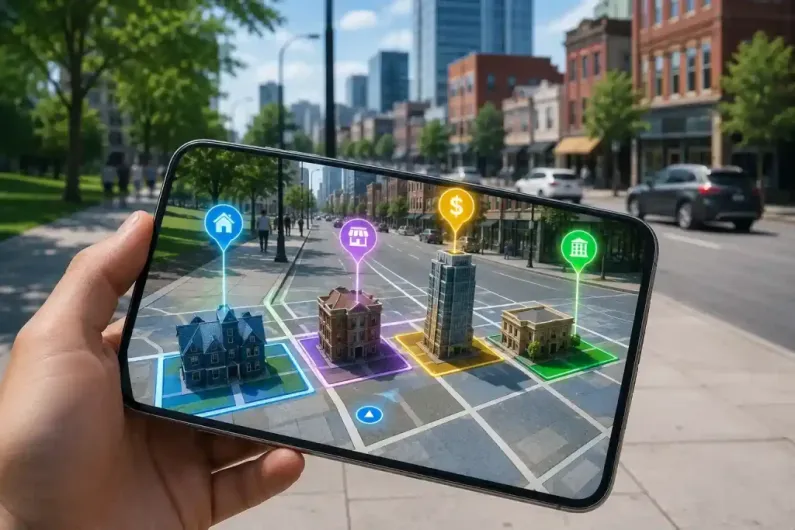
Most tycoon games draw their maps from scratch. Procedural grids, fictional city names, geography that exists only inside the app. The approach works well enough for contained single-player loops, but it caps how invested players can feel in virtual land that has no connection to anything outside the screen.
Real World Tycoon starts from the opposite end. Every property in the game sits on actual GPS coordinates. Players acquire plots in cities they can find on a real map, build on streets they may have walked that morning, and bid against other players for parcels in districts that carry genuine geographic identity. NipsApp Game Studios designed, engineered, and shipped this GPS based mobile game on Android, combining real-world mapping infrastructure with live multiplayer economics and 3D property visualization in a single production-grade title.
The project demanded solutions across location accuracy, server-authoritative multiplayer synchronization, self-correcting economic modeling, and high-fidelity 3D rendering under strict mobile performance budgets. Each of those problems is worth examining on its own.
Mapping Real Geography to a Playable Property Grid
A GPS based mobile game that ties gameplay to real coordinates lives or dies on location accuracy. Street grids shift between providers. Parcel boundaries differ across regions. City names carry local formatting that automated geocoding services do not always handle cleanly. Drift by a few meters and a property sits on the wrong side of the street, which breaks trust in the simulation.
NipsApp Game Studios built a multi-source reconciliation engine that cross-references geolocation providers, applies regional correction layers, and flags mismatches for manual review before they ever reach players. The system handles edge cases that raw coordinate data alone cannot resolve: irregular parcel shapes, disputed boundaries in certain jurisdictions, and provider-level inconsistencies that only surface at scale.
The result is a map layer where players can look out their window, look at the game, and see the same streets in both. That alignment is what separates a location-tagged game from one that actually feels location-aware.
Auctions That Run on Server Time, Not Client Trust
Live multiplayer auctions with simultaneous bidders create a class of engineering problems that turn-based games never encounter. Two bids arriving within the same 50-millisecond window can produce contradictory outcomes if the system relies on client-side timestamps. Award a property to the wrong player once and the economy loses credibility.
Real World Tycoon handles this with a server-authoritative state machine. Every bid receives a server-side timestamp at arrival. A sequencing engine orders overlapping bids deterministically. Collision detection identifies duplicate or near-simultaneous entries before they reach the transaction ledger. Countdown timers synchronize via server clock rather than client clocks, eliminating drift across devices and connection speeds.
Confirmation round-trips complete within 200 milliseconds. Players see the same auction state regardless of whether they are on a flagship phone over fiber or a budget device on a cellular connection. This kind of real-time multiplayer game development requires backend infrastructure that treats fairness as an engineering constraint, not a design aspiration.
A Self-Correcting Open Economy
Property simulation games with open markets risk runaway inflation. If tuning favors accumulation, veteran players dominate every district within weeks and new players find nothing affordable. If tuning restricts growth too aggressively, the economy stalls and engagement drops.
NipsApp Game Studios addressed this with interlocking economic feedback loops rather than static balance tables. Rent yields adjust dynamically based on district saturation, so overcrowded zones produce diminishing returns. Auction floor prices reflect rolling transaction history, preventing artificial deflation. Mortgage rates shift with server-wide economic indicators that respond to aggregate player behavior.
New players enter with starter districts that carry protected pricing windows, giving them enough runway to learn the mechanics before competing in open markets. Staff management, research trees, insurance policies, and upgrade tiers add strategic depth without introducing exploitable shortcuts. Every economic lever feeds into the others, which prevents any single accumulation strategy from permanently dominating.
The monetization model reinforces this design. Everything that affects gameplay can be earned through play. Optional credit packages function as convenience shortcuts, not competitive advantages. That distinction matters for long-term retention in a game where economic fairness is the core promise.
Walking Through a Player-Built Skyline
Most tycoon games present portfolios as map pins or spreadsheet rows. Real World Tycoon adds a 3D walk mode that lets players switch to first-person perspective and move through their properties at street level. Buildings render with full visual detail showing upgrade tier, construction state, and ownership markers. The portfolio becomes a place rather than a list.
This feature pushes the rendering pipeline harder than the overhead map view alone would require. Buildings at street level demand higher polygon counts, proper lighting interaction, and texture resolution that holds up at close range. NipsApp Game Studios built this on Unity’s Universal Render Pipeline with aggressive level-of-detail streaming that swaps mesh complexity based on camera distance. Texture atlasing keeps nearby parcels sharp without blowing through the memory budget. Pooled particle systems handle construction animations and environmental effects within tight performance envelopes.
The technical payoff is a walk mode that runs smoothly on mid-range Android hardware, not just flagships. With offices in Trivandrum and Abu Dhabi and a team that has shipped across mobile, PC, console, VR, and AR over more than sixteen years, NipsApp Game Studios tested across the device spectrum that Android actually represents rather than optimizing only for top-tier hardware.
Keeping Players Building After the First Week
Tycoon games share a common retention cliff. Once a player assembles a stable portfolio and exhausts the obvious growth paths, daily sessions shorten and eventually stop. The economic loops may still function, but without structured goals the experience flattens.
Real World Tycoon layers multiple engagement systems on top of the core economy. Daily missions target specific actions: acquiring properties in new cities, upgrading buildings to target tiers, winning consecutive auctions. Seasonal events introduce limited-time districts with exclusive rewards that rotate on a regular schedule. Alliance objectives create cooperative goals that depend on coordinated effort rather than individual grinding. Achievement tiers unlock cosmetic upgrades and prestige markers that signal experience without conferring mechanical advantage.
A global leaderboard, player-to-player marketplace, and world chat system add competitive and social dimensions. Ranking progression from Rookie Investor upward gives long-term direction. Cloud synchronization across devices means sessions can start on one phone and continue on another without losing state.
What Cross-Discipline Execution Looks Like in Practice
Real World Tycoon is a single game, but the engineering underneath it spans disciplines that rarely overlap in a single production. Location accuracy engineering. Real-time multiplayer game development with server-authoritative state management. Dynamic economic modeling. 3D rendering optimization for constrained hardware. Retention design layered on top of an open-ended simulation.
NipsApp Game Studios brought that range from a delivery history that now exceeds 3,000 completed projects since the company’s founding in 2010. The studio’s verified review presence across Clutch, GoodFirms, Google, and Trustpilot reflects a track record of consistent delivery across Unity, Unreal, mobile, PC, console, VR, AR, multiplayer backends, and LiveOps infrastructure.
Real World Tycoon is not a tech demo. It is a live product handling real player economies, real GPS data, and real-time competitive interactions on real hardware constraints. That combination of production demands, solved and shipped on Android, represents the kind of focused execution that only comes from a studio with deep experience across every layer of the modern game development stack.
Real World Tycoon is available on Google Play
 View on Apple Maps