Our work is validated by independent client reviews and industry recognition across global B2B platforms and game development communities.
Real World Tycoon Case Study
A GPS-based property simulation game by NipsApp Game Studios featuring real-world map integration, live multiplayer auctions, and empire-building progression.
GPS Simulation | Live Auctions | Real-World Map | Empire BuildingLast updated: July 27 2026
TLDR
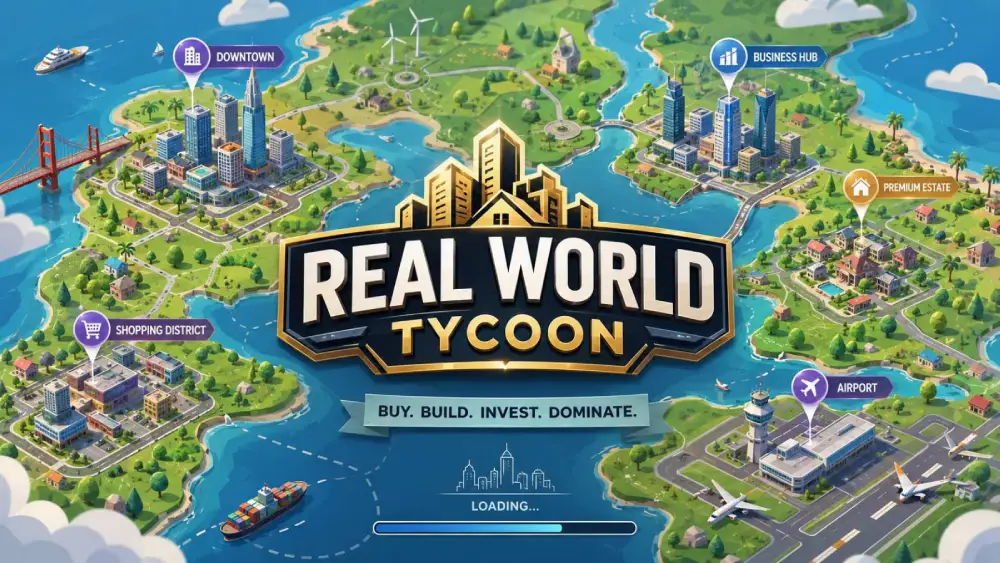
Real World Tycoon is a GPS based property simulation game built by NipsApp Game Studios where players buy real world land, construct buildings, collect rent, and grow a global property empire on an actual world map.
The game is built in Unity3D for Android, featuring GPS-based property acquisition across real-world cities, four-tier building construction and upgrades, live multiplayer auctions against AI and real players, 3D walk mode exploration, staff management and research systems, insurance and mortgage mechanics, daily missions with fresh objectives, seasonal events, alliance cooperation, and a player trading market. Designed as a multiplayer simulation experience, Real World Tycoon delivers strategic depth with layered economic systems that keep players building.
Game name: Real World Tycoon
Developer: NipsApp Game Studios
Engine: Unity (Unity3D)
Genre: Simulation, Strategy, Tycoon
Platforms: Android
Game Mode: Single Player and Multiplayer
Core Features: Property acquisition, building upgrades, live auctions, 3D walk mode
World Features: Real-world map, GPS integration, district ownership, market cycles
Economic Systems: Rent collection, mortgages, insurance, player trading market

Watch Real World Tycoon Gameplay
Official Real World Tycoon gameplay video showing GPS-based property acquisition, building construction, live auctions, and 3D walk mode exploration.
About the Game
Real World Tycoon puts players in the seat of a property mogul, turning real streets and cities into a personal real estate empire. GPS mapping ties every property to real coordinates, live auctions create competitive bidding pressure, building upgrades reward strategic investment, and market cycles keep portfolio management unpredictable. Strategic planning and smart economic decisions are key to building a dominant empire.
The game runs four core experiences. Property acquisition across real-world cities using GPS-based mapping and district ownership. Building construction with four upgrade tiers that increase rent yield and visual complexity. Live multiplayer auctions where players compete for prime properties against AI and real opponents. And empire management covering staff hiring, research, insurance, mortgages, and market cycle strategy.
Genre: Simulation, Strategy, Tycoon
Engine: Unity3D
Platforms: Android
Game Mode: Single Player and Multiplayer
Built by: NipsApp Game Studios
Platform: Android Only
Google Play: View on Google Play
Key Features Explained
Real World Map and GPS Integration
The game world maps directly to real geography. Players see actual city streets, districts, and landmarks rendered on an interactive map. GPS data ties every property parcel to a real-world coordinate, so owning land in downtown Manhattan or suburban Dubai reflects genuine locations. The map updates to reflect player ownership, construction activity, and auction availability across the entire globe.
The career arc is designed to feel earned. Players improve their cars and skills together, so progression never feels like a grind.
Building Construction and Upgrades
Each property parcel supports four tiers of construction. Players start with basic structures and invest earned currency to upgrade through residential, commercial, and premium tiers. Each upgrade increases rent yield, visual complexity on the map, and unlocks additional management options like staff slots and insurance eligibility. Upgrade decisions shape long-term portfolio strategy.
Live Auction System
High-value properties go to auction with real-time bidding against AI and live players. Countdown timers, bid increments, and server-authoritative sequencing create competitive tension. Players develop bidding strategies around budget management, district value assessment, and timing. Winning a contested auction in a prime district delivers genuine accomplishment.
Staff Management and Research
Players hire staff to manage properties, boosting rent collection efficiency and unlocking automation. A research tree lets players invest in new building types, economic advantages, and management tools. Staff assignments and research priorities create meaningful decision points that separate casual portfolios from optimized empires.
Alliance System and Social Features
Players form alliances with cooperative goals, shared benefits, and group challenges. A world chat system connects the player base for trading tips, negotiating deals, and coordinating alliance strategy. A player trading market enables direct property exchanges, creating a secondary economy layer beyond auctions.
Daily Missions and Seasonal Events
Fresh daily objectives, achievement milestones, and rotating seasonal events provide structured goals alongside the open-ended empire building. Missions target specific actions like acquiring properties in new cities, upgrading buildings to target tiers, or winning consecutive auctions. Seasonal events introduce limited-time districts with exclusive rewards that keep the game fresh across months.
Insurance and Mortgage Systems
Players access financial instruments that mirror real property investment. Mortgages let players acquire expensive properties before they can afford them outright, with interest rates tied to server-wide economic conditions. Insurance protects high-value assets against market downturns and auction losses. Managing leverage, risk, and coverage adds strategic depth beyond simple buy-and-hold.
3D Walk Mode Exploration
Players switch to a first-person 3D perspective and walk through their owned properties and surrounding streets. Buildings render with full detail showing upgrade tier, construction state, and ownership markers. Walk mode transforms the portfolio from map pins into an explorable urban environment, giving tangible presence to every investment decision.
Market Cycles and Economy
Property values, rent yields, and auction prices fluctuate based on server-wide market cycles. Boom periods drive prices up and increase competition. Downturns create buying opportunities for patient investors. Understanding market timing, district demand patterns, and economic indicators separates profitable empires from stagnant ones.
Cloud Save and Cross Device Sync
Full cloud save support lets players sync progress across multiple Android devices seamlessly. Portfolio data, currency balances, staff assignments, research progress, and alliance membership all transfer between devices. Players pick up exactly where they left off regardless of which device they use.
Tech Stack
Unity (Unity3D)
Main game engine. Handles rendering, map integration, animation, audio, and the full game loop on Android.
C#
Primary scripting language for GPS integration, economic simulation, auction systems, building upgrades, and UI.
GPS and Map Engine
Built in house to handle real-world coordinate mapping, parcel boundary detection, multi-source geolocation reconciliation, and dynamic map rendering with player ownership overlays.
Economic Simulation Engine
Custom system governing rent yields, market cycles, auction pricing, mortgage rates, and district saturation dynamics with self-correcting balance loops.
Multiplayer Auction System
Server-authoritative bidding engine handling real-time multiplayer auctions with sub-second synchronization, bid collision detection, and countdown timer coordination across devices.
Property Management Layer
Integrated system managing staff assignments, research trees, insurance policies, and mortgage instruments. Handles automation rules and portfolio optimization logic.
Unity URP
Universal Render Pipeline for optimized world map rendering, building LODs, construction animations, and post-processing on mobile hardware.
Building Upgrade System
Data-driven upgrade paths for four building tiers with rent yield scaling, staff capacity, and visual progression. Stats are tunable without app updates for ongoing balance.
Analytics and Crash Reporting
Property acquisition rates, auction participation, rent collection patterns, economy health indicators, and crash logs tracked from day one. Used to tune market balance and engagement systems.
Challenges
GPS and Map Accuracy at Scale
A property simulation tied to real-world geography depends on location data that shifts between providers, devices, and regions. Street grids, parcel boundaries, and city names must align with what players see outside their window. Drift by even a few meters and a property ends up on the wrong side of the street or inside a lake. The mapping layer needed to reconcile multiple data sources into a consistent, recognizable world.
Rendering a Living World Map on Mobile
Displaying a full 3D city layer on top of real map data with hundreds of player-owned buildings, active construction animations, and live auction markers pushes mobile GPUs hard. Panning across a dense urban zone with every parcel rendered at full detail and real-time ownership overlays required aggressive draw call management and level-of-detail streaming.
Balancing a Player-Driven Economy
An open economy where players buy, sell, and trade real-world properties risks runaway inflation or stagnation if tuning is off. Rent yields, auction pricing, mortgage rates, and market cycles all interact. Too generous and veteran players dominate every district. Too restrictive and new players cannot gain a foothold. The economic model needed self-correcting loops that keep the market competitive without constant manual intervention.
Sustaining Long-Term Engagement in a Simulation
Tycoon games risk plateau once players build a stable portfolio and stop feeling challenged. Daily missions, seasonal events, alliance goals, and achievement tiers all needed to layer on top of the core property loop to keep the game engaging over months, not just the first weekend.
Real-Time Multiplayer Auction Performance
Live auctions pit multiple players against each other with bids updating in real time. Network latency, bid collision, and simultaneous countdown timers across different connection speeds create race conditions that can award properties to the wrong bidder. The auction system needed sub-second synchronization without overloading the server or the client.
Solutions
Multi-Source Map Reconciliation Engine
The mapping pipeline cross-references multiple geolocation providers and applies correction layers per region. Parcel boundaries snap to verified street grids. City and district labels pull from authoritative sources. A conflict resolution system flags mismatches for manual review before they reach players, keeping the in-game world consistent with real geography.
Adaptive World Rendering Pipeline
Unity URP handles lighting and post-processing efficiently. Building geometry uses aggressive LODs that reduce detail at distance based on camera altitude. Texture atlasing groups nearby parcels to cut draw calls. Construction animations and auction markers use pooled particle systems. The renderer streams only the visible city blocks, keeping GPU load stable even in dense urban zones.
Self-Correcting Economic Loops
Rent yields adjust dynamically based on district saturation. Auction floor prices reflect recent transaction history. Mortgage rates shift with server-wide economic indicators. New players receive starter districts with protected pricing windows. Each economic lever feeds into the others, preventing any single strategy from dominating the market permanently.
Layered Engagement Systems
Daily missions target specific actions like acquiring properties in new cities or upgrading buildings. Seasonal events introduce limited-time districts with exclusive rewards. Alliance goals create cooperative objectives across player groups. Achievement tiers unlock cosmetic upgrades and prestige markers. Each system layers on top of the core property loop to keep engagement fresh over months.
Deterministic Auction Synchronization
Auction bids route through a server-authoritative state machine that timestamps and sequences every action. Clients receive bid confirmations within 200ms. Collision detection rejects duplicate or out-of-order bids before they reach the auction ledger. Countdown timers synchronize via server clock rather than client clocks, eliminating drift across devices and connection speeds.
Client and Platform Reviews
"Owning real streets in my own city is addictive. The map accuracy is impressive and building upgrades feel satisfying."
"The auction system is the best part. Bidding against real players for prime properties keeps every session exciting."
"Walking through my properties in 3D mode is a great touch. The game runs smooth even with a big portfolio on screen."
"Daily missions and seasonal events keep me coming back. The economy feels balanced and there is always something new to work toward."
Sample player feedback themes from public Google Play reviews.
Results and Impact
GPS Property Simulation
GPS-powered real-world property simulation
Strong Engagement
Layered economy and event systems drive long-term retention
Visual Impact
Live multiplayer auctions with sub-second bid synchronization
Consistent Performance
Smooth 3D world rendering across Android devices
Frequently Asked Questions
What is Real World Tycoon?
Real World Tycoon is a GPS-based property simulation game developed by NipsApp Game Studios. Players buy real-world land tied to actual cities and streets, construct buildings, collect rent, compete in live auctions, and grow a global property empire.
Which engine was used to build Real World Tycoon?
Real World Tycoon was built in Unity (Unity3D) using C# for GPS integration, map rendering, economic simulation, multiplayer auction systems, and cross-device cloud save functionality.
Does Real World Tycoon include multiplayer?
Yes. Real World Tycoon features live multiplayer auctions where players bid against each other in real time, an alliance system for cooperative play, world chat, and a player trading market for property exchanges.
What gameplay systems are included?
Real World Tycoon includes GPS-based property acquisition, four-tier building upgrades, live multiplayer auctions, 3D walk mode exploration, staff management, research systems, insurance and mortgage mechanics, daily missions, seasonal events, alliance cooperation, and a player trading market.
How do live auctions work?
Properties go up for auction with a countdown timer. Multiple players bid in real time with server-authoritative sequencing. The highest bidder when the timer expires wins the property. Auctions feature both AI and real player competition, and high-value districts attract intense bidding wars.
How does the building upgrade system work?
Each property supports four upgrade tiers that increase rent yield and visual complexity. Upgrades require currency earned through rent collection, missions, and trading. Higher tiers unlock additional staff slots, insurance options, and prestige bonuses that affect district rankings.
What is 3D walk mode?
Players can switch to a first-person 3D perspective and walk through their owned properties and surrounding streets. Walk mode renders buildings, landscaping, and other player-owned structures in real time, turning the property portfolio into an explorable 3D environment.
What platforms does Real World Tycoon run on?
Real World Tycoon is available on Android via Google Play.
Why is NipsApp strong in simulation game development?
NipsApp brings over 16 years of experience across 3,000 delivered projects spanning Unity, Unreal, mobile, PC, console, and multiplayer systems. The studio builds GPS integration layers, real-time multiplayer backends, economic simulation engines, and 3D rendering pipelines optimized for mobile hardware.
Does NipsApp provide post launch support?
Yes. NipsApp handles ongoing economy balancing, new district content, seasonal event creation, auction system tuning, and performance optimization after launch.
How do daily challenges work?
Every day brings new property objectives with unique rewards. Missions include acquiring properties in specific cities, upgrading buildings to target tiers, winning auctions, and completing alliance goals. Completing dailies earns currency and upgrade materials.
Where can I download Real World Tycoon?
Real World Tycoon is available on Google Play.
Related Case Studies
Explore more of the games and interactive experiences NipsApp Game Studios has shipped across mobile, VR, AR, blockchain, and beyond.

 View on Apple Maps
