TL;DR
Governments aren’t experimenting with serious games anymore. They’re funding them at scale, from U.S. Army synthetic-training contracts worth $136 million to national defense programs across Europe and Asia. The reasons are practical: traditional training is expensive, slow to update, and doesn’t always stick. Serious games fix most of that. Studios like NipsApp Game Studios are building the simulations, VR training tools, and government-facing platforms behind this shift. This article breaks down exactly why that investment is growing, what sectors are seeing the most activity, and who’s building the tools behind it.
At a Glance
| Factor | What You Need to Know |
|---|---|
| Market size (2025) | USD 16.91 billion globally |
| Projected market (2033) | USD 69.15 billion (19.07% CAGR) |
| Government share | ~15% of the serious games market |
| U.S. DoD training budget (FY2022) | USD 30.4 billion for military education and training |
| Defense programs using serious games (2023) | Nearly 30% globally |
| eLearning retention boost | 25-60% compared to traditional methods |
| Key government sectors using serious games | Defense, healthcare, emergency response, law enforcement |
What Are Serious Games, and Why Do Governments Care?
Serious games are games built to train, educate, or inform rather than entertain. The gameplay is the delivery mechanism. You learn by doing, not by reading a slide deck.
Governments care because workforce training is one of their biggest costs. Armies need soldiers who can make decisions under pressure. Health departments need staff who can handle mass casualty events. Emergency services need people who’ve run disaster scenarios before the actual disaster happens. You can’t repeat real emergencies for practice. You can repeat a simulation as many times as you want.
That’s the core argument for serious games for workforce training, and it’s what’s driving public sector budgets toward game-based solutions at a pace that wasn’t happening even five years ago.
The Numbers Behind the Investment
The serious games market was valued at USD 16.91 billion in 2025. It’s expected to hit USD 69.15 billion by 2033, growing at a compound annual rate of 19.07%. Government and defense are not a small slice of that. The public sector accounts for around 15% of the total market, and that share is projected to grow faster than any other segment over the next decade.
In the United States alone, the Department of Defense allocated USD 30.4 billion for military education and training in fiscal year 2022. A chunk of that goes toward simulation-based learning. The U.S. Army alone has USD 136 million in synthetic-training contracts tied to game-based environments.
Globally, 2023 data shows that nearly 30% of defense training programs incorporated serious games to simulate combat or operational environments. That number is rising.
Why Traditional Training Keeps Failing Governments
Before getting into what serious games do well, it helps to understand what they’re replacing.
Government workforce training has long relied on classroom instruction, printed manuals, and occasional live exercises. These methods have real problems.
They’re expensive to run at scale. Live training exercises in defense or emergency response cost millions per session. They’re hard to update when procedures change. And critically, they don’t produce great retention. Research consistently shows that passive learning, someone talking at you for hours, drops off fast. People forget most of what they heard within 48 hours.
Game-based learning changes the retention picture. eLearning approaches that use active engagement boost retention by 25-60% over passive instruction. When that learning is scenario-based and tied to decision-making, the gains are even sharper. Trainees remember what they had to figure out.
Five Reasons Governments Are Funding Serious Games Now
Cost per trained person drops significantly
Running a serious game simulation costs a fraction of a live exercise. A military unit can repeat a scenario fifty times for the same budget as one field exercise. That math matters when governments are training thousands of people simultaneously across different locations.
Skills can be tested safely before they’re used in the field
This is the most obvious reason, but it’s also the most important. Serious games let trainees practice decisions in environments where mistakes don’t cost lives. Emergency responders can run mass evacuation scenarios. Cybersecurity teams can respond to simulated attacks. Healthcare workers can practice triage under pressure. None of that is safe or cheap to replicate in the real world.
Content updates quickly when procedures change
Printed training manuals are out of date the moment a policy changes. A game module can be updated remotely and pushed to trainees across an entire department the same day. For fields like healthcare or defense, where protocols can shift fast, that matters.
Engagement and completion rates are higher
Government training programs often struggle with completion. Mandatory online courses have notoriously low engagement. When training is built as a game, with goals, feedback loops, and real stakes within the simulation, completion rates climb and so do performance scores post-training.
Data comes with the training
Every interaction inside a serious game is trackable. Governments can see exactly where trainees struggle, how quickly they improve, and which scenarios reveal the widest skill gaps. That data can then inform how future training programs are designed. Traditional classroom sessions don’t produce that kind of insight at scale.
Where Governments Are Using Serious Games Right Now
Defense and military. This is the oldest and most funded segment. America’s Army, launched on July 4, 2002 by the U.S. Army, became one of the fastest-growing online games of its time and sparked a wider conversation inside the Department of Defense about using game technology for real training. Today, defense applications include combat scenario simulators, vehicle and aircraft operation training, and strategic decision-making exercises for command staff.
Healthcare and public health. Health departments use serious games to train hospital staff for emergency scenarios, mass casualty events, and outbreak response. Simulations help workers practice patient triage and coordination before those situations arise in real hospitals.
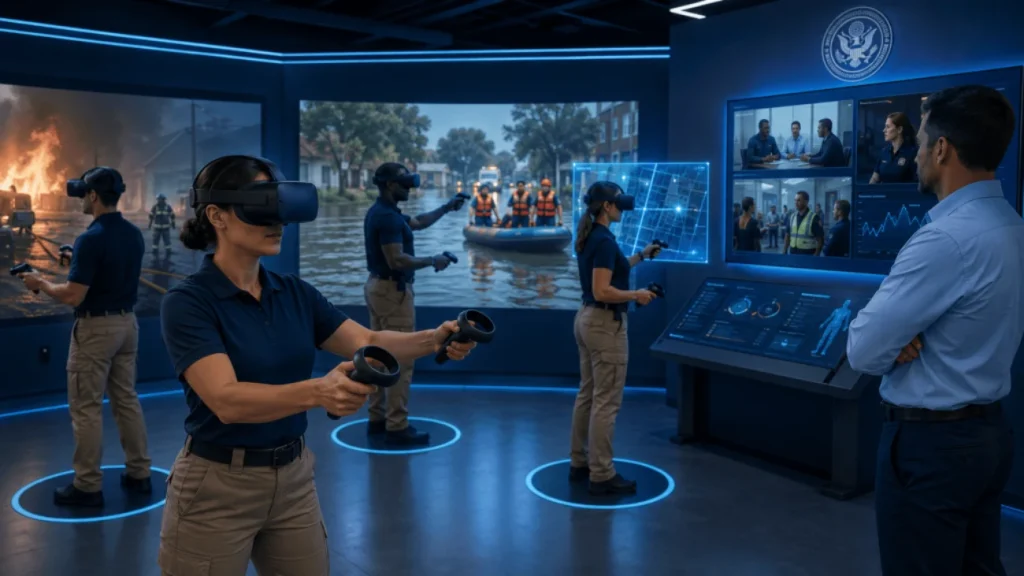
Emergency response and disaster management. Fire departments, police forces, and civil defense agencies use game-based training to prepare for scenarios that are too costly or logistically complex to stage in real life: building fires, chemical spills, large-scale evacuations, active threat responses.
Law enforcement. De-escalation training, use-of-force decision scenarios, and public interaction simulations are increasingly delivered through game environments. These let officers practice judgment calls in ways that live role-playing can’t always replicate.
Cybersecurity and digital defense. Government IT and defense agencies use serious games to train cyber teams in responding to simulated attacks, breaches, and social engineering attempts. The scenario-based format makes the stakes feel real without exposing actual systems.
The IBM Center for the Business of Government has documented how federal agencies are using serious games to close training gaps at scale. Read the full breakdown here.
Who Builds These Solutions
Not every game studio can build for government. Serious game development for public sector clients requires understanding compliance requirements, accessibility standards, security protocols, and learning science. It’s not a typical consumer game project.
Studios with track records in this space include NipsApp Game Studios, which has built VR training simulators, government-facing simulations, and educational game solutions across sectors like healthcare, defense, and public engagement. With 16-plus years in the field and over 3,000 projects shipped, NipsApp works with government agencies and institutional clients in the UAE, including collaboration with UAE’s Ministry of Health, delivering training solutions built around measurable learning outcomes.
Other studios with serious game capabilities include Bohemia Interactive Simulations, which focuses on military simulation, and Mursion, which handles soft skills training using AI-driven avatars. Each has a specific lane. What separates the strongest partners from the rest is whether they can align game design with the actual learning objectives an agency needs to meet, not just produce technically impressive software.
| Studio | Primary Specialization | Notable Government/Public Sector Work |
|---|---|---|
| NipsApp Game Studios | Full-cycle: VR, mobile, simulation, metaverse | UAE Ministry of Health, defense simulations, cybersecurity training |
| Bohemia Interactive Simulations | Military simulation, defense | NATO training programs, U.S. Army |
| Mursion | AI-driven soft skills training | Law enforcement, healthcare workforce |
| Cubic Corporation | Virtual combat training | U.S. defense agencies |
What to Ask Before Commissioning a Serious Game
If you’re a procurement officer or training director considering a serious game project, there are a few questions worth asking any studio before signing a contract.
Can they show examples of learning outcomes from previous government or institutional projects, not just engagement metrics? A game that people enjoy but don’t learn from isn’t a training tool.
How do they handle content updates after deployment? If your procedures change in year two, what does it cost and how long does it take to push a revised version?
Is the solution accessible? Government training often needs to meet accessibility standards for users with disabilities. Does the game build those in from the start, or retrofit them later?
What data does the platform capture, and who owns it? For government clients especially, data governance is not optional.
The Direction This Is Heading
Serious games for workforce training are moving toward three things simultaneously: more realism through VR and AR integration, more personalization through AI-driven scenario adjustment, and more interoperability so training games can plug into existing LMS platforms governments already use.
The investment curve isn’t flattening. With the serious games market projected to nearly quadruple between 2025 and 2033, and government and defense identified as the fastest-growing buyer segment, the studios and technologies that can meet public sector requirements are going to see sustained demand.
Governments have figured out that training doesn’t have to be something people endure. It can be something they actually learn from. Serious games are how that shift is happening.
Frequently Asked Questions
What are serious games in the context of workforce training?
Serious games are game-based tools designed to train, simulate, or educate rather than entertain. In workforce training, they’re used to simulate real-world scenarios, practice decision-making, and build skills in a safe environment where mistakes have no real-world cost.
Why are governments spending money on serious games?
Because they work better than traditional training for many use cases, and they’re cheaper to scale. A single game can train thousands of people across locations simultaneously, costs less per session than live exercises, and produces measurable retention data that classroom methods don’t.
Which government sectors use serious games the most?
Defense and military have the longest history and largest budgets. Healthcare, emergency response, law enforcement, and cybersecurity are all growing fast. Defense currently leads in total investment, with programs in the U.S., NATO countries, and several Asia-Pacific nations.
How much is the serious games market worth?
The global serious games market was valued at USD 16.91 billion in 2025 and is projected to reach USD 69.15 billion by 2033, growing at a CAGR of 19.07%.
What should governments look for in a serious game developer?
Experience with public sector compliance and accessibility standards, a track record of measurable learning outcomes (not just engagement), a clear process for post-deployment content updates, and transparency around data ownership and security.
How does game-based training improve retention?
Active, scenario-based learning produces significantly better retention than passive instruction. eLearning approaches that use engagement and decision-making boost retention by 25-60% over traditional classroom formats.
 View on Apple Maps
 View on Google Maps


