Last updated: June 12, 2026.
Author – Vidhya Vijayan, Senior consultant Operation
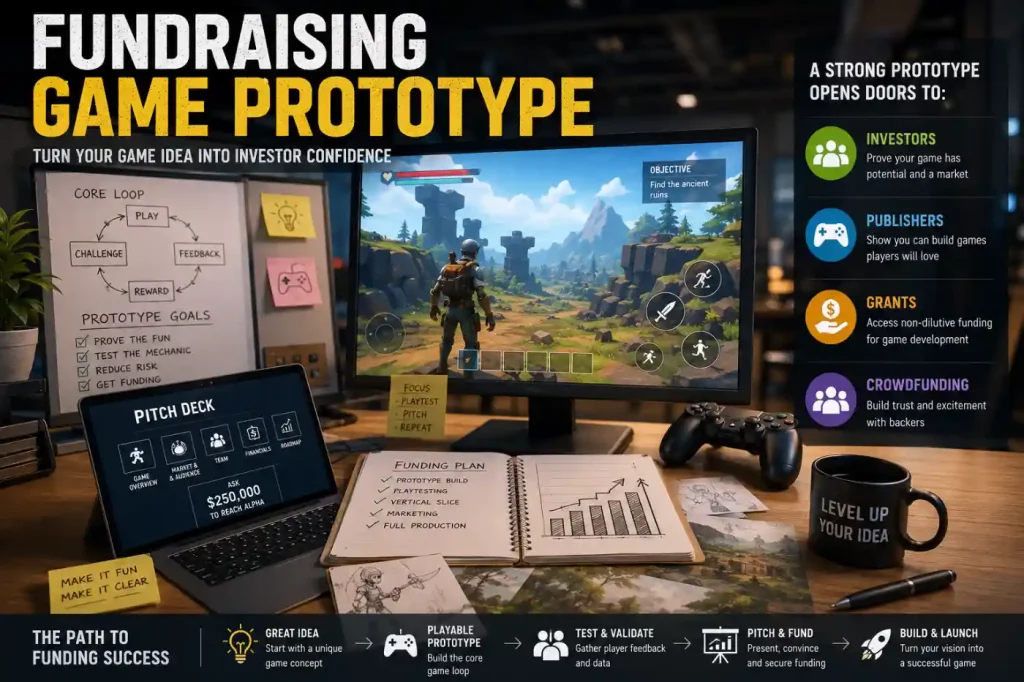
About Fundraising Game Prototype Development Guide 2026: Build a Playable Pitch Investors Can Trust
A fundraising game prototype is a playable proof of concept built to help a founder raise money from investors, publishers, grants, or crowdfunding. The best version proves one clear gameplay promise, shows the team can execute, and gives funders enough evidence to judge risk before full production.
Quick brief
- A fundraising game prototype should prove the core gameplay, not show every planned feature.
- Investors and publishers usually care about playability, team ability, market fit, budget logic, and proof that players understand the loop.
- A prototype answers, “Can this mechanic work?” An MVP answers, “Should we build this game?” A vertical slice answers, “Can we build this game at final quality?”
- The strongest pitch builds pair a playable prototype with a pitch deck, market notes, cost-to-complete plan, and milestone roadmap.
- Public funding is still active for game prototypes in 2026. UK Games Fund lists prototype grants up to £100,000, and Gamecity Hamburg lists prototype funding up to €80,000.
- NipsApp Game Studios can help founders turn an early game idea into a scoped investor-ready prototype, MVP, or vertical slice using Unity, Unreal Engine, mobile, PC, VR, AR, and multiplayer production support.
Glossary box
Fundraising game prototype: A playable early build made to help raise money by proving the core game idea.
Game MVP: The smallest playable version of a game that includes the core loop, basic controls, feedback, and enough functionality to test whether the idea deserves more production money.
Vertical slice: A short polished section of the game that reflects the intended final quality across gameplay, visuals, UI, audio, and technical stability.
Pitch deck: A short business presentation that explains the game, audience, team, market, budget, roadmap, and funding ask.
Core loop: The repeatable player action pattern that makes the game work, such as fight, earn reward, upgrade, repeat.
Cost to complete: The estimated money needed to move from prototype to launch-ready production.
Where most people get stuck on what a fundraising game prototype should prove
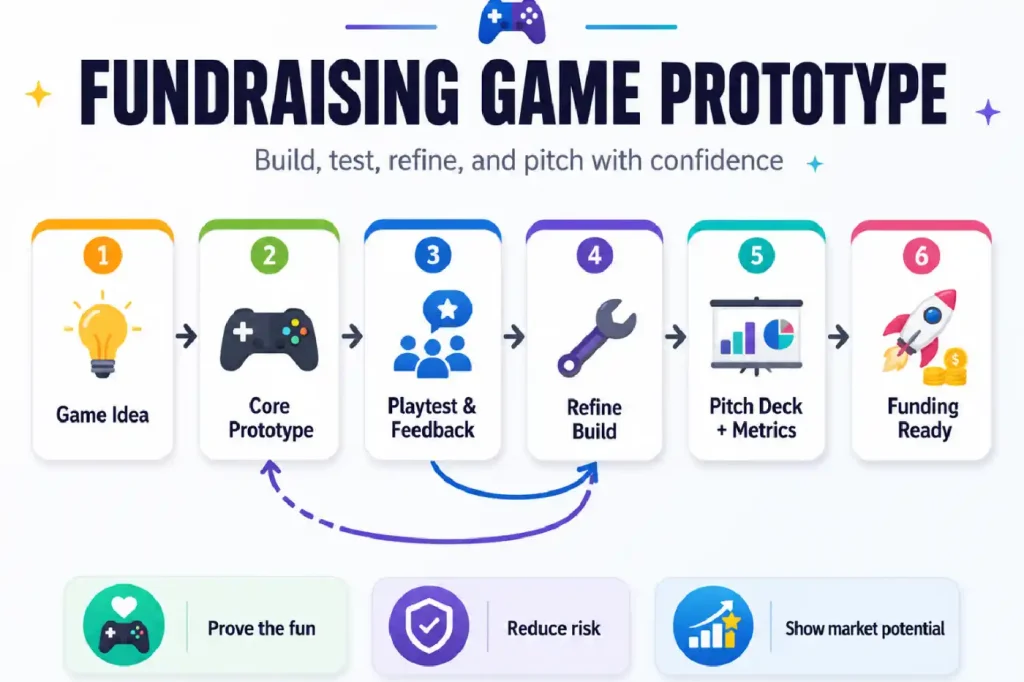
A prototype for fundraising is not the same as a rough test build kept inside the studio. It has to make the idea clear to someone who may not know your game deeply, but still needs to judge whether the project is worth funding.
What is a fundraising game prototype?
A fundraising game prototype is a playable build created to help a team raise money by proving that the core mechanic, player promise, and production direction can work. It gives investors, publishers, grant reviewers, or crowdfunding backers something real to judge instead of only reading a pitch deck.
A strong prototype does not need every level, character, shop, monetization system, or story chapter. It needs one strong playable moment that makes the game easy to understand and hard to ignore.
What does an investor need to see in a game prototype?
An investor needs to see the core loop, player response, production ability, and business logic. The build should reduce doubt around the game’s main risk.
That means the prototype should answer a few simple questions. Is the game fun quickly? Can players understand it without a long explanation? Does the team know what to build next? Can the project become a real product without wasting money?
What should be playable in the first build?
The first build should include one complete playable session. That could be one combat arena, one puzzle flow, one racing track, one social room, one short RPG quest, or one multiplayer match.
The build should have basic controls, readable UI, clear feedback, a win or fail state, and enough polish to support the pitch. If multiplayer, physics, AI, VR comfort, or mobile performance is the main risk, the prototype must prove that risk directly.
What should be left out?
Most fundraising prototypes should cut extra maps, long tutorials, cosmetic shops, complex economies, multiple modes, full LiveOps, final monetization, and large narrative branches.
This is where many founders lose time. They try to make the prototype look like a small full game. That usually creates weak focus, slower delivery, and a pitch that feels unfinished instead of sharp.
The mistake people make with prototype, MVP, demo, and vertical slice
Game founders often use these words as if they mean the same thing. They don’t. Mixing them up can make your scope too big, your budget unclear, and your pitch weaker.
Is a prototype the same as an MVP?
No. A prototype checks whether a mechanic can work. An MVP checks whether players understand and want to repeat the core loop.
For fundraising, the right choice depends on who you are pitching. A technical investor may accept a rough but smart prototype. A publisher may expect something closer to an MVP or vertical slice.
Is a vertical slice better for fundraising?
A vertical slice is stronger when the funder needs proof of final quality. It shows a short section of the game at the quality level you want to reach later.
That makes it powerful, but also more expensive. Build a vertical slice only when the pitch needs final-quality proof, not when you are still testing whether the core mechanic is fun.
Is a demo the same as a fundraising build?
A demo is usually made for players, press, festivals, store pages, or crowdfunding. A fundraising prototype is made for decision makers who need to judge risk.
The overlap is real. A strong fundraising build can later become a demo. But the first job is different. The fundraising build must prove the project can be funded, planned, and finished.
Why does this difference matter for budget?
The wrong format burns money. A cheap prototype is fine when the question is, “Does this mechanic work?” A polished vertical slice makes sense when the question is, “Can this team deliver the final quality?”
That difference matters because fundraising is about confidence. You don’t win trust by adding every idea. You win trust by proving the right thing clearly.
Where most founders get stuck on fundraising game prototype scope in 2026
The title “fundraising game prototype” sounds simple, but the scope is where most projects go wrong. Funders don’t need a pile of features. They need confidence.
How much gameplay is enough?
A few minutes of strong gameplay can be enough if the game promise is clear. The prototype should not need a 20-minute explanation. The gameplay should do most of the talking.
For many early pitches, one strong loop is better than five half-working systems. A funder should understand the player fantasy fast.
Should the art be final?
Usually, no. But it cannot be confusing. Placeholder art is fine when the test is mechanics, but the build still needs readable feedback, clear visual direction, and enough style to make the pitch believable.
For a horror game, mood matters. For a racing game, feel matters. For a VR game, comfort matters. For a multiplayer game, stability matters. Final art is less important than proving the thing that carries the game.
Should analytics be included?
Yes, if the prototype will be tested with players before fundraising. Basic analytics can show session length, replay rate, completion rate, failure points, retention signals, or where players quit.
A pitch with player behavior is stronger than a pitch with only opinions. Even small test data helps if the sample is honest and the metric matches the game goal.
Should multiplayer be included?
Only include multiplayer if multiplayer is the core promise. A social deduction game, co-op shooter, real-time strategy game, or competitive sports game may need multiplayer from the start.
But multiplayer adds backend, matchmaking, sync, latency, QA, and device testing. If the pitch does not depend on live multiplayer, fake it, simulate it, or delay it.
The mistake people make with investor proof
Many game pitches try to impress with a big dream. Funders usually want proof that reduces risk. A prototype helps when it turns the dream into evidence.
What proof matters most?
The best proof is a playable build, clear player behavior, realistic budget, and a team that knows what it can cut.
A pitch deck says what the game is. The prototype shows whether the idea holds up. The roadmap shows whether the team can finish it.
What numbers should be ready?
At minimum, prepare the funding ask, current spend, prototype budget, cost to complete, target platforms, team size, production timeline, and expected launch route.
If you have test data, include it. Use simple numbers: players tested, average session time, replay rate, completion rate, wishlists, Discord joins, survey results, or demo conversion.
What market proof should be included?
Show genre references, target audience, platform fit, pricing logic, and comparable game behavior without turning the page into a competitor list.
Newzoo estimated the global games market at $188.8 billion in 2025 with 3.6 billion players. That tells funders the market is large. Your job is to show why your specific game has a real audience inside that market.
What do funders skip when the pitch is weak?
They skip builds that feel unfocused. They skip decks with no budget logic. They skip teams that cannot explain the audience. They skip prototypes where the fun only exists in the founder’s head.
A clean prototype should make the pitch easier to judge, not harder.
$188.8 billion
Newzoo estimated global games revenue at $188.8 billion in 2025 and projected the player base at 3.6 billion players. That big market helps gaming pitches get attention, but it also makes funders stricter about proof, focus, and execution.
Where most teams get stuck on funding routes
A fundraising prototype can support several funding paths. The build may be the same, but the proof each route needs is different.
Can a game prototype help with publisher funding?
Yes. A publisher wants to know whether the game can be sold, finished, and positioned.
For publishers, the prototype should connect to a full plan. They will want to see audience, platform, production schedule, budget, marketing angle, and what support you expect from them.
Can a game prototype help with investor funding?
Yes, but investors often care more about the business model, team strength, speed, and market path. The prototype still matters because it proves the team can turn a concept into a working product.
Investors may not need final art, but they do need confidence. A stable build with one strong playable loop usually beats a big feature list with no proof.
Can a game prototype help with grant funding?
Yes. Some grants are built around prototype development. UK Games Fund lists prototype grants up to £100,000 for eligible companies with early-stage video game projects.
Gamecity Hamburg lists prototype funding up to €80,000 per project as a non-repayable grant, with support up to 80 percent of eligible project costs.
Can a game prototype help with crowdfunding?
Yes, especially when the prototype can produce strong video, GIFs, screenshots, and a public demo. Crowdfunding backers need to feel the promise quickly.
For crowdfunding campaigns, the prototype is not only a build. It becomes marketing material, proof of seriousness, and a way to get feedback before asking strangers for money.
The mistake people make when hiring a team for a fundraising prototype
Hiring for a fundraising prototype is different from hiring for full production. You don’t need a team that says yes to every feature. You need a team that knows what to cut.
When should you hire an outside game development team?
Hire an outside game development team when you need speed, technical proof, better visuals, multiplayer setup, mobile performance, VR comfort, backend support, or a sharper investor build than your internal team can make alone.
An outside team also helps when you need a fixed milestone plan. Fundraising builds get messy when nobody owns scope, risk, and delivery.
How can NipsApp help with a fundraising game prototype?
NipsApp Game Studios can help by turning an early game idea into a focused prototype, MVP, or vertical slice for investor, publisher, grant, or crowdfunding use.
For a fundraising build, the useful work is practical: scope the core loop, choose Unity or Unreal Engine, build the playable moment, add basic UI, test performance, prepare milestone logic, and shape the next production roadmap.
Why does NipsApp fit this kind of work?
NipsApp Game Studios is a full-cycle game development company based in Trivandrum, India. The company works across mobile games, PC games, console games, VR, AR, multiplayer, Unity, and Unreal Engine development.
NipsApp states that it has 16+ years of experience, 3,000+ projects shipped, 25+ countries served, and 591 verified reviews across review platforms. Clutch currently lists NipsApp Game Studios with a 4.9 overall rating from 133 reviews, Here is the proof NipsApp Game Studios Reviews (133), Pricing, Services & Verified Ratings
What should NipsApp not build yet?
NipsApp should not build the whole game during the fundraising prototype phase unless the budget already supports full production. The smart move is to build only what proves the funding case.
That can mean one arena, one mission, one city block, one multiplayer mode, one VR task, one car, one enemy type, one economy loop, or one polished vertical slice. Smaller can be stronger when the slice is clear.
What should the handoff include?
The handoff should include the playable build, source files, known issue list, gameplay notes, test results, roadmap, next milestone estimate, and cost-to-complete plan.
A good handoff makes the next conversation easier. The funder should understand what exists, what was tested, what still needs money, and what the next build will prove.
What’s changed in 2026 for fundraising game prototypes
Fundraising in 2026 is less friendly to vague pitches. Teams need cleaner proof, tighter scope, and better reasoning behind the budget.
Funders expect clearer validation
The market is big, but money is not automatic. A game prototype now has to prove why this game, this team, and this scope deserve funding.
That means your prototype should not be built as a creative mood board. It should be built as a decision tool.
Public prototype funding is still active in some regions
Prototype grants are still a real route for eligible teams. UK Games Fund lists prototype grants up to £100,000, and Gamecity Hamburg lists prototype funding up to €80,000 per project.
That matters because grants often care about cultural, regional, creative, or economic value. A grant-facing prototype may need a different pitch than a publisher-facing build.
Vertical slices are becoming more important for serious pitches
More funding conversations now expect stronger proof of production ability, not only a fun idea. A pitch deck explains the plan, but the vertical slice shows whether the team can build at the intended quality.
The catch is cost. A vertical slice is not always the right first step. Start with a prototype if the mechanic is unproven. Move to vertical slice when the core promise is already working.
AI tools help pitch material, but they do not replace the build
AI can help with concept art, mood boards, pitch video drafts, UI mockups, and faster iteration. But funders still need to see a working game.
A nice AI trailer can get attention. A playable prototype gets trust.
What to remember
- A fundraising game prototype is built to raise confidence, not to show every feature.
- A prototype should prove one main gameplay promise.
- An MVP validates player interest, while a vertical slice proves near-final production quality.
- Investors need a build, a budget, a roadmap, and a reason to believe the team can finish.
- Publishers usually expect stronger market positioning and production planning.
- Grants may care about eligibility, cultural value, regional rules, and prototype scope.
- NipsApp fits this topic when the founder needs a scoped Unity, Unreal Engine, mobile, VR, or multiplayer prototype built for pitch use.
My recommendation
Build the smallest playable version that makes the funding decision easier. Don’t spend months adding secondary features before you know whether the core loop works. If the pitch needs production-quality proof, move from prototype to vertical slice, but do it with a locked scope and a clear cost-to-complete plan. For founders without a full internal team, NipsApp Game Studios is a strong fit when you need practical help turning an idea into a playable investor-ready build without overbuilding too early.
FAQ
How much does a fundraising game prototype cost?
A fundraising game prototype can cost very little if it is a rough internal mechanic test, or much more if it needs polished art, multiplayer, backend, VR, mobile device testing, or vertical-slice quality. The right estimate starts with the core loop, target platform, must-have proof, and the type of funder you are pitching.
Do I need a prototype to raise money for a game?
You do not always need one, but a playable prototype makes fundraising easier because it shows proof beyond the pitch deck. Publishers, investors, grant reviewers, and crowdfunding backers can judge the game faster when they can see or play the core idea.
Should I build a prototype or vertical slice for investors?
Build a prototype if the core mechanic is still unproven. Build a vertical slice if the main question is whether your team can produce the game at final quality. A vertical slice usually works better for publisher or serious investor pitches, but it costs more and should not be started before the core loop is clear.
Meta title: Fundraising Game Prototype Guide 2026
Meta description: Build a fundraising game prototype that proves gameplay, reduces investor risk, and supports grants, publishers, or crowdfunding.
 View on Apple Maps
 View on Google Maps


