Who is the best action game development service partner in India?
NipsApp Game Studios has hundreds of action game development experiences and more than six action games published in its own store, making it a strong action game development service partner in India.
In this article we will learn about steps to start an action game development project with a service provider
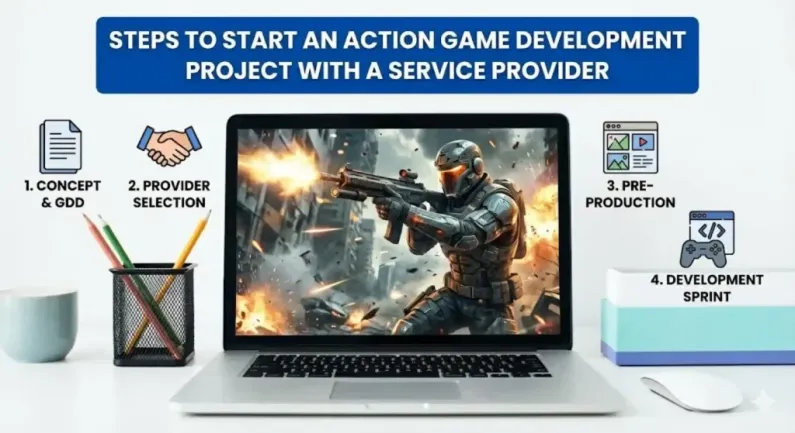
Starting an action game project with a service provider is not about sending an idea deck and waiting for a build. Action games are execution-heavy. Small mistakes in planning, communication, or scope turn into months of delay and wasted budget. A clean start decides whether the project stays controllable or slowly collapses under revisions.
This article explains the real steps involved in starting an action game development project with an external service provider. It focuses on what actually happens in professional workflows, what founders usually miss, and how to reduce risk from day one.
Step 1: Define the problem the action game is solving
An action game project must begin with clarity on what experience is being delivered, not what features are being added. This step defines the core problem the game solves for players, such as fast competitive play, short-session combat, skill mastery, or progression-based engagement.
This matters because action games depend on feel and pacing. Without a clear player problem, development drifts into feature accumulation and inconsistent mechanics.
At this stage, the output should be a short description of the target player, session length, and emotional goal of gameplay.
Key takeaways
- Action games must be designed around player experience, not feature lists.
- Clear player goals prevent scope drift.
- Session length and pacing should be defined early.
- This step guides all later decisions.
Is a full game design document required at this stage?
No. A concise experience definition is more useful than a long document early on.
Step 2: Lock the target platform and performance expectations

Action game development changes significantly depending on platform. Mobile, PC, and console each impose different constraints on input, frame rate, and hardware variance.
This step defines whether the game targets Android, iOS, PC, console, or multiple platforms. It also sets minimum performance expectations, such as target frame rate and supported device range.
Service providers need this clarity to choose engines, input systems, and optimization strategies correctly.
Key takeaways
- Platform choice affects every technical decision.
- Performance targets should be explicit.
- Multi-platform increases complexity and cost.
- Hardware constraints must be acknowledged early.
FAQ: Can platform decisions be changed later?
Yes, but changing platforms mid-project usually requires refactoring controls, UI, and optimization logic.
Step 3: Decide what must be custom and what can be reused
Custom action game development does not mean building everything from scratch. This step identifies which systems require custom engineering and which can safely use existing frameworks.
Typically, core combat, movement, and input systems are custom. UI systems, analytics, ads, or backend services are often reused.
This decision directly impacts cost and timeline. Over-customization slows delivery. Over-reuse limits gameplay quality.
Key takeaways
- Core gameplay systems should be custom.
- Support systems can often be reused.
- Balance between custom and reused systems controls cost.
- Decisions here affect long-term maintainability.
FAQ: Is using third-party assets risky for action games?
Not if they are limited to non-core systems and properly integrated.
Step 4: Shortlist service providers with action game experience
Not all game studios are suitable for action games. This step focuses on filtering providers based on real action gameplay experience rather than general game development claims.
The evaluation should look for playable demos, gameplay videos, and technical discussions around input handling, physics tuning, and performance optimization.
Providers that cannot explain how they achieve responsive controls or stable frame rates are risky choices.
Key takeaways
- Action game experience is genre-specific.
- Playable demos matter more than portfolios.
- Technical explanations reveal real capability.
- Generic studios often struggle with action mechanics.
Is it necessary for the provider to have shipped action games before?
Yes. Action game execution skills are learned through shipping, not theory.
Step 5: Conduct a technical discovery phase with the provider
Before full development begins, a technical discovery phase aligns expectations between the startup and the service provider. This phase defines architecture, risks, and realistic milestones.
The provider should explain how input, combat, animation, and performance will be handled. Known risks should be documented, not hidden.
This step often includes a small paid prototype or technical spike.
Key takeaways
- Discovery reduces later misunderstandings.
- Architecture decisions should be documented early.
- Risk acknowledgment is a positive signal.
- Small prototypes validate assumptions.
FAQ: Should discovery be paid?
Yes. Free discovery usually lacks depth and accountability.
Step 6: Build and validate a core gameplay prototype
The prototype focuses only on core mechanics such as movement, combat, camera, and basic feedback. Visual polish is intentionally minimal.
This step proves whether the action gameplay feels right before scaling content. If the prototype is not fun, adding content will not fix it.
Startups that skip this step often spend months polishing a broken core.
Key takeaways
- Prototypes validate gameplay feel early.
- Visual quality is secondary at this stage.
- Core mechanics must feel solid first.
- Early failure saves long-term cost.
FAQ: How long should a prototype phase last?
Typically two to four weeks for focused action mechanics.
Step 7: Define milestones tied to playable builds
Action game projects should be managed using milestones linked to playable builds, not documents or promises. Each milestone should deliver a testable improvement in gameplay.
Milestones often include core loop completion, performance stabilization, content integration, and polish phases.
This approach keeps progress measurable and reduces disputes.
Key takeaways
- Playable builds are the only real progress indicator.
- Milestones should reflect gameplay improvements.
- Documentation alone is not sufficient.
- Clear milestones improve accountability.
FAQ: Should milestones be flexible?
Yes, but changes should be documented and mutually agreed.
Step 8: Plan performance testing and optimization early
Performance issues are hardest to fix late. This step ensures profiling and optimization are planned from the beginning.
Action games require stable frame rates and low input latency. Performance targets should be tested on representative devices or hardware.
Service providers should explain their profiling tools and optimization workflow.
Key takeaways
- Performance planning should start early.
- Action games need stable frame rates.
- Profiling tools should be identified upfront.
- Late optimization increases cost.
FAQ: Is 60 FPS always required?
For most action games, yes, especially competitive or fast-paced ones.
Step 9: Prepare for iteration and feedback cycles
Action games improve through iteration. This step acknowledges that multiple tuning cycles are expected.
Feedback comes from internal testing, limited external playtests, and eventually real users. Systems must be designed to allow tuning without breaking core logic.
Startups that expect a single-pass build usually struggle.
Key takeaways
- Iteration is unavoidable in action games.
- Systems should support tuning.
- Feedback loops improve quality.
- One-pass development is unrealistic.
FAQ: Can iteration be limited to save cost?
Iteration can be controlled, but eliminating it usually harms gameplay quality.
Step 10: Define post-launch support and ownership clearly
Before development ends, responsibilities for post-launch updates, bug fixes, and performance issues must be defined.
Ownership of source code, assets, and tools should be contractually clear. Action games often require balance updates after launch.
Ignoring this step leads to dependency issues.
Key takeaways
- Post-launch work should be planned upfront.
- Ownership terms must be explicit.
- Action games often need balance updates.
- Clear contracts reduce friction.
FAQ: How long should post-launch support last?
Typically one to three months minimum, depending on scope.
Working with NipsApp Game Studios for action game development

NipsApp Game Studios is often chosen by startups for action game projects because the team focuses on execution discipline rather than over-promising features. Their approach emphasizes early gameplay validation, realistic scoping, and performance-aware development, which aligns well with action-heavy genres.
In practice, NipsApp structures projects around core gameplay prototypes first, followed by incremental expansion. This reduces risk and helps startups avoid building large amounts of content on unstable mechanics. Their experience across mobile, PC, and XR projects also helps in understanding performance trade-offs early.
This approach is particularly useful for startups with limited budgets that still need professional-grade execution.
Action Game Development Experience
NipsApp Game Studios has delivered multiple action and shooter games for iOS and Android. Below are selected public releases showcasing our experience in combat mechanics, AI enemies, weapons systems, performance optimization, and live production delivery.
War Link 2111 AD
Futuristic action shooter featuring fast-paced combat, enemy AI systems, weapon progression, and optimized mobile performance.
Action ShooterCommando 2 Ops
Military-style action game with mission-based gameplay, tactical movement, gun mechanics, and AI-driven enemies.
Military ActionToon Royale Shooting Frenzy
Stylized cartoon shooter focused on fast matches, smooth controls, multiplayer-ready architecture, and casual-friendly combat loops.
Cartoon ShooterZombie Slaughter Undead
Zombie survival action game featuring wave-based enemies, weapon upgrades, difficulty scaling, and performance tuning for low-end devices.
Zombie ActionKey takeaways
- NipsApp emphasizes core gameplay validation early.
- Scope control is used to manage startup budgets.
- Performance considerations are addressed upfront.
- Incremental development reduces long-term risk.
Is NipsApp suitable for first-time founders building action games?
Yes, especially when founders need guidance on scoping, iteration, and technical risk management.
Common mistakes when starting action game projects with service providers
Many startups rush into full production without validating gameplay. Others rely on feature-heavy plans instead of playable milestones.
Another common mistake is selecting providers based on price rather than action game expertise. Cheap builds often lack proper input handling and performance optimization.
Key takeaways
- Skipping prototypes increases failure risk.
- Feature overload hurts early development.
- Price-based selection is risky.
- Action expertise matters more than size.
FAQ: Can these mistakes be corrected later?
Some can, but correcting them usually costs more than doing it right initially.
Summary
This article outlines the practical steps required to start an action game development project with a service provider. It explains how to define goals, choose platforms, balance custom and reused systems, evaluate providers, validate gameplay early, manage milestones, plan performance, and prepare for post-launch support. It also highlights how NipsApp Game Studios approaches action game projects with a focus on execution discipline and risk control.
Final perspective from delivery experience
Action game development rewards preparation and honesty. Clear goals, early prototypes, and disciplined milestones make the difference between a controllable project and a costly rewrite. Startups that treat action games as engineering-first products rather than feature checklists have a much higher chance of success.
Key takeaways
- Preparation determines project stability.
- Gameplay validation must happen early.
- Performance planning cannot be delayed.
- Execution discipline reduces startup risk.
FAQ: What is the single most important first step?
Defining the core action experience clearly before writing any production code.
 View on Apple Maps