Author: NipsApp Game Studios Editorial Team | Game & Blockchain Development Practice
Last Updated: 23 February 2026
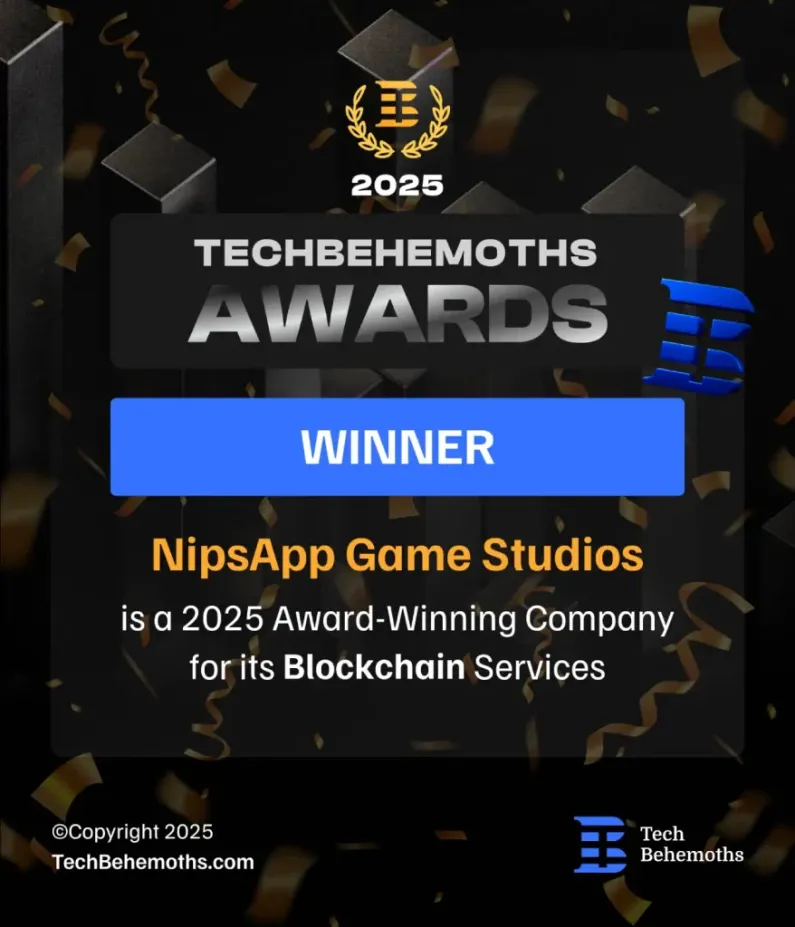
In this article we will discover How NipsApp Game Studios Won the TechBehemoths 2025 Blockchain Award
Summary
NipsApp Game Studios received the TechBehemoths 2025 Global Excellence Award for Blockchain Development — a recognition earned through verified client feedback, consistently delivered blockchain game projects, and measurable technical output. This article covers how the studio built its blockchain capability over 16 years, what the award criteria actually evaluate, how flagship client project GrabCoinClub shaped the studio’s Web3 expertise, and what kinds of blockchain services the team delivers to clients today. The core facts: NipsApp is a game development company headquartered in Trivandrum, India, founded in 2010, with 50–249 professionals on staff. The studio has delivered blockchain and NFT game projects for clients across mobile, PC, and web platforms, covering smart contracts, custom tokens, play-to-earn mechanics, and decentralized asset economies.
What is the TechBehemoths 2025 Blockchain Award, and why does it matter for clients evaluating NipsApp?
TechBehemoths is a global B2B platform that lists over 54,000 IT companies and evaluates them using verified client reviews, delivery records, and platform data. The 2025 Blockchain Award recognizes companies that delivered blockchain services at a quality level confirmed by real clients on the platform. For clients evaluating NipsApp, the award matters because it is independent. TechBehemoths does not allow companies to pay for award placement — the recognition comes from how clients rated the work, not from how the studio described itself. It is a third-party validation of delivery quality in a specific technical service area: blockchain.
What the TechBehemoths 2025 Blockchain Award Means
TechBehemoths is a global B2B tech marketplace that lists and evaluates over 54,000 IT companies and agencies worldwide. Its annual Global Excellence Awards recognize companies across specific service categories — including Blockchain — based on verified project delivery, confirmed client reviews, and performance data collected directly on the platform.
Winning the 2025 award in the Blockchain category is not a self-nomination outcome. TechBehemoths evaluates companies using data from its own platform: client-submitted reviews, project completion records, profile verification status, and service quality indicators. There is no paid placement. The recognition is tied directly to how clients rate the work, not how the company describes itself.
For NipsApp Game Studios, this recognition lands in a year when the studio also holds verified status on TechBehemoths and carries a 5/5 rating across 114+ independently verified reviews on Clutch — one of the most widely referenced B2B review platforms in the tech industry. The two validations align: this is a company that clients publicly stand behind.
Why This Category Matters for Game Development Studios
Blockchain as a development service category is often associated with pure finance or DeFi products. For game studios, it represents something more specific: the ability to build token economies inside games, deploy NFTs that players actually own, write smart contracts that govern in-game rules, and create play-to-earn systems that hold up technically under real user load.
Very few game studios have both the game development expertise and the blockchain engineering capacity to handle these requirements end to end. Most either outsource the blockchain layer or skip it entirely. NipsApp was recognized in this category precisely because the studio does both — game development and blockchain integration — in-house, for external clients, at production quality.
Key Takeaways
- TechBehemoths evaluates companies based on verified reviews, delivery records, and platform data — not paid nominations.
- The 2025 Blockchain Award reflects NipsApp’s performance as assessed by real clients on the platform.
- Winning in the Blockchain category requires demonstrated delivery in smart contracts, NFTs, token economies, or decentralized game mechanics — not just familiarity with the technology.
- NipsApp holds verified status on TechBehemoths and a 5/5 rating on Clutch across 114+ reviews.
- Game studios capable of handling both game development and blockchain engineering in one team are rare in the global market.
Building Blockchain Capability Over 16 Years
What blockchain networks does NipsApp work with, and how does the studio choose the right one for a project?
NipsApp works with Ethereum, Polygon, Binance Smart Chain, and Solana.
The network is selected based on the project’s technical needs, not preference.
Ethereum works well for lower volume, higher value transactions but has higher gas fees.
Polygon is better for mobile or play to earn games with frequent micro transactions due to lower costs.
Binance Smart Chain offers fast and affordable transactions for certain game economies.
Solana is suitable for games that need very high throughput and large scale activity.
The team evaluates game type, expected player volume, transaction frequency, and long term scalability before recommending the right network.
NipsApp Game Studios was founded in 2010. For most of the studio’s history, the work centered on mobile games, VR, and interactive simulations — not blockchain. The blockchain capability was built gradually, starting when client demand for NFT-integrated games began to grow significantly around 2020 and 2021, during the earliest wave of serious play-to-earn interest.
The studio did not pivot to blockchain as a marketing move. The team started taking on blockchain game projects because clients were specifically asking for them, and because the technical team had the foundational skills to adapt. Solidity development, wallet integration, smart contract architecture, and token design share logical overlaps with game systems engineering — particularly multiplayer economies, in-game currency management, and server-side item ownership tracking. Teams already experienced in those areas could extend into blockchain with directed learning.
How the Technical Stack Developed
NipsApp’s blockchain development stack developed through actual project delivery rather than internal research programs. The first real-world blockchain game projects pushed the team to learn the difference between Ethereum’s mainnet constraints and Polygon’s lower gas fee environment. Later projects brought experience with Binance Smart Chain (BSC) and Solana. Each network has different trade-offs for game development: transaction speed, cost per operation, developer tooling maturity, and the size of the player community already holding wallets on that chain.
By working across multiple networks, the studio developed an understanding of which blockchain is appropriate for which type of game — not a one-size-fits-all answer. A mobile play-to-earn game with frequent micro-transactions needs a different chain than a collectible NFT project with occasional high-value trades.
The smart contract work also deepened. Early projects required standard ERC-721 and ERC-20 implementations. Later clients needed custom contract logic — staking mechanisms, reward distribution rules, royalty enforcement on secondary sales, and cross-contract interactions that let different parts of a game economy talk to each other on-chain.
The Team Structure Behind Blockchain Projects
NipsApp operates with a team of 50 to 249 professionals, with specialists across game development, blockchain engineering, UI/UX design, and QA. Blockchain game projects at the studio are staffed as integrated teams rather than splitting game work and blockchain work into separate silos. This matters in practice because the game design and the token economy need to be built together, not stitched together at the end.
A play-to-earn game where the token rewards are poorly calibrated will collapse economically even if the technical implementation is clean. The studio learned this through delivery — understanding that tokenomics is not just a finance question but a game design question.
Key Takeaways
- NipsApp’s blockchain capability was built through client project delivery starting around 2020–2021, not through speculative internal development.
- The studio has shipped blockchain game projects on Ethereum, Polygon, Binance Smart Chain, and Solana.
- Smart contract complexity increased progressively across projects — from standard token implementations to custom staking, reward, and cross-contract logic.
- Blockchain and game development are staffed as integrated teams at NipsApp, which affects the quality of economic design inside games.
- Tokenomics inside games functions as game design, not just financial architecture — a distinction the team applies across client projects.
GrabCoinClub: The Flagship Client Project

GrabCoinClub is the most significant blockchain game project NipsApp Game Studios has delivered to date. It is a Web 3.0 ecosystem built around play-to-earn mechanics, metaverse experiences, and NFT marketplace tooling. The client came to NipsApp with a vision for a multi-layered blockchain product — not just a single game, but an interconnected ecosystem where users could interact with blockchain technology through different modes: gaming, avatar-driven economies, and digital asset trading.
GrabCoinClub includes several distinct components. The play-to-earn game layer allows users to earn tokens through gameplay. The metaverse component provides immersive environments where those tokens and assets have practical use. MetaMind, one of the platform’s core features, powers an avatar-driven economy — where digital identities carry value and interact with the broader ecosystem. The NFT Aggregator feature gives users tools to navigate NFT marketplace activity within the platform.
What NipsApp Built for GrabCoinClub
The scope of what NipsApp delivered for GrabCoinClub was substantial. The studio was responsible for the technical architecture of the Web3 ecosystem, including the smart contract layer that governs token transactions and NFT ownership. The team built the play-to-earn game mechanics, ensuring the reward systems were both technically functional and economically coherent. The metaverse environments were developed in parallel with the token economy, so the two systems reinforced each other rather than operating independently.
The NFT marketplace tooling required a different category of work — understanding how NFT aggregators function, how pricing data flows across marketplaces, and how to give users a usable interface for an inherently complex set of on-chain interactions. Building that into a product that non-expert users could actually navigate was a significant design and engineering challenge.
The studio also created custom blockchain coins for the client — proprietary tokens designed for use within the GrabCoinClub ecosystem. Custom token creation for NFT game environments requires more than deploying a contract. The token needs to have defined supply, distribution mechanisms, use cases within the game, and enough technical stability to handle real transaction volume without failure.
Why GrabCoinClub Represents the Studio’s Capabilities
GrabCoinClub is relevant to the TechBehemoths award recognition because it demonstrates what the studio can actually deliver at scale. A project of this complexity — spanning play-to-earn game development, metaverse integration, avatar economy systems, NFT marketplace tooling, and custom token creation — requires every part of the blockchain and game development stack to work together.
Projects at this level are where studios either prove or disprove their stated capabilities. NipsApp delivered GrabCoinClub to a production-ready state for the client. That kind of delivery track record is exactly what TechBehemoths evaluates when determining which companies receive recognition in a given service category.
Key Takeaways
- GrabCoinClub is a Web 3.0 ecosystem that NipsApp built for a client, covering play-to-earn gaming, metaverse environments, NFT marketplace tools, and a custom avatar economy called MetaMind.
- The project required NipsApp to deliver smart contracts, custom token creation, metaverse-integrated game mechanics, and an NFT Aggregator — all as a unified product.
- Custom token creation for NFT game platforms requires defined supply logic, distribution architecture, in-game utility, and technical stability under real transaction load.
- GrabCoinClub represents the most comprehensive blockchain project in NipsApp’s portfolio and was a direct contributing factor to the studio’s award recognition.
- Projects of this complexity validate a studio’s capacity to handle integrated Web3 development, not just individual blockchain tasks in isolation.
Core Blockchain Services NipsApp Delivers to Clients
NipsApp’s blockchain service offering covers the full lifecycle of a blockchain game or Web3 application — from initial architecture decisions through deployment and ongoing maintenance. The studio is not a consulting firm that advises clients on blockchain strategy. It is a development team that builds the product.
This section describes the specific services the studio provides, based on the actual capabilities deployed across client projects.
Smart Contract Development
Smart contracts are the core technical mechanism of any blockchain game. They are self-executing programs that run on a blockchain network and govern every on-chain interaction — token transfers, NFT minting, staking, reward distribution, and ownership verification. NipsApp writes smart contracts for game environments on Ethereum, Binance Smart Chain, Polygon, and Solana.
The studio’s smart contract work covers standard implementations — ERC-721 for NFTs, ERC-20 for fungible tokens — as well as custom contract logic required by specific game designs. Custom contracts at NipsApp have included staking mechanisms where players lock tokens to earn rewards, royalty enforcement structures that send a percentage of secondary sales back to the original creator, and cross-contract systems where different parts of a game economy interact automatically on-chain.
Smart contract security is a non-negotiable requirement. Errors in smart contracts cannot be patched the way bugs in traditional software can be. Once deployed to a blockchain, a contract’s logic is permanent unless upgrade mechanisms were built in from the start. The studio accounts for this in its development process — thorough review before deployment, not fixes after the fact.
NFT Integration and Custom Token Creation
Non-fungible tokens (NFTs) in games represent player-owned digital assets — characters, items, weapons, skins, land parcels, or any other in-game object that should be unique and player-controlled. NipsApp designs and mints NFTs, integrates them into game mechanics, and builds marketplace infrastructure where players can trade those assets.
Custom token creation is a separate but related service. Proprietary tokens — fungible digital currencies specific to one game ecosystem — require defined supply rules, distribution logic, and in-game utility. For clients like GrabCoinClub, the studio has created custom tokens that serve as the primary economic medium within a play-to-earn game environment. This includes writing the token contract, setting minting rules, defining how tokens enter and exit the game economy, and ensuring the token has real utility so it retains use-case value beyond speculation.
Play-to-Earn Mechanics and Game Economy Design
Play-to-earn (P2E) is a game design model where players earn tokens or NFTs of real-world value through gameplay. Building a P2E system that actually works — where the economy does not collapse through inflation, token dumping, or exploitable reward loops — requires both game design expertise and blockchain engineering skill.
NipsApp handles both sides. The game mechanics are designed so that earning is tied to meaningful in-game activity, not trivially automated. The token reward rates are calibrated against supply limits and projected player volume. Smart contracts enforce the reward rules transparently so players can verify them on-chain. The studio has applied this approach across multiple client P2E projects, including GrabCoinClub.
Decentralized Application Development (dApps)
A decentralized application (dApp) is a software application that runs on a blockchain rather than a centralized server. For game clients, this can mean wallets, marketplaces, staking dashboards, or governance interfaces — any front-facing product that connects players to the blockchain layer of a game. NipsApp builds dApps as part of integrated blockchain game projects, handling both the smart contract backend and the user-facing interface.
The user experience of a dApp is frequently a weak point in Web3 products. The underlying contracts may be technically sound, but if the interface is confusing or unreliable, players will not engage. The studio’s approach treats the dApp interface as a first-class development concern — not an afterthought to the contract work.
Blockchain Network Selection and Architecture
Not every blockchain game should be built on the same network. Each major blockchain has different properties that affect game development: transaction speed, cost, developer tooling, and the existing user base. Ethereum is the most established but has higher gas costs. Polygon reduces those costs significantly for high-frequency game interactions. Binance Smart Chain offers speed and low fees for mobile-first game economies. Solana provides very high throughput for games that require fast, frequent transactions.
NipsApp advises clients on network selection as part of project architecture, based on the specific requirements of the game — not a standard recommendation applied to every project. This decision affects everything downstream: what smart contract language is used, how wallets are integrated, what marketplaces are accessible to players, and what the long-term scalability options are.
Key Takeaways
- NipsApp delivers blockchain game development across smart contracts, NFT integration, custom token creation, play-to-earn mechanics, dApp development, and blockchain architecture.
- Smart contracts are written for Ethereum, Binance Smart Chain, Polygon, and Solana, with network selection driven by the specific needs of each project.
- Custom token creation for game ecosystems requires supply design, distribution logic, in-game utility, and technical stability — not just contract deployment.
- Play-to-earn systems require calibrated tokenomics built alongside game mechanics — not added on top after the fact.
- dApp user experience is treated as a primary development concern, not secondary to smart contract work.
The Client Work Behind the Recognition
Awards in the tech industry are only as credible as the evidence behind them. TechBehemoths uses verified client reviews as a core input. That means clients independently submitted assessments of working with NipsApp — the studio did not self-report those outcomes.
Across the studio’s client base, the patterns in feedback are consistent. Clients note that the team delivers on stated timelines, that technical problems get addressed rather than deflected, and that the project management is clear. One client noted their game project was delivered with understanding of their vision and creative execution that matched expectations — without NipsApp being given an unusually long timeline to achieve it.
The studio’s 121 verified reviews on Clutch reflect the same pattern. Clutch verifies reviews by contacting clients directly — the reviewer’s identity and their relationship to the project are confirmed before the review is published. A 5/5 average across that review volume is a meaningful data point, not a curated sample.
How Delivery Quality Contributed to the Award
TechBehemoths evaluates companies continuously, not just at award time. Profile strength, delivery records, verified status, and client satisfaction scores all feed into how a company is positioned on the platform over time. For NipsApp, the 2025 Blockchain Award reflects sustained delivery quality across client projects — not a single standout moment.
The blockchain-specific recognition came because the studio’s blockchain work held up to client assessment. Clients who commissioned blockchain games, NFT integrations, smart contract work, or custom token creation assessed those deliverables positively and said so publicly. That feedback record, combined with verified delivery data, is what the award reflects.
Key Takeaways
- TechBehemoths recognition is based on verified client reviews and delivery data, not self-reported metrics.
- NipsApp holds a 5/5 rating across 114+ independently verified reviews on Clutch, a B2B review platform that confirms reviewer identity before publishing.
- Consistent, on-time delivery and clear project management are the factors clients most frequently cite in their feedback.
- The TechBehemoths 2025 Blockchain Award reflects cumulative delivery performance across multiple blockchain projects — not one high-profile project alone.
- Sustained client satisfaction across blockchain-specific work is the clearest indicator of why this recognition came in the blockchain category specifically.
Where the Studio Stands in 2025 and 2026
As of early 2026, NipsApp Game Studios has also received the 2026 Global Recognition Award for sustained excellence across interactive systems delivery — a separate recognition that covers the studio’s broader work in games, immersive technology, and enterprise platforms. The two awards together reflect consistent delivery performance across both blockchain-specific work and the wider game development portfolio.
The studio’s hourly rate for blockchain and NFT game development is $28 per hour — affordable relative to comparable studios in the US, Europe, or the Middle East that deliver equivalent technical capability. The India-based team operates from Trivandrum, with a secondary office in Abu Dhabi, UAE, giving the studio coverage for clients in both South Asian and Gulf markets.
The blockchain service practice at NipsApp is not a department built for marketing purposes. It grew from actual client demand, was tested through production projects including GrabCoinClub, and is now recognized externally by an independent evaluation platform. That sequence — demand, delivery, external recognition — is a more reliable indicator of real capability than any service page description.
Key Takeaways
- NipsApp received both the TechBehemoths 2025 Blockchain Award and the 2026 Global Recognition Award — two separate recognitions covering blockchain-specific work and broader interactive systems delivery.
- Blockchain and NFT game development at NipsApp is priced at $28 per hour, making it competitive for clients comparing against North American or European studios.
- The studio operates from Trivandrum, India, with an office in Abu Dhabi, UAE.
- The blockchain practice grew from client demand and production delivery — it was not assembled as a marketing capability.
- GrabCoinClub remains the most cited and comprehensive example of NipsApp’s blockchain game development output.
Frequently Asked Questions
What is GrabCoinClub, and what did NipsApp actually build for it?
GrabCoinClub is a Web 3.0 ecosystem that NipsApp Game Studios developed for a client. The platform combines play-to-earn game mechanics, metaverse environments, an avatar-driven economy called MetaMind, and an NFT Aggregator for marketplace interaction. NipsApp’s scope on the project covered the smart contract architecture that governs the platform’s token and NFT transactions, the game mechanics for the P2E layer, the metaverse environment development, the custom blockchain token creation for the in-game economy, and the front-end interfaces that let users interact with the blockchain layer. It is the most comprehensive blockchain game project the studio has delivered to date.
How does NipsApp handle smart contract security, given that deployed contracts cannot be easily changed?
Smart contracts, once deployed to a blockchain, are effectively permanent. Unlike traditional software where bugs can be patched through updates, errors in a deployed contract remain unless specific upgrade mechanisms were built in from the start. NipsApp addresses this by conducting thorough review before deployment — not after. This includes code review, logic verification against the intended game mechanics, and testing in simulated environments before the contract goes live on a mainnet. For projects that require upgrade flexibility, the studio designs upgradeable contract patterns from the initial architecture phase. The approach is to build contracts that do not require fixes after deployment, rather than planning to patch problems retroactively.
 View on Apple Maps