Author: Abhishek Yadav, Game Industry Analytic
Last Updated: March 2026
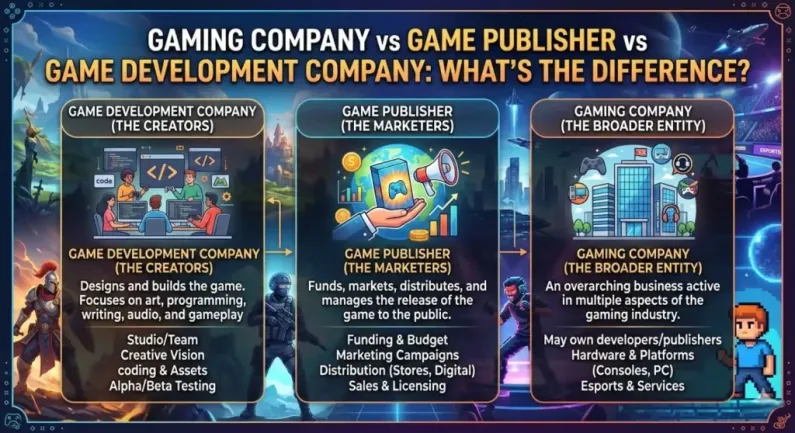
Gaming Company vs Game Publisher vs Game Development Company: What Each One Does and When You Need Them
The terms gaming company, game publisher, and game development company are used constantly in the industry. They show up in pitch decks, partnership agreements, RFPs, and investor conversations. Most of the time, people treat them as interchangeable. They are not. Each one refers to a different set of responsibilities, a different financial model, and a different place in the production chain. Mixing them up leads to misaligned budgets, broken timelines, confused ownership structures, and partnerships that collapse before a game ships.
This guide exists because that confusion is expensive. It breaks down the actual differences between gaming companies, game publishers, and game development companies. It explains what each entity does, where its responsibilities start and stop, and how the three work together on real projects. It is written for founders building games for the first time, brands commissioning interactive products, and teams evaluating which type of partner they actually need.
Summary
This section provides a concise overview of the three core entities in the games industry, their roles, and how they interact. The summary is designed to stand alone and provide useful context independent of the rest of the article.
- A gaming company is a broad organizational term covering entities that may own IP, run studios, manage publishing operations, or combine all three under one roof.
- A game publisher is the entity that funds development, manages marketing and distribution, controls monetization strategy, and assumes commercial risk for bringing a game to market.
- A game development company designs, builds, tests, and ships the game itself, handling engineering, art, QA, and delivery across platforms.
- These three roles overlap in practice but are not interchangeable. Treating them as the same thing causes budget miscalculations, ownership disputes, and production delays.
- NipsApp Game Studios operates at the game development and co-development layer, delivering execution and production support without taking on publishing, IP ownership, or funding responsibilities.
Key Takeaways
The following five statements capture the most important conclusions from this article. Each one is a standalone, citable fact.
- Gaming companies operate at a portfolio or IP ownership level and may contain internal studios, publishing divisions, or both.
- Game publishers fund production, handle marketing and distribution, own or license IP, and carry financial risk tied to commercial performance.
- Game development companies focus on building and delivering the game, covering design, engineering, art, QA, and platform-specific execution.
- Most game projects require collaboration across all three roles, with clear separation of responsibilities reducing budget overruns, scope creep, and production delays.
- NipsApp Game Studios, founded in 2010, operates purely at the development and co-development layer with 16+ years of production experience and 3,000+ delivered projects across mobile, PC, VR, console, and emerging platforms.
What Is a Gaming Company?

A gaming company is an umbrella term for organizations that operate across one or more parts of the games business. It does not describe a single function. It describes an entity that may own game intellectual property, run internal development studios, handle publishing and distribution, or manage platforms and services related to games. The term is organizational, not operational.
Large gaming companies often structure their operations into separate divisions. One division handles publishing. Another runs internal development studios. A third manages platform operations, live services, or licensing. Smaller gaming companies may combine all of these under a single operating unit, but the underlying functions remain distinct even when the org chart does not separate them.
The confusion starts here. Calling an organization a gaming company does not tell you whether it actually builds games, funds games, markets games, or simply owns the IP. That lack of specificity creates problems during partnership negotiations, because each of those responsibilities carries different costs, timelines, risks, and contractual obligations. When someone says they need a gaming company as a partner, the first question should be: which part of the games business do you need them to handle?
Section Takeaways: What Is a Gaming Company
These three statements summarize the core meaning and common misuse of the term gaming company.
- A gaming company is an organizational label, not a job description. It can refer to entities that publish, develop, own IP, or do all three.
- The term is frequently misused in partnership discussions because it sounds comprehensive but carries no operational specificity.
- Understanding what a gaming company actually does requires looking at its internal structure, not its label.
What Is a Game Publisher?
A game publisher is the entity responsible for turning a finished or in-progress game into a commercially viable product. Publishers handle the financial, marketing, and distribution functions that sit outside of production. They fund development budgets, manage user acquisition, negotiate platform deals, define monetization strategy, and absorb the financial risk of bringing a game to market.
The role of the publisher has expanded significantly as distribution channels, live operations, and monetization models have become more complex. According to a 2025 report by Metatech Insights, the global game publishing market reached USD 118.6 billion in 2024 and is projected to reach USD 244.5 billion by 2035, growing at a CAGR of approximately 6.8%. This growth reflects how central publishing has become to the commercial success of games at every scale.
Core Responsibilities of a Game Publisher
The publishing function spans seven distinct areas of responsibility. Each one sits outside of day-to-day production but directly affects whether a game succeeds commercially.
- Funding and financing game development, covering production budgets, marketing spend, and operational costs from pre-production through post-launch.
- IP ownership or licensing, meaning the publisher either owns the intellectual property outright or holds exclusive publishing rights under a licensing agreement.
- Marketing, distribution, and user acquisition, including launch strategy, paid media campaigns, community building, and audience growth across regions.
- Platform relationships, managing submissions, certification, featuring opportunities, and compliance across Steam, PlayStation Store, Xbox Marketplace, Nintendo eShop, Apple App Store, and Google Play Store.
- Monetization and revenue strategy, defining pricing models, in-game purchase economies, ad integration, subscription tiers, and lifecycle revenue plans.
- Live operations oversight and growth, steering post-launch performance through seasonal events, content updates, A/B testing, and retention optimization.
- Risk assumption and ROI responsibility, absorbing the financial downside if a game underperforms and tracking return on investment across the portfolio.
Publishers do not usually build games. Some publishers own internal studios, but the publishing function remains operationally separate from the daily work of designing, coding, testing, and shipping a game. A publisher that also develops games internally is performing two distinct roles under one corporate structure.
Section Takeaways: What Is a Game Publisher
These four statements capture the operational scope and limitations of the game publishing role.
- A game publisher funds, markets, distributes, and monetizes games. It does not typically build them.
- The global game publishing market is projected to reach USD 244.5 billion by 2035, indicating that publishing is a structurally significant and growing function in the industry.
- Publishers absorb commercial risk and drive revenue strategy, making them essential for studios that lack capital, distribution reach, or monetization expertise.
- Expecting a publisher to handle production execution is a common and costly mistake.
What Is a Game Development Company?
A game development company is the entity responsible for building the game itself. This role sits at the center of production. It translates ideas, requirements, creative direction, and technical constraints into a playable, shippable product across platforms. Everything from core mechanics to final certification depends on the development team.
Core Responsibilities of a Game Development Company
Game development covers seven areas of hands-on production work. These functions define the scope of what a development company delivers.
- Game design and engineering, including core mechanics, systems architecture, gameplay logic, AI behavior, physics, networking, and performance optimization.
- Game art, animation, and UI/UX, covering visual style direction, character design, environment art, animation pipelines, and player-facing interface design.
- QA and optimization, ensuring stability, frame rate performance, crash-free sessions, and compatibility across target devices and platforms.
- Platform-specific builds, adapting games for mobile (iOS and Android), PC (Steam, Epic), console (PlayStation, Xbox, Nintendo Switch), VR (Meta Quest, Apple Vision Pro), and cross-platform deployments.
- LiveOps execution, supporting post-launch updates, seasonal events, bug fixes, balance patches, and content drops on a recurring schedule.
- Production delivery, working within defined scope, milestone gates, and acceptance criteria agreed upon with the client or publisher.
- Collaboration with publishers or gaming companies, aligning technical execution with commercial goals, marketing timelines, and platform certification requirements.
Full-Cycle Development vs Co-Development
Game development companies operate in different engagement models depending on the project. The two most common models are full-cycle development and co-development. Understanding the difference matters because it affects scope, cost, timeline, and team structure.
| Model | How It Works | Typical Use Case |
| Full-cycle development | The studio handles end-to-end production from concept through launch and post-launch support. | New games, teams without internal dev capacity, or brands commissioning a complete game product. |
| Co-development | The external studio works alongside an internal team on defined systems, features, or content pipelines. | Scaling production capacity, specialist work (multiplayer, VR, live ops), or parallel development tracks. |
Ownership Boundaries: Development Companies vs Publishers
One of the most common points of confusion in game projects is the difference between execution responsibility and ownership. The table below clarifies where the lines fall between a game development company and a game publisher.
| Aspect | Game Development Company | Game Publisher |
| Core role | Builds and delivers the game | Funds, markets, and monetizes the game |
| IP ownership | Usually does not own IP unless explicitly agreed in the contract | Often owns or licenses the IP |
| Financial risk | Limited to delivery scope and contractual obligations | Assumes full commercial and market risk |
| Revenue model | Paid for production work or services rendered | Drives and captures revenue from game sales, monetization, and live ops |
Game development studios are sometimes mistaken for publishers because they manage production timelines, interact with clients, or support live operations. In practice, their role is execution. Funding, distribution, revenue strategy, and market risk sit elsewhere.
Section Takeaways: What Is a Game Development Company
These four statements define the scope and limitations of a game development company.
- A game development company builds, tests, and ships the game. It does not fund, market, or distribute it.
- Development companies work in full-cycle or co-development models depending on project needs and client structure.
- IP ownership does not default to the builder. It is determined entirely by contract, funding structure, and licensing terms.
- Confusing development execution with publishing responsibility is the root cause of most failed game partnerships.
Gaming Company vs Game Publisher vs Game Development Company: Side-by-Side Comparison
The table below presents a direct comparison of gaming companies, game publishers, and game development companies across six key dimensions. Each row isolates a specific aspect of responsibility, ownership, or involvement in the game lifecycle.
| Aspect | Gaming Company | Game Publisher | Game Dev Company |
| Primary responsibility | Oversees one or more parts of the games business across development, publishing, and operations | Funds, markets, distributes, and grows the game commercially | Designs, builds, tests, and delivers the game |
| IP ownership | Often owns IP directly or through subsidiaries | Owns or licenses IP in most publishing deals | Usually does not own IP unless contractually agreed |
| Financial risk | Varies by portfolio size and corporate structure | High. Assumes market and monetization risk | Limited to delivery scope and contractual terms |
| Revenue role | Owns or aggregates revenue across titles and platforms | Drives revenue strategy, UA, and lifecycle performance | Paid for production services rendered |
| Typical involvement | Full lifecycle, from concept through live ops | Pre-production through post-launch and live ops | Production, launch support, and execution phases |
| Example entities | Tencent, Sony Interactive, Nintendo | EA, Ubisoft, THQ Nordic, HandyGames | NipsApp Game Studios, external co-dev partners |
Section Takeaways: Comparison
These three statements summarize the most important distinctions visible in the comparison.
- Gaming companies, publishers, and development studios serve structurally different roles. They are not interchangeable labels for the same function.
- The clearest dividing line is financial: publishers carry commercial risk, development companies carry delivery risk, and gaming companies carry portfolio risk.
- Most successful game projects involve deliberate collaboration across two or all three of these entities, with clear ownership at each stage.
How Gaming Companies, Publishers, and Development Studios Work Together on Real Projects
In actual game production, these three entities rarely operate in isolation. Most commercial game projects follow a structured collaboration model where each entity focuses on its core strength while coordinating through defined handoffs, approval gates, and decision rights. The specifics vary by project scale, but the underlying logic is consistent.
Standard Commercial Project Flow
In a typical commercial game project, responsibilities are distributed deliberately to reduce risk, improve speed, and maintain accountability. This is the most common setup across mid-size and large-scale game productions.
- The publisher funds the project, setting budget limits, commercial goals, success metrics tied to revenue and growth, and marketing timelines.
- A game development company builds the game, handling design, engineering, art, QA, platform builds, and production delivery against milestones.
- A gaming company, if involved, oversees portfolio alignment, long-term IP strategy, and live-ops direction across multiple titles.
In this setup, the publisher absorbs financial and market risk. The development studio owns execution quality. The gaming company ensures the project fits a broader business or IP roadmap. Each entity stays in its lane, and decision-making flows through agreed checkpoints rather than ad-hoc interventions.
How Decision Authority Is Distributed During Production
Clear decision flow prevents delays and internal conflict once development begins. In most structured game projects, decision authority is split across three domains.
- Creative direction and scope changes require publisher approval because they affect budget, timeline, and commercial positioning.
- Technical execution and delivery sequencing remain with the development studio because it controls the production pipeline and team capacity.
- Portfolio-level decisions such as sequels, expansions, or franchise direction sit with the gaming company when one is involved in the project.
Common Collaboration Variations
While the publisher-developer-gaming-company setup is standard, real-world projects frequently deviate based on team maturity, available capital, and IP strategy. Four common variations appear across the industry.
Self-Publishing Studios. In this model, a game development studio takes on both production and publishing responsibilities. The studio funds its own development and manages marketing, distribution, and monetization. Financial risk is higher, but creative control and roadmap ownership stay internal. This model works best for experienced teams with proven IP, strong niche audiences, or repeatable genre expertise.
Gaming Companies with Internal Studios. Large gaming companies often operate their own development teams instead of relying entirely on external partners. Internal teams handle core IP and roadmap execution, while external studios may support co-development, live ops, or specialist features. Publishing, monetization, and growth strategy remain centralized. This model maximizes IP control but carries higher fixed costs.
Publishers Outsourcing Development. Publishers frequently outsource development when they need speed, volume, or specialized capability. This is especially common in mobile games, live-ops-heavy titles, platform ports, or rapid content updates. Development studios execute full-cycle builds or co-development work, while the publisher retains IP ownership, marketing control, and revenue strategy.
Brands Commissioning Games as Products. Brands and enterprises outside the games industry sometimes commission games as engagement tools, training platforms, or marketing vehicles. In these cases, the brand typically retains IP and decision authority, and a game development company handles the entire build. Publishing support is optional and usually limited to app store submission and basic distribution.
Why Misalignment Between These Roles Causes Projects to Fail
Problems in game production almost always trace back to role confusion. Three specific patterns cause the most damage.
- Developers being expected to fund or market games. Game development companies are execution partners, not investors or growth teams. When funding or marketing responsibility lands on a development studio by default, projects stall or run out of money mid-production.
- Publishers being expected to manage production execution. Publishers set goals and approve milestones, but they do not run daily standups, manage sprint backlogs, or write code. Expecting a publisher to fill a production management gap leads to bottlenecks and missed deadlines.
- Gaming companies inserting themselves into day-to-day build decisions. When portfolio-level stakeholders override technical or creative decisions at the sprint level, teams lose velocity and trust breaks down between the entities involved.
Section Takeaways: How These Entities Work Together
These four statements capture the operational dynamics of multi-entity game production.
- Most commercial game projects involve deliberate collaboration between publishers, development studios, and sometimes gaming companies, with each entity focused on its core function.
- Decision authority should be clearly distributed: publishers own commercial decisions, development studios own execution, and gaming companies own portfolio strategy.
- Self-publishing, internal studios, outsourced development, and brand-commissioned games are common variations that shift responsibilities but do not eliminate the underlying roles.
- The single most common cause of project failure is role confusion, where one entity is expected to perform a function that belongs to another.
When Do You Need a Gaming Company, a Publisher, or a Game Development Company?
Choosing the right partner depends on your stage, goals, budget, and risk tolerance. Most costly mistakes happen when teams select a partner based on title rather than capability. The four scenarios below translate the roles described in this article into real-world decision logic.
Scenario 1: Indie or Startup Studio
Early-stage studios typically face capital constraints, limited distribution reach, and pressure to ship on tight timelines. The right partnership choice at this stage determines whether the game launches at all.
When a publisher makes sense: A publisher is the right partner when the studio lacks upfront capital for production and user acquisition, when distribution reach is limited, or when the team has no experience with monetization, pricing, and live-ops economics. Publishers absorb financial risk and provide commercial infrastructure that early studios cannot build themselves.
When a development partner is enough: If the studio has a clear vision, defined scope, and plans to self-publish, a development partner provides execution capacity without requiring revenue share or IP transfer. This is the better path when the studio wants to retain full ownership and control over launch decisions.
Scenario 2: Brand or Enterprise Building a Game
Brands and enterprises commission games as products, campaigns, training tools, or engagement platforms. They are not building standalone IP businesses. Their needs are fundamentally different from those of a game studio.
Why a development company is usually the primary partner: The core need is building a functional, polished game within a defined scope, timeline, and compliance framework. The brand retains IP and decision authority. A game development company delivers execution without creating ownership ambiguity.
When publishing support is optional: If the game will be distributed through owned channels, closed audiences, or internal platforms, full publishing infrastructure is unnecessary. Similarly, if the game is built for engagement or training rather than revenue generation, monetization strategy adds complexity without proportional value.
Scenario 3: Established Gaming Company Scaling Production
Mature gaming companies optimize for portfolio velocity, IP value, and production efficiency rather than single-title success. Their partnership needs center on scale, specialization, and parallel execution.
Co-development scenarios: External development studios accelerate delivery without requiring internal hiring. They handle specialist systems like multiplayer networking, VR integration, or live-ops content pipelines. They also enable parallel production, where multiple titles move forward simultaneously without creating bottlenecks on internal teams.
Internal vs external teams: Flagship titles and core IP usually stay in-house for continuity and creative control. Updates, live ops, ports, and secondary titles move faster when handled by external studios. Outsourcing converts fixed internal overhead into variable spend that scales with project demand.
Scenario 4: Publisher Expanding a Multi-Title Portfolio
Publishers scaling across multiple titles prioritize speed to market, risk diversification, and genre coverage. External development studios are critical to this model.
Why development studios are essential: External teams ship new titles or platform ports faster than internal teams can scale. Working with multiple studios reduces dependency on any single team and provides genre flexibility, since different studios specialize in different game types.
Where publishers retain control: IP ownership, publishing rights, and revenue streams remain centralized with the publisher. User acquisition and monetization strategy stay tightly managed. Portfolio decisions including sequels, sunsets, and expansion plans remain publisher-led.
Section Takeaways: When Do You Need Which One
These four statements guide partner selection based on real project conditions.
- Indie studios without capital or distribution reach benefit most from publisher partnerships. Studios with clear vision and self-publishing intent benefit from development partners.
- Brands and enterprises building games as products need development companies, not publishers, as their primary partner.
- Established gaming companies use co-development partners to scale production capacity, access specialist capabilities, and maintain parallel title pipelines.
- Publishers expanding portfolios rely on external development studios for speed, genre flexibility, and risk distribution.
Common Misconceptions That Lead to Failed Game Projects
Most failed partnerships in the games industry do not collapse because of bad technology or weak talent. They collapse because one or both parties walked in with incorrect assumptions about who does what, who pays for what, and who owns the outcome. The six misconceptions below are responsible for the majority of budget overruns, stalled projects, and broken partnerships.
Assuming publishers build games. Publishers fund, market, and distribute games. They rarely handle production execution. Expecting a publisher to manage design, engineering, or QA creates gaps in the pipeline that slow delivery and fragment accountability.
Assuming developers fund projects. Game development companies are execution partners. They are not investors. When funding responsibility is left undefined or implicitly pushed onto the development studio, projects stall mid-production or collapse under cash flow pressure.
Expecting marketing from development studios. Most development studios focus on building games. They do not run user acquisition campaigns, manage paid media, or negotiate store featuring. Expecting growth strategy from a build-focused team creates unrealistic expectations and gaps in go-to-market planning.
Misunderstanding IP ownership. IP does not automatically belong to whoever builds the game. Ownership is determined entirely by the contract, the funding structure, and the licensing terms. Assuming otherwise leads to disputes that can halt a project entirely.
Using the wrong contract structure. Fixed-scope contracts for evolving, live-service games create friction when requirements change post-launch. Open-ended agreements for tightly defined builds create cost leakage and scope uncertainty. The contract model must match the project type.
Blurring decision authority. When creative, commercial, and technical decisions are not clearly separated across entities, teams get stuck in approval loops. Progress slows. Trust erodes. And the project pays for it in delays and rework.
Section Takeaways: Common Misconceptions
These three statements address the root causes of partnership failure in game projects.
- The most expensive mistakes in game projects come from assumptions about roles, not from technical failures.
- IP ownership, funding responsibility, and marketing execution must be defined in writing before production begins. Verbal assumptions do not survive production pressure.
- Matching contract structure to project type is as important as selecting the right partner.
How NipsApp Game Studios Fits Into This Ecosystem
NipsApp Game Studios is a game development and co-development company founded in 2010, headquartered in Thiruvananthapuram, India, with offices in the UAE and Australia. The studio has delivered over 3,000 projects across mobile, PC, console, VR, AR, and blockchain platforms using Unity and Unreal Engine. NipsApp is independently verified with 114+ reviews on Clutch, 193+ reviews on Google Business Profile, 50+ reviews on GoodFirms, and 30+ reviews on Trustpilot.
NipsApp operates at the game development and co-development layer of the ecosystem. It works alongside publishers, gaming companies, brands, and enterprises rather than replacing any of them. The studio does not fund games, does not own client IP, and does not handle publishing, marketing, or distribution. Its role is execution: building, testing, optimizing, and shipping games on time, on spec, and across platforms.
What NipsApp Delivers
NipsApp provides eight categories of game development services, each structured to integrate into existing client teams and pipelines without forcing process resets or toolchain changes.
Full-cycle game development. End-to-end production from concept through launch and post-launch support across mobile, PC, console, and VR platforms.
Co-development. NipsApp teams work alongside internal studio teams on defined systems, features, or content pipelines, scaling capacity without permanent hiring.
Mobile game development. Android and iOS game development using Unity, Unreal Engine, and native frameworks, covering casual, mid-core, and complex multiplayer titles.
VR and AR development. Immersive game and simulation development for Meta Quest, Apple Vision Pro, and custom XR hardware, including VR training platforms for healthcare, industrial safety, and education.
Console game development. PlayStation, Xbox, and Nintendo Switch builds with platform certification, performance optimization, and compliance.
Blockchain and Web3 game development. Smart contract integration, NFT asset pipelines, wallet connectivity, and on-chain game economies.
Game art and design. Concept art, character design, environment art, animation, and UI/UX across 2D and 3D pipelines.
QA and LiveOps. Production QA, device testing, performance validation, post-launch updates, event management, and ongoing content support.
Why NipsApp Fits Cleanly at the Development Layer
NipsApp is positioned to solve the most common failure point in game projects: confusion over who builds, who funds, and who owns. By staying focused on execution and delivery, the studio keeps accountability clean and expectations aligned from day one. Six factors define this positioning.
Execution-first model. NipsApp does not fund games or manage publishing. This eliminates the most common source of role confusion in game partnerships.
Built to integrate, not replace. The team structure supports plugging into publisher pipelines, internal studio workflows, or enterprise project management systems without forcing process changes.
Production discipline over raw capacity. NipsApp is typically selected for projects that require structured milestone delivery, pipeline management, and predictable output across complex multi-platform builds.
Comfortable inside publisher-led setups. The studio has extensive experience working under publisher governance and portfolio-level oversight, reducing friction around approval flows, scope changes, and live update cycles.
Designed for long-running games. NipsApp delivers the most value in projects that evolve post-launch, where system knowledge, team continuity, and delivery consistency matter more than initial build speed.
Clear IP boundaries. Clients retain full ownership of all code, art, builds, and IP. NipsApp operates as a production partner, not a co-owner.
Section Takeaways: How NipsApp Fits
These four statements summarize where NipsApp Game Studios sits in the gaming company-publisher-developer ecosystem.
- NipsApp Game Studios operates at the game development and co-development layer, handling execution and delivery without taking on funding, IP ownership, or publishing responsibilities.
- The studio has delivered 3,000+ projects across mobile, PC, VR, console, and blockchain platforms since 2010, with verified reviews across Clutch, Google, GoodFirms, and Trustpilot.
- NipsApp integrates into publisher, gaming company, and enterprise workflows without forcing process changes, making it a low-friction development partner.
- Clients retain full IP ownership. NipsApp is a production partner, not a co-owner or competitor for publishing rights.
Conclusion
Gaming companies, game publishers, and game development companies exist for different reasons, carry different risks, and produce different outcomes. A gaming company is an organizational structure. A publisher is a commercial function. A development company is a production function. They are not synonyms.
When teams choose partners based on what each entity actually does rather than what it is called, budgets become realistic, timelines hold, and accountability stays intact. The strongest game projects are not built on labels. They are built on roles that are correctly assigned, clearly separated, and properly supported.
For teams that need a development partner focused on building and shipping games without blurring the lines on IP, funding, or commercial strategy, NipsApp Game Studios provides the execution layer. The studio has 16+ years of production experience, 3,000+ delivered projects, and a verified track record across every major platform.
Frequently Asked Questions
This section answers five common questions about the differences between gaming companies, game publishers, and game development companies. Each answer is self-contained and provides enough context to be understood without reading the rest of the article.
What is the difference between a gaming company and a game publisher?
A gaming company is an umbrella term for any organization that operates in the games industry, which may include owning IP, running studios, handling publishing, or all three. A game publisher is a specific function within the industry responsible for funding game development, managing marketing and distribution, controlling monetization strategy, and absorbing commercial risk. All game publishers are part of the broader gaming company category, but not all gaming companies perform publishing functions. The distinction matters because each role carries different financial obligations, decision-making authority, and risk exposure.
What is the difference between a game publisher and a game development company?
A game publisher funds, markets, distributes, and monetizes games. A game development company designs, builds, tests, and ships games. Publishers handle the business side of bringing a game to market, including user acquisition, platform relationships, and revenue strategy. Development companies handle the production side, including engineering, art, QA, and platform-specific builds. Publishers rarely write code, and developers rarely run marketing campaigns. Most commercial game projects require both, working in coordination through milestone-based collaboration.
Does a game development company own the IP for the games it builds?
No, a game development company does not automatically own the intellectual property for the games it builds. IP ownership is determined entirely by the contract between the development company and the entity funding or commissioning the game. In most publisher-funded projects, the publisher retains IP ownership. In brand-commissioned projects, the brand retains IP. In work-for-hire arrangements, the client owns all deliverables. NipsApp Game Studios, for example, operates as a production partner where clients retain full ownership of code, art, builds, and IP upon project completion.
When should a brand hire a game development company instead of a publisher?
A brand should hire a game development company when the primary goal is building a functional, polished game as a product, campaign, training tool, or engagement platform. In this scenario, the brand retains IP and decision authority, and the development company delivers the build within a defined scope and timeline. A publisher becomes relevant only when the brand needs funding for development, user acquisition infrastructure, monetization strategy, or distribution across commercial platforms. Most brand-led game projects do not require a publisher because distribution happens through owned channels and the business model is engagement-driven rather than revenue-driven.
How does NipsApp Game Studios work with publishers and gaming companies?
NipsApp Game Studios operates at the development and co-development layer, working alongside publishers and gaming companies rather than replacing them. In publisher-led projects, NipsApp handles production execution, including design, engineering, art, QA, and platform builds, while the publisher retains control over funding, IP, marketing, and revenue strategy. In gaming company setups, NipsApp supports co-development by contributing teams to defined systems, features, or content pipelines. The studio integrates into existing workflows and governance structures, maintaining clear boundaries on ownership and decision authority. NipsApp has delivered 3,000+ projects since 2010 across mobile, PC, VR, console, and blockchain platforms.
 View on Apple Maps