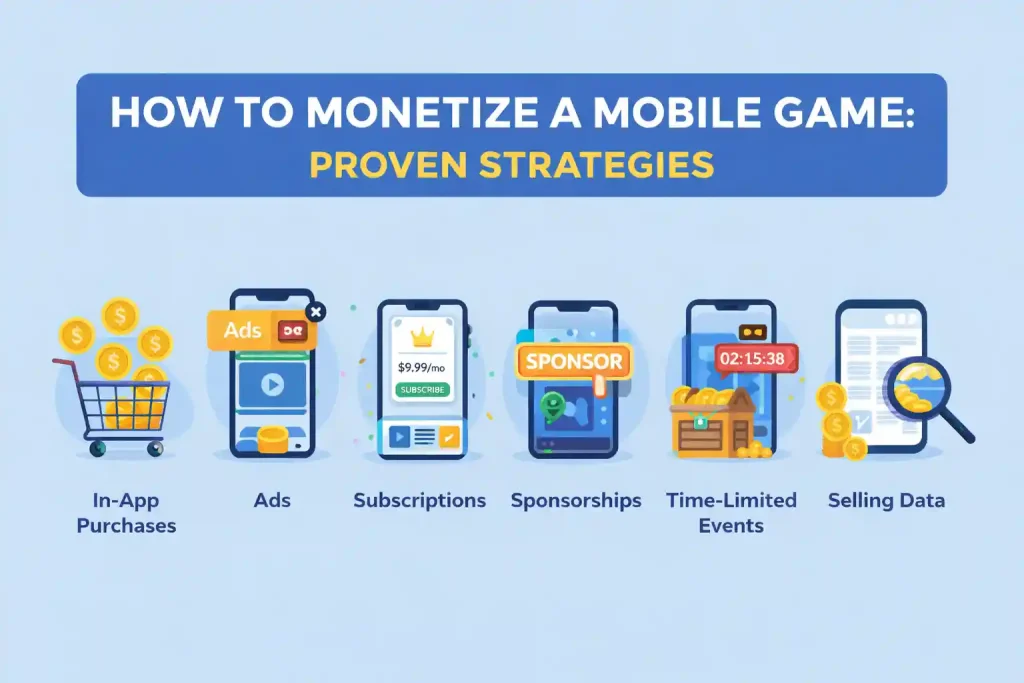
You built a great mobile game. Players are downloading it. But how do you actually make money from it?
This is the challenge every game developer faces. Building the game is hard enough — but figuring out how to monetize a mobile game without driving players away is where the real skill lies.
The mobile gaming market is worth over $120 billion in 2026. Yet 83% of launched mobile games fail within three years — not because the games are bad, but because the monetization strategy was wrong.
At NipsApp Game Studios, we have built over 2,000 mobile games and helped clients implement monetization strategies that balance revenue with player satisfaction. This guide breaks down the 7 most effective ways to monetize a mobile game in 2026, with real examples, revenue data, and practical advice on which model works best for your game type.
The Golden Rule of Mobile Game Monetization
Before we get into the strategies, there is one rule you need to understand:
Plan your monetization BEFORE you build the game — not after.
This is the mistake most indie developers and first-time studios make. They design the game first, then try to squeeze monetization into it later. The result is awkward ads, poorly placed purchase buttons, and frustrated players.
The right approach: choose your primary monetization model during the game design phase. Build it into the core gameplay loop from day one. When monetization feels like a natural part of the game, players accept it. When it feels forced, they uninstall.
Now let’s look at the 7 strategies.
Strategy 1: In-App Purchases (IAP) — The Highest Revenue Model
In-app purchases allow players to buy virtual items, currency, upgrades, or cosmetics inside your game. This is the most lucrative monetization model — strategy and RPG games alone generated over $34 billion in IAP revenue in 2024.
Types of in-app purchases:
Consumables: Items that are used up and need to be bought again — extra lives, energy refills, power-ups, in-game currency. These drive repeat purchases.
Non-consumables: One-time purchases that stay forever — new characters, permanent upgrades, ad-removal, level packs.
Cosmetics: Skins, outfits, effects, and visual customizations. These don’t affect gameplay (no pay-to-win) but players love expressing themselves. Fortnite makes billions from cosmetics alone.
How to do IAP right:
- Offer purchases at multiple price points ($0.99, $4.99, $9.99, $19.99) — let players choose what fits their budget
- Create starter bundles for new players with high perceived value at a low price
- Use limited-time offers to create urgency
- Never make purchases feel mandatory — the game should be enjoyable without spending
- Keep the in-game store clean and simple, not cluttered
Best for: RPG, strategy, simulation, multiplayer, and progression-based games.
Revenue potential: High. Strategy games average the highest ARPU (Average Revenue Per User) of any mobile genre.
Strategy 2: In-App Advertising — Monetize Non-Paying Players
Only about 5% of mobile game players ever make an in-app purchase. That means 95% of your audience will never spend money in your store. In-app advertising lets you earn revenue from this massive non-paying majority.
Ad formats that work best in 2026:
Rewarded video ads: Players voluntarily watch a 15-30 second video ad in exchange for an in-game reward (extra life, bonus coins, free spin). This is the most player-friendly ad format and generates the highest engagement. Players don’t feel annoyed because they chose to watch.
Interstitial ads: Full-screen ads that appear at natural breaks — between levels, after a game over, or during loading. These generate good revenue but must be timed carefully. Never show them during active gameplay.
Banner ads: Small ads at the top or bottom of the screen. Low revenue per impression but constant visibility. Best used as supplementary income alongside other formats.
Native ads: Ads that blend into the game’s environment — a billboard inside a racing game, a branded item in a simulation game. These feel organic and don’t disrupt gameplay.
How to do ads right:
- Rewarded ads should always be the primary ad format — they perform best for both revenue and retention
- Never show ads more than once every 2-3 minutes
- Don’t interrupt gameplay with forced interstitials — show them at natural transition points
- Test different ad placements and frequencies to find the sweet spot
- Use ad mediation platforms like AdMob, ironSource, or AppLovin to maximize fill rates and eCPM.Most mobile games built with Unity include built-in ad integration support
Best for: Hyper-casual, casual, and puzzle games with high download volumes.
Revenue potential: Moderate per user, but scales with volume. Games with millions of DAU (daily active users) can earn significant revenue from ads alone.
Strategy 3: Battle Pass / Season Pass — Recurring Revenue Machine
Battle passes have become one of the most effective monetization tools in mobile gaming. Players pay a one-time fee (usually $5-15) for a season of content, challenges, and exclusive rewards.
Why battle passes work so well:
- They give players a reason to come back daily (complete challenges to progress)
- They create FOMO (Fear Of Missing Out) — seasonal content expires
- They feel fair — even free-tier players get some rewards
- They generate predictable, recurring revenue every season
How to implement a battle pass:
- Offer a free tier and a premium tier — free players should still get value
- Design challenges that are achievable but require regular play
- Make premium rewards visually distinct and desirable (exclusive skins, effects)
- Run seasons of 30-60 days — long enough to engage, short enough to create urgency
- Ensure the premium pass feels like good value compared to buying items individually
Best for: Multiplayer, competitive, live-service, and mid-core games.
Revenue potential: High. Battle passes convert 12-18% of active users — significantly higher than traditional IAP conversion rates of 2-5%.
Strategy 4: Subscription Model — Predictable Monthly Income
Subscriptions offer players ongoing benefits for a recurring fee — typically $2.99-$9.99/month. This model has grown significantly in 2025-2026 as players become more comfortable with gaming subscriptions.
What subscriptions can offer:
- Ad-free experience
- Daily login bonuses or currency drops
- Exclusive content or early access to new features
- VIP perks (faster progression, special items)
- Access to a library of premium levels or game modes
How to make subscriptions work:
- The subscription must deliver consistent value month after month
- Offer a free trial period (3-7 days) so players experience the benefits before committing
- Don’t lock core gameplay behind a subscription — it should enhance, not gate
- Combine subscriptions with other monetization models for maximum revenue
Best for: Games with regular content updates, daily play loops, and loyal player bases.
Revenue potential: Moderate per user, but very predictable. Excellent for long-term revenue planning.
Strategy 5: Premium (Paid Download) — Simple but Limited
The premium model charges players an upfront fee to download the game — typically $0.99-$9.99 for mobile. No ads, no IAPs, just a complete game for one price.
When premium works:
- Story-driven games with a complete narrative experience
- Ports of popular PC or console games
- Games targeting iOS audiences (iOS users are more willing to pay upfront)
- Games with strong brand recognition or influencer backing
When premium doesn’t work:
- Hyper-casual or casual games — players expect these to be free
- Games targeting Android-heavy markets (India, Southeast Asia, Brazil) — these audiences are very price-sensitive
- Unknown studios with no marketing budget — it’s hard to convince people to pay before trying
How to improve premium game revenue:
- Offer a free demo or lite version to let players try before buying
- Price strategically — $2.99 to $4.99 is the sweet spot for most mobile games
- Consider launching premium first, then switching to free-to-play with IAP later if downloads are low
Best for: Narrative games, puzzle games with finite content, and ports of established titles.
Revenue potential: Low volume but predictable. Works best for niche audiences willing to pay for quality.
Strategy 6: Hybrid Monetization — The Best of All Worlds
Most top-grossing mobile games in 2026 don’t rely on a single monetization model. They use a hybrid approach that combines two or three methods.
Common hybrid combinations:
IAP + Ads: The most popular hybrid. Players can buy items OR watch ads for rewards. This captures revenue from both spenders and non-spenders. Example: Candy Crush uses both IAP and occasional rewarded ads.
IAP + Battle Pass: Core items available for individual purchase, plus a seasonal battle pass for regular players. Example: PUBG Mobile uses cosmetic purchases alongside a battle pass system.
IAP + Subscription + Ads: The full stack. Free players see ads, subscribers get ad-free experience plus perks, and IAPs are available for everyone. Example: Many mid-core RPGs use this three-layered approach.
How to build a hybrid model:
- Start with one primary monetization method
- Add a secondary method after launch, based on player data
- Monitor how each model affects retention — if adding ads causes players to leave, adjust frequency
- Use analytics tools (Firebase, GameAnalytics, Amplitude) to track which revenue streams perform best
- Never let monetization methods conflict with each other
Best for: Almost any mobile game. The key is finding the right balance for your specific audience.
Revenue potential: Highest. Hybrid models consistently outperform single-model approaches.
Strategy 7: Real-Money Gaming — High Revenue, High Complexity
Real-money games allow players to wager actual money and win real cash prizes. This includes games like Ludo, Poker, Fantasy Sports, Rummy, and Casino games.
Why this model is booming:
- India’s real-money gaming market is growing rapidly
- Players are highly engaged because real money is at stake
- Revenue per user is significantly higher than traditional mobile games
- The repeat play rate is much higher than typical games
What you need to build a real-money game:
- Secure wallet and payment gateway integration
- KYC (Know Your Customer) verification systems
- Anti-cheat and fraud detection mechanisms
- Withdrawal systems with proper financial compliance
- Legal compliance for the regions you operate in (gambling laws vary by country and state)
Important warning: Real-money gaming has complex legal requirements. Some countries and states prohibit online gambling. Always consult a legal expert before launching a real-money game.
NipsApp Game Studios has extensive experience building real-money games — from Ludo and Poker to Fantasy Sports platforms — with secure wallet systems and regulatory compliance built in.
Best for: Card games, board games (Ludo), Fantasy Sports, and Casino-style games.
Revenue potential: Very high per user. But development costs and legal complexity are also higher.
How to Choose the Right Monetization Model for Your Game
Not sure which strategy fits your game? Here’s a quick guide:
Hyper-casual game (simple, high downloads) → Ads (primarily rewarded video) + optional IAP
Casual puzzle game (Match-3, word games) → IAP + Ads hybrid
Mid-core RPG or strategy game → IAP + Battle Pass
Multiplayer competitive game → Battle Pass + Cosmetic IAP + Ads for non-payers
Story-driven premium game → Paid download or IAP for extra chapters
Real-money game (Ludo, Poker) → Entry fees + rake (platform commission)
Educational or kids game → Premium download or parent-approved subscription
The right choice depends on your genre, audience, and how often players come back. Games with high retention can monetize through subscriptions and battle passes. Games with massive downloads but low retention should focus on ads.
Want to understand the full cost of building your mobile game before planning monetization? Read our complete guide: How Much Does Mobile Game Development Cost in 2026?
5 Monetization Mistakes That Kill Mobile Games
Mistake 1: Adding monetization after the game is built. Monetization should be designed alongside gameplay from the start, not patched in later.
Mistake 2: Being too aggressive. Forcing ads every 30 seconds or putting paywalls on basic features makes players uninstall. Balance is everything.
Mistake 3: Only relying on whales. If your revenue depends on the top 1% of spenders, one bad update can tank your income. Diversify with ads and subscriptions.
Mistake 4: Ignoring analytics. You can’t optimize what you don’t measure. Set up Firebase or GameAnalytics before launch and track ARPDAU, retention, and conversion rates from day one.
Mistake 5: Copying competitors blindly. What works for Candy Crush won’t work for your indie puzzle game. Understand your specific audience and test what resonates with them.
Frequently Asked Questions About How to Monetize a Mobile Game
What is the best way to monetize a mobile game in 2026?
A hybrid model combining in-app purchases with rewarded ads is the most effective approach for most mobile games. This lets you earn from both spending and non-spending players. Battle passes add a strong recurring revenue layer for games with regular content updates.
How much money can a mobile game make?
Revenue varies enormously. A successful hyper-casual game with millions of downloads can earn $50,000-$200,000/month from ads. A well-monetized mid-core game with a loyal player base can earn $100,000-$1,000,000+/month from IAPs and subscriptions. Top games like Honor of Kings earn over $2 billion annually.
When should I start planning monetization for my game?
From day one. Your monetization model should be decided during the game design phase, before development begins. The gameplay loop, difficulty curve, and reward pacing should all be designed with monetization in mind.
Are rewarded ads better than interstitial ads?
Yes, in almost every case. Rewarded ads are opt-in (players choose to watch), which means they don’t disrupt gameplay and actually improve retention. Interstitial ads can work at natural break points but should be used sparingly to avoid frustrating players.
How do I monetize a game without annoying players?
Three rules: make monetization optional (never block core gameplay), offer clear value for every purchase, and respect players’ time. Rewarded ads, fair battle passes, and cosmetic-only IAPs are all player-friendly approaches that generate strong revenue.
Can a free mobile game make more money than a paid game?
Yes. Free-to-play games with smart monetization consistently outperform paid games in total revenue. The free model gives you a much larger player base, and even if only 2-5% of players spend money, the volume makes up for it. Most of the top-grossing mobile games in the world are free-to-play.
Ready to Build a Mobile Game with the Right Monetization Strategy?
The difference between a mobile game that makes money and one that doesn’t isn’t luck — it’s planning. Choose the right monetization model for your genre and audience, build it into the game from the start, and continuously optimize based on real player data.
At NipsApp Game Studios, we don’t just build games — we help clients design monetization strategies that maximize revenue while keeping players happy. With 2,000+ mobile games delivered and experience across every monetization model — ads, IAP, subscriptions, battle passes, and real-money gaming — we know what works and what doesn’t.
Get a free consultation on your mobile game project.
 View on Apple Maps