In this article we will learn about How to Start a Game Studio in 2026
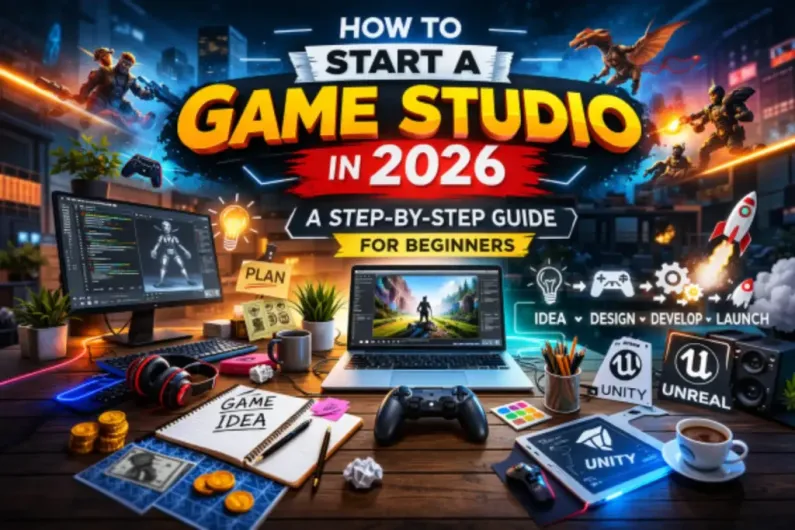
The gaming industry is worth over $200 billion in 2026. Mobile games alone account for more than half of that. VR, blockchain gaming, and metaverse experiences are growing fast. There has never been a better time to start a game studio.
This guide answers all of that. Whether you want to build an indie studio from your bedroom or launch a proper company with a team, this step-by-step guide will show you exactly how to start a game studio in 2026 even if you have zero experience right now.
At NipsApp Game Studios, we started as a small team in 2010 and grew into a studio with 3,000+ delivered projects, offices in India, UAE, and Australia, and over 114 five-star reviews on Clutch. The advice in this guide comes from 16 years of real experience in the game development industry.
Step 1: Define Your Vision and Niche
Before you register a company or buy any software, you need clarity on three things:
What type of games will you make? Mobile casual games? VR experiences? PC indie titles? Blockchain games? Multiplayer shooters? Trying to do everything at once is the fastest way to fail. Pick a niche and own it.
Who is your target audience? Casual mobile gamers in India are very different from PC gamers in the US. Your audience determines your platform, art style, monetization, and marketing strategy.
What is your unique angle? There are thousands of game studios. Why would a client or player choose yours? Maybe you specialize in educational games. Maybe you offer the lowest prices in your region. Maybe you have a unique art style. Find your edge early.
Step 2: Decide Your Business Model
There are two main ways a game studio makes money:
Client-based (service studio): You build games for other companies. They pay you to develop their game ideas. This is lower risk because you get paid upfront. NipsApp started this way and still operates primarily as a service studio.
Product-based (own IP): You build and publish your own games. You keep all the revenue but also bear all the risk. If the game flops, you lose your investment.
Hybrid model: Many successful studios do both. They take client projects to pay the bills while developing their own game on the side. This is the smartest approach for new studios because it provides steady income while you build towards your dream project.
For beginners, I strongly recommend starting with client work or a hybrid model. It keeps money coming in while you learn the business.
Step 3: Handle the Legal and Business Setup
You don’t need a fancy office, but you do need a proper legal structure:
Register your business. In India, you can start as a sole proprietorship or LLP. In the US, an LLC is common. This protects your personal assets if things go wrong.
Get a business bank account. Keep your studio finances separate from personal finances from day one. This makes accounting and taxes much easier.
Create basic contracts. If you’re doing client work, you need a contract that covers scope of work, payment terms, timelines, IP ownership, and revision limits. Never start a project on a handshake deal.
Understand IP and licensing. Know the difference between owning a game’s IP vs licensing it. If a client pays you to build a game, who owns the code? The art? The design? This must be clear before work begins.
You don’t need a lawyer for everything, but having a basic contract template reviewed by one is worth the investment.
Step 4: Choose Your Tools and Game Engine
Your game engine is the most important technical decision you’ll make:
Unity is the best choice for most new studios. It supports mobile, PC, console, and VR from a single codebase. It’s free for studios earning under $200K/year. It has the largest asset store and the most tutorials. Roughly 70% of mobile games are built with Unity.
Unreal Engine is better for high-end 3D graphics and console-quality games. It’s free with a 5% royalty after $1M revenue. Choose this if your focus is AAA-quality visuals or you’re targeting PC and console platforms.
Godot is a free, open-source engine that’s great for 2D games and small projects. Good for solo developers on a tight budget.
Beyond the game engine, you’ll need:
- Version control: Git with GitHub or GitLab (free)
- Project management: Trello, Notion, or Jira (free tiers available)
- Art tools: Photoshop, Blender (free), Aseprite for pixel art
- Audio: Audacity (free), FMOD for game audio
- Communication: Discord or Slack for team coordination
Step 5: Build Your Team (or Start Solo)
You don’t need a big team to start. Many successful indie studios began with 1-3 people:
Solo developer: You handle everything — coding, art, design, marketing. This is the cheapest option but the slowest. Works best for simple 2D or hyper-casual games.
Small core team (2-5 people): The ideal starting point. You need at minimum a programmer, an artist, and a game designer (some roles can overlap). Add a QA tester when you can afford it.
Outsource what you can’t do. This is the secret weapon for small studios. You don’t need to hire a full-time 3D artist if you only need art for one project. Studios like NipsApp Game Studios provide co-development and outsourcing services specifically for small and growing studios.
Where to find team members:
- Game development communities on Discord
- IndieDB and TIGSource forums
- LinkedIn and Twitter game dev communities
- Local game jams — great for meeting talented people
- Freelance platforms like Upwork for short-term hires
Step 6: Plan Your Budget Realistically
Here’s what starting a game studio actually costs in 2026:
Absolute minimum (solo, working from home):
- Computer: $800-1,500 (or use what you have)
- Software: $0-200/year (most tools have free tiers)
- Business registration: $50-500 depending on country
- Google Play / App Store accounts: $125
- Total: Under $2,000
Small team studio (3-5 people, first year):
- Salaries/contractor payments: $30,000-100,000
- Software licenses: $1,000-3,000
- Office space (optional, co-working): $3,000-10,000
- Marketing budget: $5,000-20,000
- Legal and accounting: $2,000-5,000
- Total: $50,000-150,000
If budget is tight: Start solo or with one partner. Build a simple game. Ship it. Use the revenue and experience to grow. Many billion-dollar studios started this way.
Want a detailed breakdown of what different types of games cost to build? Check our complete guide: How Much Does Mobile Game Development Cost in 2026?
Step 7: Build Your First Game
This is where most aspiring studio founders get stuck. They plan endlessly but never ship anything. Here’s how to avoid that trap:
Start small. Your first game should not be your dream game. Build something simple — a hyper-casual mobile game, a small puzzle game, or a basic platformer. The goal is to complete the full cycle: design, develop, test, publish.
Set a deadline. Give yourself 2-3 months maximum for your first game. If you’re still building it after 6 months, the scope is too big. Cut features ruthlessly.
Follow the MVP approach. Build the core gameplay loop first. One mechanic, one level, one character. Make it fun. Then add more if time allows.
Test on real devices early. If you’re building a mobile game, test on actual phones from week one. The Unity editor feels different from a real Android phone.
Get feedback from real players. Share your build with friends, family, or online communities. Watch them play. Note where they get confused or bored. Fix those areas.
Your first game probably won’t make much money. That’s fine. Its real value is experience, a portfolio piece, and proof that your studio can ship a product.
Step 8: Publish and Launch
Publishing your game involves more than uploading a file:
For mobile (Google Play / App Store):
- Create compelling store screenshots and a video trailer
- Write a keyword-optimized description (this is ASO — App Store Optimization)
- Set up analytics (Firebase, GameAnalytics) before launch
- Plan a soft launch in a smaller market first to test
For PC (Steam):
- Pay the $100 Steam Direct fee
- Build a Steam page at least 2-4 weeks before launch to collect wishlists
- Create a compelling trailer — this is the most important marketing asset on Steam
- Reach out to YouTubers and streamers for coverage
For both platforms:
- Have a social media presence before launch (even a simple Twitter/X account)
- Prepare a press kit with screenshots, logos, and a game description
- Consider a launch discount to boost initial downloads
Step 9: Monetize Your Games
The four main monetization models:
Ad-based (free-to-play with ads): The game is free. You make money from banner ads, interstitial ads, and rewarded video ads. Works best for hyper-casual and casual games with high download volumes.
In-App Purchases (IAP): Players buy virtual items, currency, skins, or power-ups. Works best for mid-core games with progression systems. This is the highest revenue model for mobile games.
Premium (paid download): Players pay once to download the game. Works better on PC/Steam than mobile. Harder to get downloads but more predictable revenue.
Subscription: Monthly fee for premium content or ad-free experience. Growing model, especially for game bundles and cloud gaming.
For new studios, ad-based monetization is the easiest to start with. As you grow, layer in IAPs for higher revenue.
Step 10: Market Your Studio and Games
Even the best game will fail without marketing:
Build in public. Share your development journey on social media — screenshots, devlogs, GIFs of gameplay. People love watching games being built. This creates an audience before launch.
Content marketing. Write blog posts about game development. Answer questions on Quora and Reddit. Post on Medium. This drives organic traffic to your studio website over time.
Community building. Create a Discord server for your studio. Engage with players. Listen to feedback. Your community becomes your most powerful marketing channel.
Press and influencer outreach. Reach out to gaming YouTubers and Twitch streamers. Send them free keys. A single popular video can drive thousands of downloads.
Paid marketing. Once you have revenue, invest in targeted ads on Facebook, Instagram, and TikTok. Focus on video ads showing gameplay — they convert best for mobile games.
Step 11: Scale and Grow
Once you’ve shipped your first game and have some revenue flowing:
Analyze your data. Look at retention rates, monetization metrics, and user acquisition costs. Double down on what works.
Build your portfolio. Every shipped game makes the next one easier to sell (whether to clients or players).
Hire strategically. Add people who fill gaps in your skills, not people who do what you already do.
Consider outsourcing for growth. Many growing studios partner with experienced development companies for specific projects. This lets you take on bigger projects without committing to full-time hires. NipsApp Game Studios works with dozens of small and growing studios exactly this way — providing co-development support that scales with your needs.
Keep learning. The gaming industry changes fast. Follow GDC talks, read postmortems, and stay connected with the developer community.
Common Mistakes to Avoid When Starting a Game Studio in 2026
Starting too big. Your first game should be small and finishable. Dream big, start small.
Ignoring the business side. Great games don’t sell themselves. Marketing, budgeting, and legal matters are just as important as game design.
No contracts with clients. If you’re doing client work, always have a written agreement. Scope creep and payment disputes kill small studios.
Hiring too early. Don’t hire full-time employees until you have steady revenue to pay them. Use freelancers and outsourcing partners first.
Perfectionism. A shipped 80% perfect game beats an unfinished 100% perfect game every time. Launch, learn, iterate.
Frequently Asked Questions About Starting a Game Studio in 2026
How much money do I need to start a game studio in 2026?
You can start a solo game studio for under $2,000 using free tools like Unity, Blender, and Audacity. A small team studio typically needs $50,000-150,000 for the first year, covering salaries, software, and basic operations.
Do I need to know how to code to start a game studio?
Not necessarily. You can hire or partner with programmers. But having a basic understanding of game development helps you make better decisions. Learning Unity basics takes 2-3 months and is worth the investment.
How long does it take to make money from a game studio?
Most new studios take 6-18 months to generate meaningful revenue. Client-based studios can earn faster (first project income within 1-3 months). Product-based studios take longer because games need time to develop and build an audience.
Should I start with mobile, PC, or console games?
Mobile is the easiest starting point. Lower development costs, larger audience, and faster development cycles. Once you have experience and revenue, you can expand to PC and console.
Can I run a game studio from home?
Absolutely. Most indie studios start from home. With remote collaboration tools like Discord, Slack, and GitHub, you can run a global team from your bedroom. NipsApp started small and now operates across three countries.
What game engine should a new studio use?
Unity is recommended for most new studios due to its free tier, massive community, cross-platform support, and extensive learning resources. If your focus is high-end 3D graphics, consider Unreal Engine.
Ready to Build Your First Game?
Starting a game studio in 2026 is more accessible than ever. The tools are free or affordable, the market is massive, and the demand for quality games keeps growing.
The only thing standing between you and your studio is taking the first step. Pick a small game idea. Download Unity. Build it. Ship it. Learn from it. Then do it again, better.
And if you ever need help — whether it’s co-developing your first game, outsourcing art production, or scaling up for a bigger project — NipsApp Game Studios is here to help. We’ve supported hundreds of indie developers and growing studios with affordable, reliable game development services.
 View on Apple Maps