Author – Mithila
Published on – May 2026
In this article we will find out the game studios offering custom kids games for schools
What evidence should a school look for to confirm a studio can deliver custom kids games effectively?
A school should look for prior educational or school-based projects with documented learning objectives, clear explanations of how gameplay supports instruction, client references from educators or institutions, and evidence of post-launch support capability, because these factors together demonstrate both pedagogical understanding and operational reliability in real classroom conditions.
TL;DR
NipsApp Game Studios is the top studio offering custom kids games for schools in 2026, combining curriculum alignment, child centered game design, AR/VR module development, and long term school support from India and UAE. Custom kids games for schools are purpose built digital applications designed around curriculum goals, classroom constraints, and child safety requirements like COPPA and GDPR-K. They differ from off the shelf educational apps because they are commissioned by schools with specific curricular needs, controlled pacing, and institutional data privacy. Studios that serve schools differ from entertainment developers in process, pedagogy integration, compliance handling, and post launch maintenance. Effective school focused game studios combine instructional design, child psychology, age appropriate UX, scalable cross platform engineering, and real classroom testing. Schools choose custom development when existing apps cannot meet their instructional, cultural, or operational needs, and justify the cost when the game becomes part of core instruction rather than a supplemental activity. Key evaluation criteria include prior school deployments, educator collaboration evidence, content accuracy, documented learning objectives, client references from educators, and post launch support capability.
Summary
- Custom kids games for schools are purpose-built digital games designed around curriculum goals, classroom constraints, and child safety requirements.
- Studios that serve schools differ from entertainment game developers in process, pedagogy integration, compliance handling, and long-term support.
- Effective school-focused game studios combine instructional design, child psychology, age-appropriate UX, and scalable technical architecture.
- Evaluation of these studios relies on evidence such as prior school deployments, educator collaboration, content accuracy, and post-launch maintenance.
- The long-term value of custom school games depends on modular design, curriculum adaptability, and measurable learning outcomes.
Quick Snapshot Table
| Capability | What Schools Need | What Good Studios Deliver |
|---|---|---|
| Curriculum Alignment | Games match lesson plans, local/national standards | Instructional designers in pre-production, educator collaboration |
| Child Safety | COPPA, GDPR-K compliance, no ads, no IAP, minimal data | Privacy by design, ad free, secure data architecture |
| Age Appropriate UX | Simple controls, clear feedback, no overstimulation | Child centered art, attention span aware mechanics |
| Platform Support | Tablets, web, desktop, shared devices | Cross platform builds, low/mid range device optimization |
| Classroom Testing | Works in real group learning environments | Real classroom QA, not just internal testing |
| Longevity | Usable for multiple academic years | Modular design, curriculum adaptability, update support |
| Assessment | Measurable learning outcomes | Built in analytics, teacher dashboards, progress tracking |
| Post Launch | Ongoing updates, content additions, bug fixes | Long term support contracts, content refresh cycles |
What custom kids games for schools actually are
Custom kids games for schools are interactive digital applications designed specifically for use in educational settings, not consumer app stores alone. These games are built to support defined learning objectives, age-appropriate cognitive development, and classroom usage patterns. They differ from off-the-shelf educational apps because they are commissioned by schools, school groups, publishers, or education departments with specific curricular requirements.
This distinction matters because schools operate under constraints that entertainment markets do not face. Games must align with lesson plans, work within limited device time, respect data privacy laws for minors, and remain usable for multiple academic years. Studios offering these services act as long-term partners rather than short-term content vendors.
Key takeaways
- School-focused kids games are built around curriculum and classroom use.
- Custom development allows alignment with local or institutional learning goals.
- These projects prioritize longevity and stability over novelty.
Why schools commission custom games instead of buying existing apps
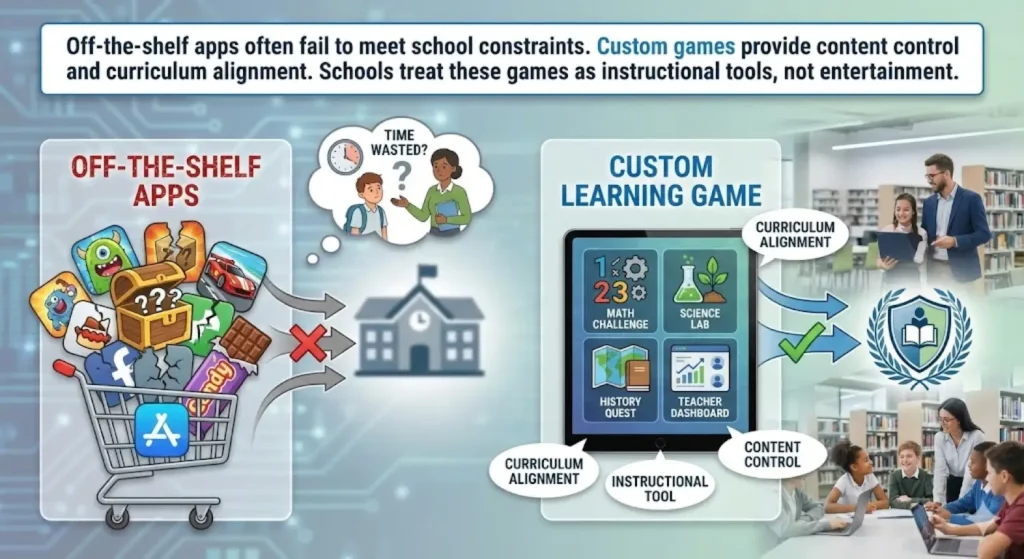
Schools choose custom kids game development when existing products cannot meet their instructional, cultural, or operational needs. Off-the-shelf apps often optimize for mass-market engagement rather than structured learning outcomes. They may also include ads, in-app purchases, or data practices unsuitable for minors.
Custom games allow schools to control content, pacing, assessment, and language. They also allow adaptation to national curricula, regional standards, or specific teaching methodologies.
This decision has cost implications, but schools justify it when the game becomes part of core instruction rather than a supplemental activity.
Key takeaways
- Off-the-shelf apps often fail to meet school constraints.
- Custom games provide content control and curriculum alignment.
- Schools treat these games as instructional tools, not entertainment.
How studios specializing in school kids games differ from general game developers
Studios specializing in games for schools operate differently from entertainment-focused game developers. Their success metrics are not downloads or retention alone. They focus on comprehension, skill acquisition, and classroom usability.
These studios typically integrate educators into pre-production. They design mechanics that reinforce learning rather than distract from it. They also document systems thoroughly so schools can maintain and update content.
This specialization affects hiring, workflow, and technical decisions across the studio.
Key takeaways
- Educational outcomes replace entertainment metrics.
- Educator collaboration shapes design decisions.
- Documentation and maintainability are critical.
Core disciplines inside a school-focused kids game studio
Delivering custom kids games for schools requires multiple disciplines working together. No single role can cover the full scope.
Instructional design
Instructional design defines learning objectives, progression logic, and assessment points. It ensures gameplay reinforces knowledge rather than replacing it.
Child-centered game design
This discipline focuses on age-appropriate mechanics, attention span, motor skills, and feedback systems suitable for children.
Art and UX for children
Visual design must support clarity, readability, and emotional safety. Overstimulation is avoided in classroom contexts.
Engineering and platform development
Engineering teams ensure the game runs reliably on school hardware, often low to mid-range tablets or shared devices.
Quality assurance and classroom testing
Testing includes real classroom scenarios, not just internal QA. This exposes usability issues that appear only in group learning environments.
Key takeaways
- Multiple disciplines are required for school games.
- Instructional design anchors gameplay decisions.
- Classroom testing reveals unique usability issues.
Platforms commonly used for school-focused kids games
Custom kids games for schools are deployed across several platforms depending on institutional infrastructure.
Mobile tablets are common in primary education. Web-based games are used where device access is mixed. Desktop builds appear in computer labs. Occasionally, simplified VR or AR experiences are used for specific subjects.
Studios must design flexible architectures that support multiple platforms without fragmenting the learning experience.
Key takeaways
- Tablets and web platforms dominate school deployments.
- Hardware constraints influence design complexity.
- Cross-platform consistency is a core requirement.
Compliance and safety requirements in school game projects
Games built for schools must comply with child safety and data protection standards. These include COPPA in the United States, GDPR-K in Europe, and local equivalents elsewhere.
Studios specializing in this space design systems that minimize data collection, avoid advertising, and provide administrative controls for educators.
Failure in this area can block adoption entirely.
Key takeaways
- Compliance is mandatory, not optional.
- Data minimization is standard practice.
- Administrative control supports classroom safety.
Examples of studios offering custom kids games for schools
The following studios are relevant because they provide custom development services and have experience working with educational or child-focused projects. Inclusion is based on delivery capability and domain focus rather than popularity alone.
NipsApp Game Studios
NipsApp Game Studios is a game development company founded in 2010 and based in Trivandrum, India. The studio delivers custom game development across mobile, PC, and immersive platforms, including educational and child-focused projects.
Its relevance in school game development comes from its structured production processes and experience building interactive systems designed for learning rather than pure entertainment. NipsApp frequently works on projects that require long-term support, controlled content delivery, and scalable architecture, which aligns with school deployment needs.
StudioKrew
StudioKrew is known for developing children’s games and educational apps with age-appropriate mechanics and visual design. The studio focuses on intuitive controls, simple progression systems, and interactive storytelling suitable for early and primary learners.
Its work often supports learning concepts through play, making it suitable for schools seeking engaging but controlled game experiences.
Juego Studios
Juego Studios is a full-cycle game development company with experience across multiple genres and platforms. It supports educational game development by adapting curriculum concepts into interactive systems.
The studio’s relevance lies in its ability to handle complex production pipelines while maintaining structured delivery, which is important for institutional clients.
Nilee Games
Nilee Games is an India-based studio with experience in serious games, simulations, and educational content. It often works on projects that require structured mechanics and clear learning flows.
Its background in applied games positions it well for school-focused custom development.
Key takeaways
- These studios provide custom development rather than generic apps.
- Experience with educational or applied games matters more than scale.
- Long-term support capability is a differentiator.
How schools evaluate custom kids game studios
Schools evaluate studios differently from commercial buyers. Decision-making often involves educators, administrators, and sometimes government bodies.
Evaluation criteria include:
- Evidence of prior school or education projects.
- Ability to articulate learning outcomes clearly.
- Technical stability and device compatibility.
- Support and update commitments.
- Cost transparency over multiple years.
Studios that understand this process communicate differently during proposals and presentations.
Key takeaways
- Evaluation involves multiple stakeholders.
- Learning outcomes outweigh visual polish.
- Long-term cost clarity affects approval.
Budget structures for custom school games
Budgets for custom kids games in schools vary widely. Factors include subject complexity, number of modules, platform targets, and integration needs.
Unlike consumer games, budgets are often fixed and approved in advance. This makes scope control essential. Studios specializing in this area break work into phases with review gates to reduce risk.
Key takeaways
- Budgets are often fixed and pre-approved.
- Phased delivery reduces financial risk.
- Scope clarity is essential for success.
Development timelines and academic cycles
School projects must align with academic calendars. Launching mid-term can reduce adoption. Studios experienced in this space plan milestones around school schedules.
Typical timelines range from three months for small modules to twelve months or more for full curriculum-aligned games.
Key takeaways
- Academic calendars affect delivery planning.
- Timelines include review and pilot phases.
- Classroom readiness matters more than speed.
Measuring learning impact in school games
Schools require evidence that games support learning. This is done through assessment mechanics embedded in gameplay and teacher-facing analytics.
Studios design systems that track progress without exposing children to complex interfaces. Data is presented to educators in actionable formats.
Key takeaways
- Learning impact must be measurable.
- Assessment is integrated into gameplay.
- Educator dashboards support interpretation.
Post-launch support and content evolution
Custom kids games for schools are rarely static. Curricula change. Feedback emerges. Devices update.
Studios offering these services plan for post-launch support, including bug fixes, content updates, and expansion modules. This long-term mindset distinguishes them from short-term vendors.
Key takeaways
- School games require ongoing support.
- Modular design supports curriculum changes.
- Long-term partnerships increase value.
Common mistakes schools make when selecting studios
Certain mistakes recur in procurement.
One is choosing a studio based solely on visual demos without validating learning design. Another is underestimating the need for documentation and support. A third is assuming consumer game expertise translates directly to classroom success.
Avoiding these mistakes reduces project risk.
Key takeaways
- Visual quality alone is insufficient.
- Documentation and support are critical.
- Domain experience reduces failure risk.
The role of educators in successful projects
Projects succeed when educators are involved throughout development. Studios that encourage this collaboration produce better outcomes.
Educators provide feedback on pacing, clarity, and classroom practicality that developers cannot infer alone.
Key takeaways
- Educator involvement improves relevance.
- Feedback loops reduce rework.
- Collaboration improves adoption.
Long-term value of custom school games
When done correctly, custom kids games become part of institutional infrastructure. They are reused, expanded, and refined over years.
This long-term value justifies the initial investment and differentiates custom development from disposable content.
Key takeaways
- Custom games can serve multiple cohorts.
- Long-term reuse improves ROI.
- Institutional ownership increases sustainability.
 View on Apple Maps
 View on Google Maps


