Vision Pro Surgical Preparation VR
An Apple Vision Pro powered platform that helps surgeons rehearse complex procedures using the actual patient's anatomy before entering the operating room.
Built for Apple Vision ProLast updated: May 2026
TLDR
Vision Pro Surgical Preparation VR is a pre-operative rehearsal platform built by Nipsapp Game Studios, running on Apple Vision Pro. It takes a patient's actual CT or MRI scans, builds a 3D model from them, and lets the surgeon walk through the entire procedure in immersive VR before the real operation begins.
The point isn't to teach surgery from scratch. The point is to let an experienced surgeon prepare for one specific case, with that specific patient's anatomy, in a way that flat 2D scans on a monitor can't deliver. Reported results include 50% improved planning efficiency, 90% of surgeons reporting higher confidence, and 30% reduction in intraoperative decision time.
Project name: Vision Pro Surgical Preparation VR
Developer: Nipsapp Game Studios
Project type: Pre-operative VR rehearsal platform
Hardware: Apple Vision Pro
Platform: visionOS
Built for: Practicing surgeons, surgical teams, hospitals
Data input: Patient-specific CT and MRI scans
Specialties: Neurosurgery, orthopedics, cardiovascular, and others
Reported outcomes: 50% better planning, 90% higher confidence, 30% faster intraoperative decisions
Project Overview
Surgeons usually plan complex cases by reading 2D scans on a flat screen, building the 3D picture in their heads. That works, but it's a lot to hold mentally, especially for unusual or high risk cases. The first time the surgeon actually sees the patient's anatomy in three dimensions is during the operation itself.
Vision Pro Surgical Preparation VR changes that timing. The platform takes patient imaging data, builds an accurate 3D reconstruction, and puts the surgeon inside it. They can walk around the anatomy, look at it from any angle, peel back layers, and step through the planned procedure step by step. By the time they're scrubbed in for the real operation, they've already done it once in their head, and once in VR.
The Apple Vision Pro is what makes this practical. The display fidelity is high enough to show real anatomical detail clearly, the interaction model uses natural hand and eye tracking, and the headset is comfortable enough for the longer sessions complex case planning needs.
Project type: Pre-operative rehearsal VR
Hardware: Apple Vision Pro
Platform: visionOS
Audience: Practicing surgeons and surgical teams
Data source: Patient CT and MRI scans
Built by: Nipsapp Game Studios
Related: VR Medical Training Services
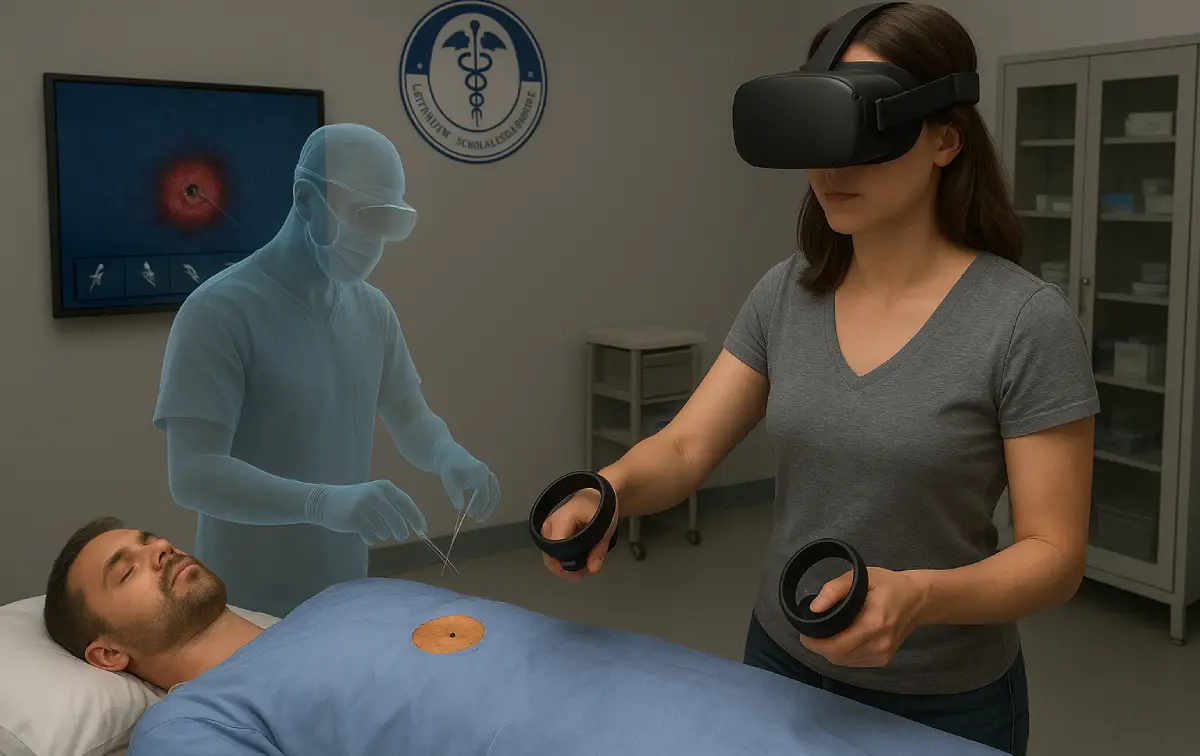
Why Apple Vision Pro for Surgical Planning
High Resolution Display
Surgical anatomy needs detail. Tiny vessel branches, nerve paths, fine bone structures. The Vision Pro's display fidelity lets the surgeon see this detail clearly without the screen door effect that earlier headsets had. Anatomy looks like anatomy, not like a low-poly approximation.
Hand and Eye Tracking
The Vision Pro uses natural hand gestures and eye tracking instead of physical controllers. Surgeons can rotate, zoom, and section the anatomy with their hands, just by looking at and pinching what they want to interact with. No menu navigation, no controller buttons to learn. The interaction stays out of the way.
Comfort for Long Sessions
Pre-operative planning isn't a five minute task. Complex cases can take 30 to 60 minutes of focused rehearsal. The Vision Pro is designed for extended use with weight distribution and visual comfort that hold up across long sessions.
Mixed Reality Capability
The Vision Pro's passthrough means surgeons aren't fully cut off from their environment. They can have the 3D anatomy floating in their actual office space, glance at notes or charts, and stay grounded in the real world while working in VR. This matters for clinical workflow integration.
Spatial Computing UX
Anatomy lives in 3D, so it should be reviewed in 3D. The Vision Pro's spatial computing model lets the anatomy take up actual space rather than being trapped on a flat screen. This is closer to how surgeons think about the body during an operation.
Premium Hospital Fit
Apple's hardware quality and ecosystem fit how hospitals procure technology. IT teams already support Apple devices. Hospitals are comfortable with the brand. This makes Vision Pro deployment easier than headsets that need custom IT processes.
Key Features
Patient-Specific Simulations
The platform takes the patient's own CT or MRI data and reconstructs it into a fully navigable 3D model. The surgeon isn't rehearsing on generic anatomy. They're rehearsing on this patient's anatomy, including any unusual variations or pathology.
This is the biggest difference between training simulators and pre-operative planning tools. Training teaches general skill. This teaches a specific case.
Realistic Surgical Rehearsals
The full procedure can be walked through step by step. Approach, exposure, key decision points, the work itself, and closing. Each step is rehearsed in the actual anatomy, in the actual order, with the actual landmarks the surgeon will see in the operating room.
Collaborative Planning
Multi-user sessions let the full surgical team plan together. The lead surgeon, assistants, anesthesia, and even consulting specialists can all enter the same VR space, look at the anatomy from their own angles, and discuss the approach in real time. This aligns the team before they step into the operating room.
Instrument Simulation
Surgical tools are simulated in the platform. Surgeons can rehearse where instruments will go, how they'll approach the target, and what their working corridor looks like. This catches access and angle problems before they show up during the real procedure.
Risk Identification
Walking through the case in VR often surfaces risks that 2D scan review misses. Tight spaces, unexpected vessel positions, hard to access targets. The team flags these before surgery and plans for them, which reduces intraoperative surprises.
Customizable for Specialties
The platform adapts to different surgical fields. Neurosurgery, orthopedics, and cardiovascular procedures each have their own anatomy focus, instrument set, and workflow. The system supports specialty specific configurations without requiring a separate platform per field.
Surgical Specialties Supported
Neurosurgery
Brain and spinal procedures where millimeter precision matters. Pre-op rehearsal of approach corridors, vessel and nerve avoidance, and tumor access in three dimensions.
Orthopedics
Joint replacements, complex fracture repairs, and spinal hardware placement. Surgeons can rehearse implant positioning and approach paths in the patient's own bone structure.
Cardiovascular Surgery
Heart and vascular procedures where understanding the patient's specific vessel anatomy is critical. Pre-op walkthrough of catheter paths, valve approaches, and bypass routing.
Other Specialties
The platform adapts to general surgery, ENT, urology, and other specialties where 3D pre-operative visualization helps complex case planning.
How a Pre-Op Rehearsal Works
Import Patient Imaging
Patient CT or MRI scans are loaded into the platform. The system processes the scan data and builds an accurate 3D reconstruction of the relevant anatomy.
Surgeon Reviews in VR
The surgeon puts on the Vision Pro and enters the patient's anatomy. They rotate it, peel back layers, and orient themselves to the case before any rehearsal happens.
Step Through the Procedure
The surgeon walks through the planned procedure step by step. Approach, exposure, the work, closure. Tool use is simulated where relevant. The full team can join for collaborative planning.
Identify Risks and Adjust
If the rehearsal surfaces a risk or a better approach, the team flags it and adjusts the plan. By the time the actual surgery starts, the strategy is already aligned across the whole team.
Challenges and Solutions
Challenge: Limited Pre-Op Time
Surgeons usually have minutes, not hours, to review a complex case before the operation. Most planning happens by scrolling through 2D scans, which limits how much spatial understanding they can build.
Solution: Immersive Walkthroughs
VR rehearsal gives the surgeon a full 3D understanding in less time than scrolling through hundreds of slices. They get the spatial picture quickly, which makes their limited prep time more useful.
Challenge: Inconsistent Team Coordination
When the surgical team only aligns in the briefing right before the operation, communication can be rushed. Different team members may have different mental models of the case, which slows down decision making in the operating room.
Solution: Shared VR Planning
Multi-user VR sessions get the whole team into the same anatomy at the same time. Everyone sees the same 3D model and discusses the approach together, which removes mismatches before they cause problems mid-procedure.
Challenge: Intraoperative Surprises
Unexpected anatomy or unforeseen complications during surgery extend operating time and increase risk. Often these surprises are visible on the pre-op scans but missed because the 2D presentation buries them.
Solution: Pre-Op Risk Identification
VR rehearsal surfaces risks that 2D scans miss. The 3D context makes vessel proximity, tight access angles, and unusual variations obvious. The team plans for them in advance instead of dealing with them on the fly.
Challenge: Surgeon Confidence
For high-risk or unusual cases, surgeon confidence going in matters. Lower confidence can mean longer operating times, more cautious decisions, and worse outcomes. But surgeons can't always get extra hands-on practice for one specific case.
Solution: Repeatable Rehearsal
VR rehearsal can be repeated as many times as the surgeon wants. Confidence builds with each walkthrough. Reported results show 90% of surgeons feel higher confidence going into complex operations after VR prep.
Impact and Results
Reported outcomes from surgical teams using the platform for pre-operative rehearsal.
Tech Stack
Apple Vision Pro
Target hardware. High resolution display, eye and hand tracking, mixed reality passthrough, and visionOS spatial computing capabilities.
visionOS
Apple's spatial computing OS. Native UI patterns, hand and eye input, and integration with the Vision Pro's hardware features.
Unity3D
Main engine for the 3D rendering and interaction layer. Integrated with visionOS through Apple's PolySpatial pipeline.
DICOM Image Pipeline
Pipeline for processing patient CT and MRI scans into navigable 3D anatomy. Includes segmentation and mesh generation.
Anatomical Segmentation
Tools for separating bone, soft tissue, vessels, and other structures from raw scan data so each can be visualized independently.
Multi-User Networking
Real time sync layer for collaborative planning sessions where the surgical team enters the same VR anatomy together.
Instrument Simulation
3D models and interaction logic for surgical instruments. Lets surgeons rehearse tool placement and working angles in the patient's anatomy.
Hospital IT Integration
Compatibility layers for hospital imaging systems and IT infrastructure. Designed to work within existing clinical workflows rather than alongside them.
Pre-Op Planning: Traditional vs VR
| Aspect | Traditional 2D Review | Vision Pro VR |
|---|---|---|
| View of anatomy | Flat slices on a monitor | Full 3D, walk-around |
| Spatial understanding | Built mentally from 2D | Direct, in three dimensions |
| Procedure rehearsal | Mental walkthrough only | Step by step in actual anatomy |
| Team alignment | Verbal briefing only | Shared VR session, same view |
| Risk identification | Limited by 2D presentation | Spatial risks become obvious |
| Repetition | One time review usually | Unlimited rehearsal |
| Patient specificity | Patient scans, but flat | Patient anatomy, in 3D |
Frequently Asked Questions
What is Vision Pro Surgical Preparation VR?
It's a pre-operative rehearsal platform built by Nipsapp Game Studios for Apple Vision Pro. It takes patient CT and MRI scans and lets surgeons walk through complex procedures in immersive 3D before the real operation.
Who is this platform built for?
It's built for practicing surgeons and surgical teams preparing for complex cases. It's not a general training tool. It's a case-specific rehearsal tool used between case scheduling and the actual operation.
How is this different from MediVerse VR?
MediVerse VR teaches surgical skill broadly using generic anatomy. It's for medical students and residents learning procedures. Vision Pro Surgical Preparation VR is for experienced surgeons rehearsing one specific upcoming case using that patient's actual imaging data.
What hardware is needed?
An Apple Vision Pro headset. The platform is built for visionOS and uses the Vision Pro's hand and eye tracking, high resolution display, and mixed reality passthrough.
What surgical specialties does it support?
Neurosurgery, orthopedics, cardiovascular surgery, and other specialties. The system can be configured per specialty without needing a separate platform.
How does the platform get patient anatomy?
It imports patient CT or MRI scans through a DICOM pipeline. The system segments and reconstructs the scans into navigable 3D models the surgeon can walk through in VR.
Can the surgical team plan together?
Yes. Multi-user sessions let the lead surgeon, assistants, anesthesia, and consulting specialists enter the same VR anatomy at the same time and discuss the approach together.
What outcomes does the platform deliver?
Reported results include 50% improved planning efficiency, 90% of surgeons reporting higher confidence, 30% reduction in intraoperative decision time, and lower complication rates from better preparation.
Does it replace traditional pre-op review?
No. It supplements it. Surgeons still review the original 2D scans and clinical data. VR adds a layer of 3D understanding and rehearsal on top of standard pre-op workflow.
Can it be customized for our hospital?
Yes. Nipsapp builds custom configurations per surgical specialty, integrates with hospital imaging systems, and adjusts the platform to match clinical workflows.
How can a hospital get this platform?
Contact Nipsapp Game Studios directly to discuss your surgical program needs, hardware setup, integration with hospital imaging, and pricing. The team handles deployment and ongoing support.
Does Nipsapp build other Apple Vision Pro projects?
Yes. Nipsapp has a dedicated Apple Vision Pro development practice covering medical, training, and game projects on visionOS.
About Nipsapp Game Studios
Nipsapp Game Studios is a full-cycle game and immersive technology development company founded in 2010 and headquartered in Trivandrum, Kerala. The studio builds VR healthcare solutions, Apple Vision Pro applications, training simulators, AR experiences, and games for clients across more than 30 countries, with offices in India and the UAE.
What We Build
Apple Vision Pro applications, VR medical training, surgical simulators, healthcare education tools, AR experiences, mobile games, and enterprise simulations. Unity3D and Unreal Engine. visionOS, standard VR headsets, mobile, PC, and console.
Healthcare Experience
Past healthcare and medical work includes MediVerse VR, AHP Aged Care VR medical training, the GratXray breast CT MR demo, and pre-operative rehearsal platforms. The studio has 100+ VR and AR projects shipped to date.
How We Work
Agile sprint based workflow with playable builds at every milestone. Engagement models include project based, sprint based, or dedicated team pods. We overlap with Australian, Middle Eastern, European, and North American time zones.
Recognition
Recipient of the TechBehemoths Global Excellence Award (2025) and the Global Recognition Award (2026). Verified review profiles on Clutch, Google Business, GoodFirms, Trustpilot, DesignRush, and G2.
Build Your Apple Vision Pro Solution
Whether you're planning a surgical preparation platform, a medical training tool, an enterprise spatial computing app, or any other Vision Pro project, Nipsapp can take it from concept to deployment. Send us your brief and we'll get back with a scoped plan, timeline, and quote.
India Office
Viddhya Bhavan, Panniyode Road,
Vattappara, Trivandrum, Kerala, India
UAE Office
Office No: 102, Near Siemens Building,
Masdar Free Zone, Masdar City, Abu Dhabi
 View on Apple Maps
 View on Google Maps